Loop stations can transform a simple riff into a full arrangement, making them useful for practice, songwriting, and live performance. The right model depends on how you play, how many parts you need, and whether you want a pedalboard-friendly unit or a tabletop looper.
Below, we focus on the best options for different budgets and workflows so you can choose a loop station that fits your setup without paying for features you will never use.
Best 10 Loop Stations Picks for 2026
Simple Starter

- Easy record, overdub, undo/redo workflow
- 12 minutes of stereo recording time
- Compact pedal with stereo I/O
Best For: Beginners and players who want a simple looper for practice and layering
Performance Hub
Sheeran Looper + Dual Track Looper Pedal

- Dual-track looping with four modes
- Saves up to 128 loops internally
- USB audio interface for recording/streaming
Best For: Gigging musicians and home recordists who want advanced looping plus storage
Feature-Rich Choice

- 32-bit processing with high audio quality
- 13 hours of stereo recording and 99 memories
- Built-in rhythms plus MIDI/USB connectivity
Best For: Players who want a compact, high-quality looper with extra control and rhythm tools
Budget Utility

- 9 loops and up to 40 minutes total time
- Built-in tuner for added convenience
- USB import/export for WAV loop files
Best For: Budget buyers who want an easy looper with a tuner and basic file transfer
Pro Dual-Track Loop Station

- Dual-track looper with 99 phrase memories
- 32-bit AD/DA and floating-point processing
- 16 drum kits, 57 rhythms, and Loop FX
Best For: players who want a feature-rich dual-track looper with advanced control
All-in-One Pedal Looper
FLAMMA FF20 Looper Drum Machine

- 300 minutes of stereo recording and 100 loop slots
- 220 drum grooves across 11 styles
- Dual footswitches plus USB and headphone out
Best For: guitarists and bassists who want a looper with built-in drums
Tabletop Performance Loop Station
BOSS RC-505mkII Tabletop Looper

- Five stereo phrase tracks with dedicated faders
- 49 Input FX and 53 Track FX types
- XLR mic inputs with phantom power and multiple outputs
Best For: vocalists and multi-instrument performers needing deep tabletop control
Flagship tabletop looper for layered performances
Boss RC-505 Mk2 Tabletop Loop Station
- Five stereo tracks for layered looping
- Two XLR mic inputs with phantom power
- Two stereo line input pairs and rhythm generator
Best For: Beatboxers, vocal performers, and tabletop loop artists
Compact hands-on looper for creators
BOSS RC-202 Compact Loop Station

- Two stereo phrase tracks with fingertip control
- 64 phrase memories for stored setups
- Four input FX and four track FX
Best For: Club performers, electronic musicians, and beatboxers
High-capacity pedal looper for live setups
Boss RC-600 High-Capacity Loop Pedal
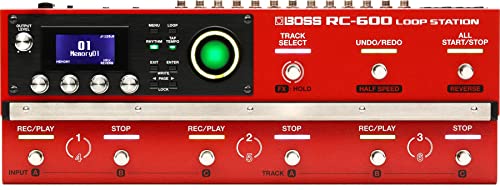
- Six stereo phrase tracks for larger arrangements
- Two XLR mic inputs with phantom power
- 99 phrase memory presets for recall
Best For: Live performers needing a high-capacity looping pedal
Simple Starter – BOSS RC-1 Loop Station Pedal
If you want one of the most straightforward loop stations for learning the basics, the BOSS RC-1 keeps the workflow simple without feeling limited. It offers record, playback, overdub, undo/redo, and a clear loop indicator, making it easy to build layers on guitar, bass, or keyboard.
Best For: Players who want an easy, compact looper for quick practice, layering, and straightforward live use.
Pros:
- Very user-friendly with clear Rec/Overdub/Play loop indication
- 12 minutes of stereo recording time for longer phrases
- Stereo inputs and outputs for flexible setup
- Compact stompbox format with BOSS five-year warranty
Cons:
- No advanced multi-track workflow or onboard storage features
- AC adaptor is optional and sold separately
The RC-1 is a strong pick if you want a reliable entry into loop stations without extra complexity. It focuses on the essentials and does them well, which is often exactly what many players need.
Performance Hub – Sheeran Looper + Dual Track Looper Pedal
Among modern loop stations, the Sheeran Looper + is built for players who want a more feature-rich, performance-ready setup. It combines dual-track looping, a full-color display, RGB loop status ring, internal storage, and USB recording, so it can handle both stage use and home studio work.
Best For: Performers who want multi-track looping, USB audio interface support, and easy loop storage management.
Pros:
- Four looping modes, including single and dual-track workflows
- Save up to 128 loops with over 3 hours of internal storage
- Acts as a 2-in/2-out USB audio interface for recording or streaming
- Durable steel chassis and over 6 hours of battery use under typical conditions
Cons:
- Larger and more complex than a basic looper pedal
- Uses 4 AA batteries rather than a built-in rechargeable system
If you want loop stations with more creative control and better integration for recording, the Sheeran Looper + stands out. It is especially appealing for players who need a rugged, stage-ready looper that also works well in a DAW setup.
Feature-Rich Choice – BOSS RC-5 Loop Station
The BOSS RC-5 is a strong option if you want loop stations with serious sound quality and more editing tools in a compact pedal. It adds 32-bit AD/DA conversion, 13 hours of stereo recording time, 99 phrase memories, rhythms, and MIDI/USB connectivity, giving you plenty of room to build and control loops.
Best For: Players who want a compact looper with high audio quality, built-in rhythms, and deeper control options.
Pros:
- 32-bit AD/DA and 32-bit floating-point processing for detailed audio capture
- 13 hours of stereo recording time with 99 phrase memories
- 57 rhythms and 7 drum kits for practice and performance support
- MIDI I/O, USB, and external control support expand its usefulness
Cons:
- Single-track design may feel limited if you want dual-track layering
- More feature-heavy than a simple practice looper
The RC-5 is a good fit when you want one of the more capable loop stations without moving into a large multi-effect unit. Its mix of sound quality, rhythm tools, and connectivity makes it especially versatile.
Budget Utility – LEKATO Looper Guitar Pedal
If you are shopping loop stations on a tighter budget, the LEKATO Looper Guitar Pedal packs a lot of utility into a small format. It offers 9 loop slots, up to 40 minutes of total recording time, unlimited overdubs, a built-in tuner, and USB import/export for managing WAV loop files.
Best For: Budget-minded players who want simple looping plus a tuner in one compact pedal.
Pros:
- 9 loops with up to 40 minutes total record time
- Built-in tuner adds extra value on stage or at home
- USB import/export makes loop file transfer easy
- Simple one-button commands for record, undo/redo, stop, and erase
Cons:
- Less advanced than higher-end loop stations
- Single-knob control may feel basic for players who want deeper editing
The LEKATO is a practical choice if you mainly want easy looping and useful basics without paying for premium extras. It is best suited to players who value convenience and affordability over advanced performance features.
Pro Dual-Track Loop Station – BOSS RC-500 Dual-Track Looper
If you want loop stations with pro-level control, the BOSS RC-500 is built for detailed live performance and serious songwriting. Its dual-track design, 32-bit processing, onboard rhythms, and deep MIDI/footswitch support make it a flexible choice for players who need more than a basic looper.
Best For: Guitarists and live performers who want a feature-rich dual-track looper with advanced control and strong sound quality.
Pros:
- Dual-track looping with 99 phrase memories for storing and recalling ideas
- 32-bit AD/DA conversion and 32-bit floating-point processing for high-quality audio
- Built-in rhythm library with 16 drum kits and 57 preset rhythms
- Reverse and Loop FX options add more creative performance tools
Cons:
- More complex than a simple looper, so it may take time to learn
- MIDI expansion requires an additional adaptor cable sold separately
The RC-500 stands out when you need a loop station that can support layered arrangements, saved memories, and performance flexibility. It is especially appealing if you want rhythm support and deeper editing controls in one pedal.
All-in-One Pedal Looper – FLAMMA FF20 Looper Drum Machine
For players shopping loop stations that also cover rhythm practice, the FLAMMA FF20 combines a stereo looper, drum machine, and easy-to-read screen in one pedal. With 300 minutes of recording, 100 loop slots, and USB file transfer, it is aimed at capturing ideas quickly and supporting home practice or solo jams.
Best For: Guitarists and bassists who want a looper with built-in drums, lots of memory, and simple hands-on control.
Pros:
- 300 minutes of stereo recording across 100 loop memory slots
- Built-in drum machine with 220 grooves across 11 drum styles
- Dual footswitches make record, overdub, play, stop, and loop switching straightforward
- USB transfer and headphone out support silent practice and file management
Cons:
- Feature-rich layout may be more than you need for very basic looping
- Designed around pedal control rather than tabletop-style operation
The FF20 is a practical pick if you want loop stations that double as a compact practice tool. Its screen, drum support, and recording capacity make it a versatile option for solo players building parts at home or on the go.
Tabletop Performance Loop Station – BOSS RC-505mkII Tabletop Looper
The BOSS RC-505mkII is one of the most capable loop stations for tabletop performance, especially if you build arrangements with voice, instruments, or both. It offers five simultaneous stereo phrase tracks, extensive onboard effects, and flexible input/output options for more advanced looping setups.
Best For: Vocalists, beatboxers, and multi-instrument performers who want a powerful tabletop looper with deep mixing and effects control.
Pros:
- Five stereo phrase tracks with dedicated faders for detailed mixing
- 32-bit AD/DA conversion and floating-point processing for pro-grade audio
- Large effects selection with 49 Input FX types and 53 Track FX types
- Two XLR mic inputs with phantom power plus multiple line input and output pairs
Cons:
- Tabletop format is less portable than a standard foot pedal looper
- Deep feature set may be overkill for users who only need simple looping
For performers who want to stack, mix, and shape loops in real time, the RC-505mkII delivers a highly flexible workstation approach. Its memory storage, track control, and effect depth make it a strong centerpiece for live creation.
Flagship tabletop looper for layered performances – Boss RC-505 Mk2 Tabletop Loop Station
If you want one of the most capable loop stations for hands-on performance, the Boss RC-505 Mk2 is built for detailed tabletop control. It gives you five stereo tracks, two XLR mic inputs with phantom power, and two stereo line input pairs, so it can handle vocals, instruments, and external sources in one setup.
Best For: Beatboxers, vocal performers, and loop artists who want a feature-rich tabletop workflow.
Pros:
- Five stereo tracks provide plenty of room for building complex loops.
- Two XLR mic inputs with phantom power support vocal-focused setups.
- Two stereo line input pairs make it easier to integrate multiple sources.
- Rhythm generator and physical looping controls support performance use.
Cons:
- Designed as a tabletop unit, so it is not as portable as a compact pedal.
- May be more looper than casual users need if you only want simple overdubs.
The RC-505 Mk2 is a strong choice when your loop station needs to be the center of a live tabletop rig. Its mix of track count, mic inputs, and hands-on controls makes it especially useful for performers who want depth and flexibility.
Compact hands-on looper for creators – BOSS RC-202 Compact Loop Station
The BOSS RC-202 is a compact loop station built for fingertip control, making it a practical pick for creators who want looping without a floor-based pedalboard. It includes two simultaneous stereo phrase tracks, 64 phrase memories, four input FX, and four track FX, so you can shape loops with a lot of onboard control.
Best For: Club performers, electronic musicians, and beatboxers who want a compact tabletop looper.
Pros:
- Two stereo phrase tracks keep the workflow focused and manageable.
- 64 phrase memories give you room to store setups and ideas.
- Four input FX and four track FX add flexible loop processing.
- USB audio/MIDI and external control support expand integration options.
Cons:
- Only two phrase tracks, so it is less expansive than larger loop stations.
- Best suited to hands-on use rather than a full pedal-style performance rig.
If you need a compact loop station with real creative depth, the RC-202 delivers a lot in a small footprint. It is especially appealing for performers who want hands-on control, memory storage, and effects in a focused desktop unit.
High-capacity pedal looper for live setups – Boss RC-600 High-Capacity Loop Pedal
The Boss RC-600 is a powerful loop station pedal for players who want more tracks and more routing in a live format. It offers six stereo phrase tracks, two XLR mic inputs with phantom power, two stereo instrument/line input pairs, and 99 phrase memory presets, giving it a broad feature set for complex performances.
Best For: Live performers who want a high-capacity pedal with extensive looping options.
Pros:
- Six stereo phrase tracks provide substantial layering capacity.
- Two XLR mic inputs with phantom power support vocal and mic-based use.
- Two stereo instrument/line input pairs help connect multiple sources.
- 99 phrase memory presets make it easier to recall performance setups.
Cons:
- Its deeper feature set may be more than a simple looping setup needs.
- As a pedal-focused unit, it is less tabletop-oriented than some loop stations.
For performers who need a loop station that can handle bigger arrangements, the RC-600 stands out for track count and memory depth. It is built for users who want a serious live looping hub with lots of control.
How We Picked These Loop Stations
We prioritized sound quality, looping length, track count, overdub flexibility, control layout, and reliability under real-world use. We also looked at whether the unit is better suited to solo practice, stage performance, or hands-on studio-style creation.
Because Loop Stations vary widely, the best choice is not always the one with the most features. A simple pedal may be ideal for guitar practice, while a multi-track tabletop unit can be far better for beatmaking, vocals, and layered live sets.
Quick Comparison
Compact pedal loopers are usually best for straightforward guitar or bass looping, while advanced multi-track Loop Stations offer deeper control, phrase memory, MIDI, and connectivity. Some models emphasize ease of use and portability; others are built for complex performances with multiple parts and longer recording time.
If you want a fast learning curve, choose a basic stompbox-style unit. If you need full control over stacked arrangements, look at advanced Loop Stations with dedicated track controls, more memory, and external sync options.
Key Buying Factors for Loop Stations
Tracks and Memory
More tracks and phrase memories matter if you build layered songs, switch between sections, or perform multiple pieces in one set. Single-track units are simpler, but limited for complex arrangements.
Recording Time and Overdubs
Longer recording time is helpful for ambient work, long practice sessions, or extended live improvisation. Unlimited or generous overdub support is important if you like building dense textures.
Controls and Workflow
Look at how easy it is to start, stop, undo, and switch parts while playing. Pedal-based Loop Stations are often best for foot control, while tabletop models can offer more hands-on editing and performance options.
Connectivity
USB, MIDI, stereo inputs, and external control support can be decisive for studio integration or live rigs. If you use drums, keyboards, or vocals, choose a model that handles your full signal chain cleanly.
Who Should Buy Which Loop Stations?
Beginner guitarists and practice-focused players usually do well with compact, easy-to-use Loop Stations. Songwriters and performers who want structured arrangements should consider multi-track pedals with memory and flexible control. Vocalists, beatmakers, and experimental artists often benefit most from tabletop Loop Stations with more hands-on features and stronger routing options.
If you want the simplest path, start small and upgrade only when your looping style outgrows the feature set. That approach keeps your setup manageable while still giving you room to create more ambitious performances.