A good desktop subwoofer can add weight and impact to music, games, and movies without requiring a full-size home theater system. The best choice depends on your available space, speaker connections, listening habits, and tolerance for low-frequency vibration.
We selected 10 options spanning compact multimedia systems, powered studio-style subwoofers, and higher-output models. Use the guide below to compare compatibility, power, size, and placement before buying.
Best 10 Subwoofers for Desktop Setups Picks for 2026
Compact Bass Pick

- 5.24-inch long-throw woofer
- 60W maximum output and Class D amplifier
- Vibration pads and two-year warranty
Best For: Desktop gaming and compact studio audio
Complete 2.1 Value
Cyber Acoustics CA-3610 Speaker System

- 62W peak and 30W RMS power
- 5.25-inch down-firing subwoofer
- Control pod with aux input and headphone jack
Best For: Complete desktop, gaming, and multimedia audio
Deep-Bass Upgrade

- 8-inch driver with 70W output
- Low-pass filter and response down to 38Hz
- MDF cabinet with automatic standby
Best For: RCA-equipped systems with room for a larger subwoofer
Studio-Ready Bass

- 8-inch driver with bass down to 30 Hz
- Bluetooth 5.0 plus TRS, RCA, and aux inputs
- Adjustable crossover and room-tuning controls
Best For: Desktop music production and monitor-based listening
Simple Desktop Upgrade
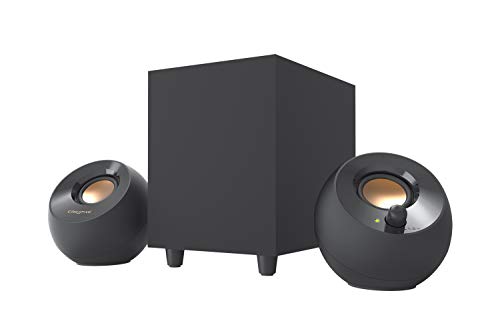
- Compact 4-inch down-firing subwoofer
- USB-powered with 3.5mm AUX input
- Elevated satellite drivers and High Gain mode
Best For: Everyday computer audio in small desktop spaces
Compact High-Power Bass

- 6-inch front-firing driver with 210W output
- Compact metal enclosure for desktop or home theater use
- Auxiliary and RCA connectivity with W3 adapter compatibility
Best For: Powerful bass in a compact desktop or stereo setup
Best Overall Desktop Bass
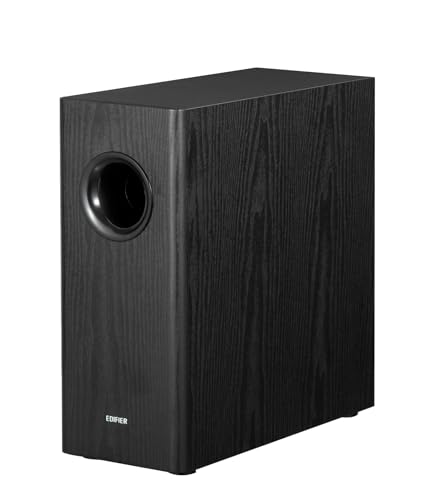
- 8-inch woofer with 70W RMS output
- Adjustable filter and phase controls
- Includes RCA and 3.5mm-to-RCA cables
Best For: Desktop and bookshelf systems with RCA connectivity
Best Premium Power
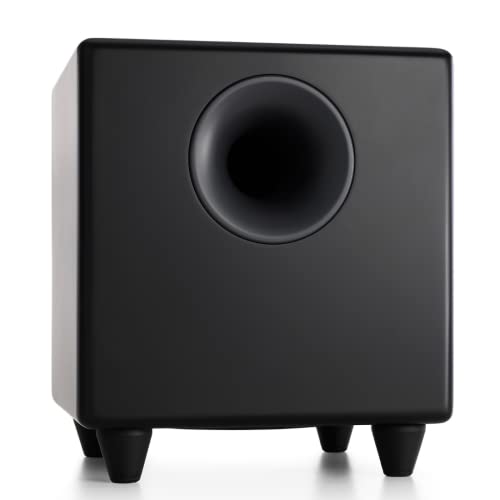
- 250-watt output from an 8-inch subwoofer
- Down-firing design for deep bass
- Wireless-ready with optional W3 adapter
Best For: High-output desktop, gaming, and home-studio systems
Best Connectivity Value
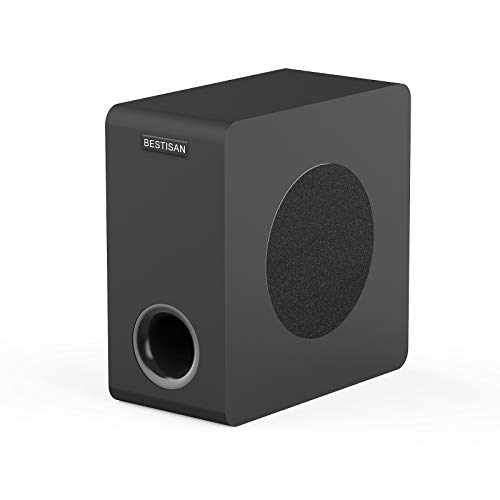
- RCA, AUX, LFE, and high-level inputs
- Compact 6.5-inch side-firing woofer
- Remote control and bass-reflex cabinet
Best For: Desktop systems needing flexible wired connections
Compact Bass Pick – Ortizan V8 Active Subwoofer
The Ortizan V8 is a practical choice for shoppers seeking subwoofers for desktop setups without stepping up to a larger home-audio cabinet. Its 5.24-inch long-throw woofer, 60-watt maximum output, Class D amplifier, and vibration pads are suited to desktop gaming and studio audio.
Best For: Desktop users who want a dedicated active subwoofer for gaming, computer audio, or compact studio listening.
Pros:
- Compact active design with a 5.24-inch woofer
- 60-watt maximum output with a built-in Class D amplifier
- Vibration pads support shelf or desktop placement
- Includes a two-year warranty
Cons:
- Its 10.91-inch depth and 8.46-inch width still require dedicated desk or shelf space
- The supplied specifications list Bluetooth connectivity but do not detail additional inputs
The V8 makes the most sense when you want a standalone bass upgrade and prefer a relatively compact enclosure. Confirm its connectivity fits your existing desktop audio chain before buying.
Complete 2.1 Value – Cyber Acoustics CA-3610 Speaker System
The Cyber Acoustics CA-3610 is a complete 2.1 speaker system for shoppers comparing subwoofers for desktop setups. It combines a 5.25-inch down-firing subwoofer with two satellite speakers, delivering 62 watts peak power and 30 watts RMS for computer audio, games, and media.
Best For: Users who need a ready-to-use wired desktop speaker system rather than a standalone subwoofer.
Pros:
- Complete 2.1 system with satellites and subwoofer
- 5.25-inch down-firing woofer with tuned port
- Control pod provides volume, bass, aux input, and headphone access
- Works with desktops, laptops, consoles, tablets, and smartphones using compatible connections
Cons:
- Wired design does not provide wireless speaker connectivity
- The 13.8-inch width and 9.1-inch depth may be substantial for a crowded desk
- One-year warranty is shorter than some competing options
Choose the CA-3610 if you want bass plus matching left-and-right speakers in one package. Its accessible control pod is especially useful for switching between desktop listening and private headphone use.
Deep-Bass Upgrade – Edifier T5 Powered Subwoofer
Edifier T5 Powered Subwoofer - 70w RMS Active Woofer with 8 inch Driver and Low Pass Filter
Check Price On AmazonThe Edifier T5 targets listeners who want more substantial low-end extension from subwoofers for desktop setups. Its 8-inch driver, 70-watt output, MDF enclosure, and low-pass filter reaching down to 38Hz make it a larger, dedicated bass component for compatible RCA-based systems.
Best For: Desktop or indoor audio systems with a suitable SUB OUT or line-out connection and room for a larger woofer.
Pros:
- Large 8-inch driver for a fuller bass presentation
- 70-watt output with frequency response down to 38Hz
- MDF enclosure is designed to reduce acoustic resonance
- Automatic standby helps avoid unnecessary power use
Cons:
- Large 16.5-inch depth and 14-inch height are demanding for small desks
- Uses wired RCA connectivity rather than a wireless subwoofer connection
- Requires compatible 2RCA, SUB OUT, or line-out equipment
The T5 is best treated as a serious bass add-on rather than a compact desktop accessory. Measure your available space and verify the source has the required RCA-style output before choosing it.
Simple Desktop System – Logitech Z313 2.1 Speaker System
The Logitech Z313 is an uncomplicated 2.1 speaker system for shoppers seeking subwoofers for desktop setups at a straightforward scale. It pairs compact satellite speakers with a subwoofer and delivers 25 watts RMS through an auxiliary connection.
Best For: Everyday desktop, laptop, MP3 player, and television listening where simple wired setup matters.
Pros:
- Complete 2.1 system with compact subwoofer
- 25 watts RMS output for personal desktop use
- Included control pod offers convenient wired control
- Auxiliary connectivity supports desktops and other compatible devices
Cons:
- Lower output than the other listed systems
- Wired auxiliary connection limits setup flexibility
- The supplied specifications describe Bluetooth-related details but identify aux as the connectivity protocol
The Z313 is a sensible fit for users who want a familiar, compact speaker package rather than a powerful standalone woofer. It is best suited to everyday personal listening in a desktop or small-room environment.
Studio-Ready Bass – PreSonus Eris Sub 8BT
The PreSonus Eris Sub 8BT is a strong choice for desktop setups that need accurate, adjustable low end. Its 8-inch front-firing driver, Bluetooth 5.0, and flexible wired inputs suit music production, gaming, and everyday listening.
Best For: Music producers, desktop listeners, and gamers who want tunable bass with broad connection options.
Pros:
- Reaches down to 30 Hz with 100 watts of power.
- Includes Bluetooth 5.0, balanced TRS, RCA, and front-panel aux inputs.
- Highpass, lowpass, and room-tuning controls help integrate it with main monitors.
- Front headphone output and automatic power-saving mode add convenience.
Cons:
- Its floor-standing design may require more space than compact desktop speakers.
- Bluetooth range is listed at up to 10 meters.
For a desktop setup built around studio monitors, the Eris Sub 8BT offers the most control-oriented design here. It is particularly practical when accurate crossover adjustment matters as much as stronger bass.
Simple Desktop Upgrade – Creative Pebble Plus 2.1
The Creative Pebble Plus is a compact 2.1 option for desktop setups that need more bass without adding a separate full-size subwoofer. Its USB power, 3.5mm connection, and included satellite speakers make it an easy fit for computers and laptops.
Best For: Computer users who want an affordable, space-conscious speaker system for everyday audio, gaming, and media.
Pros:
- Dedicated 4-inch down-firing ported subwoofer adds depth.
- USB-powered design avoids the need for a wall socket.
- 45-degree elevated drivers aim sound toward the listener.
- High Gain mode can raise output to 8W RMS with a 5V 2A USB adapter.
Cons:
- A suitable 5V 2A USB adapter is not included.
- Its 8W RMS output is more suited to desktop listening than large-room audio.
- The system uses wired audio and subwoofer connections.
The Pebble Plus is the most straightforward pick for a basic computer desk. It trades the tuning flexibility and deeper output of larger powered subwoofers for a small, USB-powered package with speakers included.
Compact High-Power Bass – Audioengine S6 Mini Subwoofer
The Audioengine S6 Mini brings substantial powered bass to desktop setups while keeping its enclosure relatively compact. Its front-firing 6-inch driver, 210-watt rating, and auxiliary and RCA connectivity make it suitable for desktops, stereo systems, and home theater applications.
Best For: Desktop listeners who want powerful, front-firing bass in a compact metal enclosure.
Pros:
- 6-inch driver and 210-watt maximum output provide strong bass potential.
- Front-firing design suits flexible placement near a desktop or entertainment setup.
- Auxiliary and RCA connections support compatible audio equipment.
- Compatible with the Audioengine W3 wireless adapter.
Cons:
- It is a standalone subwoofer, so separate main speakers are required.
- The listed frequency response starts at 33 Hz, not as low as the Eris Sub 8BT’s stated 30 Hz.
- Its 15.4-pound weight may make repositioning less convenient.
The S6 Mini is a compelling middle ground when desktop bass needs to feel substantial without moving to a much larger subwoofer. Its higher power rating favors users who want extra headroom for music, movies, or gaming.
Best Overall Desktop Bass – Edifier T5s
The Edifier T5s is a practical choice for desktop setups that need fuller low end without adding an external receiver. Its powered 8-inch woofer, 70W RMS amplifier, and 35Hz frequency response provide substantial bass, while RCA connectivity supports compatible computers, active speakers, and stereo systems.
Best For: Desktop and bookshelf-speaker systems with RCA or subwoofer outputs.
Pros:
- 8-inch long-throw woofer and 70W RMS output deliver powerful bass.
- Adjustable low-pass filter and phase selector help with system integration.
- Compact cabinet, auto-standby, and included RCA and 3.5mm-to-RCA cables simplify setup.
Cons:
- Wired RCA connectivity only; it does not support wireless communication.
- Series connection requires the main speaker to have a wired LINE IN.
The T5s stands out when you want strong, adjustable bass and straightforward plug-and-play operation. Check your desktop speakers’ connection options before buying, particularly if they lack a dedicated subwoofer output.
Best Premium Power – Audioengine S8
The Audioengine S8 is a powerful option among subwoofers for desktop setups, pairing an 8-inch down-firing driver with up to 250 watts of output. Its compact, cube-shaped design allows flexible placement, and wired RCA connectivity works with desktops, laptops, and stereo systems.
Best For: Desktop listeners, gamers, and home-studio users who want high-output bass in a compact enclosure.
Pros:
- 250-watt output provides substantial bass impact.
- Down-firing design helps produce deep, resonant low frequencies.
- Sleep mode reduces power use, and compatibility with the W3 adapter kit supports wireless-ready placement.
Cons:
- At 30 pounds, it is less portable than the other options here.
- Its listed connectivity is wired RCA; wireless operation requires the separate W3 adapter kit.
The S8 is a strong fit when output and placement flexibility matter more than minimum size or weight. It makes the most sense for a desktop system that can accommodate a larger, heavier subwoofer.
Best Connectivity Value – BESTISAN SW65D
The BESTISAN SW65D is a compact 6.5-inch powered subwoofer for desktop setups that need flexible connections. It includes RCA, 3.5mm AUX, LFE, and high-level speaker inputs and outputs, making it adaptable to bookshelf speakers, TVs, soundbars, and home-theater equipment.
Best For: Mixed desktop and home-audio systems requiring several input and output options.
Pros:
- Offers RCA, AUX, LFE, and high-level speaker connectivity.
- Side-firing woofer, bass-reflex cabinet, and internal bracing are designed for tight bass.
- Compact 6.5-inch enclosure and remote control support convenient placement and operation.
Cons:
- Its 6.5-inch driver is smaller than the 8-inch drivers in the other listed models.
- Best results require a source signal of 850mV or lower, according to the supplied guidance.
- The listed frequency-response details differ between the product bullets and specifications.
The SW65D is particularly appealing if connection flexibility is your priority. Its multiple wired inputs make it easier to integrate with varied equipment, though buyers should confirm the source’s signal level and available outputs.
How We Picked the Best Subwoofers for Desktop Setups
We focused on powered subwoofers and 2.1 speaker systems that suit computer desks, small offices, bedrooms, and compact entertainment spaces. Our selection considers driver size, stated output, connection options, cabinet footprint, crossover controls, setup simplicity, and the type of speakers each model is most likely to complement.
Because manufacturer power ratings are not always measured the same way, wattage is only one comparison point. A compact subwoofer can be a better desktop match than a larger, louder model if it integrates more cleanly and does not overwhelm the room.
Quick Comparison
| Best For | Look For |
|---|---|
| Small desks and USB speakers | Compact cabinet, modest output, simple input |
| Music and gaming | Adjustable crossover and useful bass extension |
| Nearfield studio listening | Clean low-end response and level controls |
| Large rooms or high volume | Larger driver, higher output, and stable connectivity |
| Flexible placement | Bluetooth or wireless-ready operation |
Key Buying Factors for Subwoofers for Desktop Setups
Size and Placement
Measure the space under or beside your desk before choosing. A subwoofer generally sounds best on the floor, not directly on the desktop, where vibration can transfer into the keyboard and monitor. Leave room around the cabinet and avoid blocking vents or placing it tightly in a corner unless you specifically want stronger, less controlled bass.
Connections and Compatibility
Check how the subwoofer connects to your computer, speakers, DAC, or audio interface. Some 2.1 systems are designed as complete speaker packages, while standalone powered models may use RCA, line-level, speaker-level, Bluetooth, or dedicated subwoofer outputs. Confirm that your source and main speakers can share the signal without needing an extra adapter.
Driver Size, Power, and Controls
Larger drivers and higher output can produce deeper, more authoritative bass, but they are not automatically better for a desktop. A volume control, low-pass filter, phase adjustment, or crossover control can make integration much easier. For nearfield listening, prioritize smooth blending over maximum volume.
Vibration and Room Behavior
Bass changes significantly with placement and room boundaries. Isolation feet or vibration pads can reduce desk and floor rattle. Start with the subwoofer level low, then increase it until drums, effects, and bass lines sound fuller without becoming boomy.
Who Should Buy Which Subwoofers for Desktop Setups?
Choose a compact USB-powered or small multimedia option for a basic laptop setup, limited desk space, or casual listening. A 6.5- to 8-inch powered subwoofer is a better fit for users who want deeper bass for games, films, and music in a small room. If you use studio monitors or a higher-quality desktop audio chain, prioritize a model with adjustable crossover and level controls. Buyers who need flexible placement should consider Bluetooth or wireless-ready designs, while anyone sharing walls or working at low volume should favor controlled output and isolation over raw power.