Semi-modular synthesizers offer the immediacy of a standalone instrument with the flexibility of patch cables. Their normalized signal paths make it easy to start playing, while patch points let you reshape modulation, pitch, envelopes, and audio routing as your skills develop.
We selected 10 notable options for 2026, covering affordable entry points, analog bass machines, experimental sequencers, percussion-focused instruments, and more capable desktop or keyboard systems.
Best 10 Semi Modular Synthesizers Picks for 2026
Affordable Analog Starter

- Fully analog VCO, VCF, and VCA path
- 32-step sequencer and ladder filter
- Compact metal-and-plastic design
Best For: Beginners wanting compact analog semi-modular synthesis
Polyrhythmic Experimenter

- Two VCOs with four subharmonic generators
- Four rhythm generators and two sequencers
- Tabletop or 60HP Eurorack use
Best For: Experimental polyrhythmic composition and sound design
Hybrid Sound-Design Workstation

- 24 digital oscillators and 10 percussion/noise engines
- Analog ladder filter with LFO
- 14 synth engines and 32-step sequencer
Best For: Hybrid pitched and percussive sound design
Analog Rhythm Creator

- Two analog VCOs plus white-noise generator
- Moog ladder filter and 24-point patch bay
- Eight-step sequencer for rhythmic patterns
Best For: Hands-on analog percussion and experimental grooves
Flexible Analog Powerhouse

- Two VCOs and two multi-mode filters
- Four envelopes plus wave folder
- Eurorack format with included cables
Best For: Hands-on analog sound design and modular setups
Classic Sequenced Foundation

- Analog VCO and Moog ladder filter
- 32-note step sequencer
- Tabletop or 60HP Eurorack use
Best For: Classic analog sequencing and expandable setups
Dedicated Percussive Experimenter
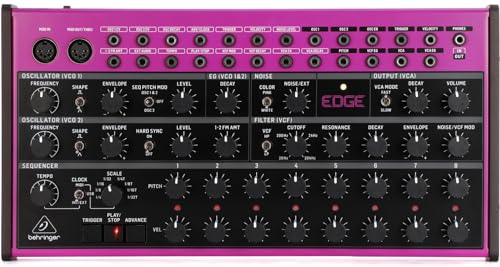
- Analog percussion-focused design
- 15-by-10 I/O patch matrix
- Two eight-step sequencers
Best For: Gritty rhythms and experimental percussion
Classic Keyboard Explorer

- 32 velocity-sensitive full-size keys
- 41 patch points with spring reverb
- Built-in arpeggiator and 256-note sequencer
Best For: Keyboard players wanting immediate performance control and modular expansion
Generative Texture Specialist

- Dual generative eight-step sequencers
- VC wavefolder and morphing VC filter
- 32-jack patch bay for flexible routing
Best For: Sound designers and producers building evolving, experimental patterns
DIY Modular Gateway

- Build-it-yourself 100% analog synthesizer kit
- 44HP format with Eurorack integration
- Built-in keyboard, wavefolder, and ladder filter
Best For: DIY learners and modular users seeking a compact expandable voice
Affordable Analog Starter – Behringer CRAVE
The Behringer CRAVE is a compact choice for shoppers exploring semi modular synthesizers with a fully analog signal path. Its VCO, ladder filter, patching connections, and 32-step sequencer cover hands-on sound design and sequencing in a small instrument.
Best For: Beginners and producers seeking an affordable, compact analog semi-modular setup.
Pros:
- Fully analog VCO, VCF, and VCA signal path
- Pulse and sawtooth oscillator outputs support varied tones
- Includes a 32-step sequencer and resonant 24 dB ladder filter
Cons:
- Uses a compact 2.5mm jack connector
- Its small dimensions may limit hands-on control space
The CRAVE is a practical entry point for analog patching and sequenced experimentation, especially when size and core synthesis features matter more than extensive onboard extras.
Polyrhythmic Experimenter – Moog Subharmonicon
The Moog Subharmonicon stands out among semi modular synthesizers for its subharmonic tone generation and interconnected rhythmic design. Two VCOs, four subharmonic generators, dual sequencers, and four rhythm generators make it suited to evolving patterns and unconventional harmonic textures.
Best For: Experimental musicians who want polyrhythmic sequencing and expandable Moog-format patching.
Pros:
- Six tonal sources create dense harmonic material
- Four rhythm generators can drive either sequencer or both
- Works as a tabletop instrument or a 60HP Eurorack module
- Can expand with compatible Moog instruments such as DFAM and Mother-32
Cons:
- Its specialized polyrhythmic workflow may require a learning period
- Four-step sequencers are less suited to long melodic sequences
The Subharmonicon is a focused creative instrument rather than a conventional general-purpose synthesizer. Choose it when complex repeating rhythms and subharmonic interplay are central to your music.
Hybrid Sound-Design Workstation – Behringer Grind
The Behringer Grind offers a broader hybrid approach to semi modular synthesizers, combining digital oscillator and percussion engines with an analog ladder filter. Its 14 synth engines, LFO, patching-oriented design, and 32-step sequencer provide a wide palette for producing both pitched and percussive sounds.
Best For: Producers wanting one semi-modular instrument for digital synthesis, percussion, and analog filtering.
Pros:
- Includes 24 digital oscillators and 10 percussion/noise engines
- Analog ladder filter adds analog-style shaping
- Offers 14 synth engines and a 32-step sequencer
- Provides a hybrid alternative to fully analog instruments
Cons:
- Its feature-rich engine selection may feel less immediate to newcomers
- The supplied notes do not specify the included patch cable configuration
Grind is a strong fit for players who value variety over a strictly traditional signal path. Its combination of digital engines and analog filtering makes it especially flexible for hybrid tracks and rhythmic sound creation.
Analog Rhythm Creator – Moog DFAM
The Moog DFAM is a dedicated percussion-focused option among semi modular synthesizers. Its two analog VCOs, white-noise generator, Moog ladder filter, eight-step sequencer, and 24-point patch bay are designed for quickly building unconventional rhythmic patterns without requiring cables.
Best For: Musicians who want hands-on analog percussion and evolving rhythmic sequences.
Pros:
- Fully analog sound engine with two VCOs and white noise
- Uses the classic Moog ladder filter
- Eight-step sequencer supports immediate rhythmic creation
- Can operate standalone or install in a 60HP Eurorack system
Cons:
- Its eight-step sequencer is focused on short rhythmic patterns
- It is percussion-oriented rather than a general melodic synthesizer
The DFAM is a compelling choice for organic analog drums, pulses, and experimental grooves. Select it when immediate rhythmic exploration is more important than traditional keyboard-style synthesis.
Flexible Analog Powerhouse – Behringer PROTON
The Behringer PROTON is a strong choice for musicians seeking semi modular synthesizers with substantial patching potential and a paraphonic analog setup. Its two VCOs, two multi-mode filters, two VCAs, four envelopes, and wave folder support detailed sound shaping, while the Eurorack format makes it suitable for modular setups.
Best For: Synthesists who want a feature-rich Eurorack-format instrument with broad analog sound-design options.
Pros:
- Two VCOs and two multi-mode VCFs provide flexible tone creation.
- Four envelopes and a wave folder expand modulation and timbral options.
- Includes MIDI, USB, audio, and headphone cables.
- Metal body and Eurorack format support studio integration.
Cons:
- Its 20.95-inch width may require considerable setup space.
- The supplied notes do not specify an onboard sequencer.
Choose the PROTON if you prioritize extensive analog architecture and Eurorack compatibility over a compact tabletop design. Its generous modulation section makes it particularly appealing for hands-on sound exploration.
Classic Sequenced Foundation – MOOG Mother-32
The MOOG Mother-32 is a practical entry point into semi modular synthesizers, combining an analog signal path with a built-in step sequencer and patchbay. It can work as a self-contained tabletop instrument or as a 60HP Eurorack module, making it adaptable as a system grows.
Best For: Beginners and experienced performers who want classic Moog-style analog tone, sequencing, and expansion flexibility.
Pros:
- Analog VCO, white noise generator, and Moog ladder filter deliver a warm, vintage sound profile.
- 32-note step sequencer supports synchronized patterns and performance use.
- Can be used without patch cables for immediate sound creation.
- Works as a tabletop synth or a 60HP Eurorack module.
Cons:
- Its single-voice design may be limiting for players seeking broader polyphonic textures.
- The compact patchbay and controls may feel less expansive than larger semi-modular instruments.
The Mother-32 stands out for its balance of immediacy and modular depth. Its sequencer and ladder filter make it especially useful for live pattern work, while the Eurorack option leaves room for future expansion.
Dedicated Percussive Experimenter – Behringer Edge
The Behringer Edge focuses on percussion rather than general-purpose melodic synthesis. Among semi modular synthesizers, it is a specialized option with a 15-by-10 input/output patch matrix, two eight-step sequencers, noise sources, and an envelope generator for gritty, hands-on rhythmic sound design.
Best For: Electronic musicians who want an analog semi-modular percussion instrument for beats, textures, and experimental rhythms.
Pros:
- Purpose-built analog percussion design offers a focused sonic workflow.
- 15-by-10 I/O patch matrix provides substantial routing flexibility.
- Two eight-step sequencers support rhythmic pattern creation.
- White/pink noise and an envelope generator add percussive texture.
Cons:
- Its percussion-focused architecture is less suited to broad melodic synthesis.
- The eight-step sequencers are shorter than the Mother-32’s 32-note sequencer.
The Edge is best viewed as a specialized rhythm and texture machine rather than an all-purpose synthesizer. Its patch matrix and dual sequencers make it a compelling choice when percussive experimentation is the priority.
Classic Keyboard Explorer – Moog Grandmother
The Moog Grandmother is a strong choice for musicians seeking semi modular synthesizers with a familiar keyboard workflow. Its 32 velocity-sensitive full-size keys, built-in sequencing, arpeggiation, spring reverb, and 41 patch points make it usable immediately while leaving room for deeper experimentation.
Best For: Keyboard players who want hands-on analog sound design, onboard performance tools, and compatibility with Moog or Eurorack systems.
Pros:
- Full-size velocity-sensitive keyboard with built-in arpeggiator and sequencer
- Analog spring reverb can add ambience or process external sounds
- 41 patch points support extensive semi-modular experimentation
- Includes MIDI DIN, MIDI over USB, and audio connectivity
Cons:
- Monophonic design is not intended for polyphonic playing
- Larger and heavier than compact desktop-focused options
The Grandmother is the most immediately playable option here, especially if you want a traditional keyboard alongside modular routing. Choose it for performance flexibility and classic Moog-inspired operation rather than maximum portability.
Generative Texture Specialist – Moog Labyrinth
The Moog Labyrinth is designed for adventurous semi modular synthesizers users who enjoy evolving patterns and unusual textures. Dual eight-step sequencers, low-harmonic oscillators, wavefolding, ring modulation, and a 32-jack patch bay make it especially suited to exploratory sound design.
Best For: Producers and sound designers creating generative sequences, metallic tones, evolving basslines, and layered rhythmic textures.
Pros:
- Dual generative eight-step sequencers encourage evolving patterns
- Wavefolder, ring modulation, and variable-tone noise expand its tonal range
- State-variable filter morphs between lowpass and bandpass responses
- 32-jack patch bay provides flexible signal routing
Cons:
- Its exploratory, generative approach may be less direct for conventional keyboard-style playing
- No built-in keyboard is listed in the supplied specifications
Labyrinth stands out when you want a sequencer-driven instrument that can generate movement and complex color with limited hands-on note entry. It is a focused choice for texture, rhythm, and sonic discovery.
DIY Modular Gateway – Moog Mavis
The Moog Mavis is a compact build-it-yourself option for exploring semi modular synthesizers and Eurorack-compatible workflows. It combines a built-in keyboard with analog oscillators, a ladder filter, full ADSR, wavefolding, sample and hold, and a 44HP format that can be removed from its case for integration.
Best For: DIY-minded beginners and modular users who want a compact Moog voice with Eurorack expansion potential.
Pros:
- Complete assembly kit includes tools, calibration equipment, cables, and instructions
- Compact 44HP design can operate standalone or integrate with Eurorack
- Includes oscillator, ladder filter, full ADSR, wavefolder, mixer, and sample and hold
- Built-in keyboard offers glide and keyboard scaling
Cons:
- Requires self-assembly rather than arriving as a fully assembled instrument
- Its compact controls and 44HP format may be less spacious than a keyboard synthesizer
Mavis is the practical pick for anyone who wants to learn both synthesis and hardware construction. Its small footprint and removable case make it particularly appealing as a first step toward a larger Eurorack setup.
How We Picked the Best Semi Modular Synthesizers
We compared these instruments by looking at their synthesis architecture, patching flexibility, sequencing or performance features, playability, connectivity, and likely use cases. The lineup includes fully analog instruments, hybrid designs, paraphonic systems, and specialized rhythm-focused synthesizers. We also considered how easily each model can function on its own before connecting it to other modular gear.
Because semi-modular synthesizers vary widely, “best” depends on whether you prioritize bass, melodies, percussion, polyrhythms, experimentation, or an accessible first step into modular synthesis.
Quick Comparison
| Best For | Recommended Models |
|---|---|
| First semi-modular synth | Behringer CRAVE, Moog Mavis |
| Classic Moog-style bass and leads | Moog Mother-32, Moog Grandmother |
| Experimental sequencing | Moog Subharmonicon, Moog Labyrinth |
| Analog percussion | Moog DFAM, Behringer Edge |
| Paraphonic and broader sound design | Behringer PROTON, Behringer Grind |
Key Buying Factors for Semi-Modular Synthesizers
Synthesis and Voice Structure
Check whether the instrument is monophonic, paraphonic, or built primarily for percussion. A monophonic synth is often ideal for bass and leads, while paraphonic designs can create layered notes with less conventional articulation. Percussion-oriented models prioritize rhythmic textures rather than traditional melodies.
Patch Points and Signal Routing
More patch connections can provide greater flexibility, but they may also increase the learning curve. Look for useful inputs and outputs for oscillator pitch, filter cutoff, envelopes, LFOs, clock, and external audio. Normalled routing is especially helpful when you want immediate sound without patching.
Sequencing and Performance Control
Consider the sequencer’s length, pattern memory, clock options, and ability to control pitch or modulation. Keyboard models may be better for traditional playing, while compact desktop units can excel at looping patterns and integrating with a modular setup.
Connectivity and Expansion
Confirm the instrument’s patch format, MIDI or USB support, clock compatibility, and external audio options. These details matter if you plan to connect hardware drum machines, controllers, Eurorack modules, or a computer-based setup.
Who Should Buy Which Semi Modular Synthesizers?
Choose the Behringer CRAVE or Moog Mavis for an approachable introduction to patching. The Mother-32 suits classic bass, sequences, and modular expansion, while the Grandmother is the stronger choice for hands-on keyboard performance. Pick the DFAM or Edge if percussion and evolving rhythmic patterns are your priority.
For unusual melodic systems and generative ideas, consider the Subharmonicon or Labyrinth. The PROTON is aimed at players who want more oscillator, filter, envelope, and paraphonic flexibility, while the Grind offers a broader hybrid sound palette. Before buying, make sure the instrument’s playing style and patching depth match the way you actually intend to create music.