Speaker selector switches make it easier to distribute audio from one amplifier or receiver to multiple speaker pairs. The right model can help you manage separate rooms, switch between listening zones, and keep your system organized.
This roundup compares 10 options ranging from simple two-way switchers to multi-zone units with impedance protection and independent volume controls. Use the guide below to match channel count, power handling, and features to your setup.
Best 10 Speaker Selector Switches Picks for 2026
Best Multi-Room Value
Monoprice 4-Channel Speaker Selector

- Supports up to four speaker zones
- Optional impedance protection
- Up to 140W per channel without protection
Best For: Multi-room home theater audio
Best A/B Flexibility

- Handles 2-in/1-out or 1-in/2-out setups
- Passive, no external power required
- 100W RMS per channel
Best For: Amp comparison or two-speaker switching
Best Push-Button Zone Control

- Connects four speaker pairs
- Simple push-button operation
- 100W per channel at 8 ohms
Best For: Basic four-pair stereo distribution
Best Passive A/B Design
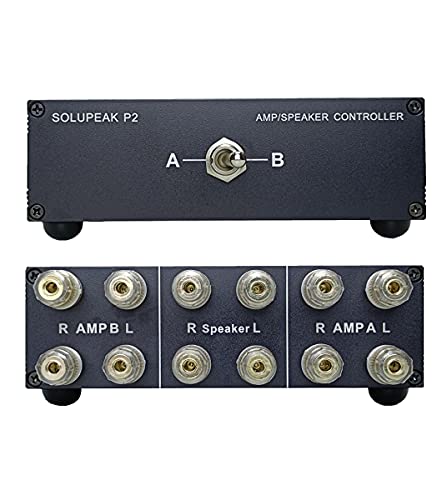
- Supports amp or speaker A/B switching
- Passive, no power required
- 100W RMS per channel
Best For: Amplifier comparisons and passive speaker switching
High-Capacity Choice
Pyle PSS6 6-Channel Speaker Selector

- Controls up to six speaker pairs
- Push-button plug-and-play operation
- Designed for systems up to 100 watts
Best For: Multi-speaker home stereo systems
Flexible Zone Control
PROZOR 4-Zone Speaker Selector

- Independent A/B/C/D zone buttons
- Passive design needs no external power
- Supports 150W RMS and 4–16Ω speakers
Best For: Whole-home audio with four passive speaker zones
Maximum Zone Coverage
Pyle PSS8 8-Channel Speaker Selector
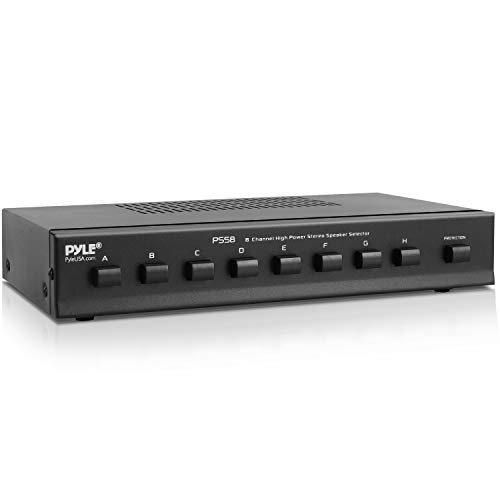
- Manages up to eight speaker pairs
- Independent A/B/C/D/E/F/G/H controls
- Supports amplifiers up to 100W per channel
Best For: Large multi-room stereo installations
Best Overall Control
Monoprice SSVC-4.1 4-Channel Speaker Selector
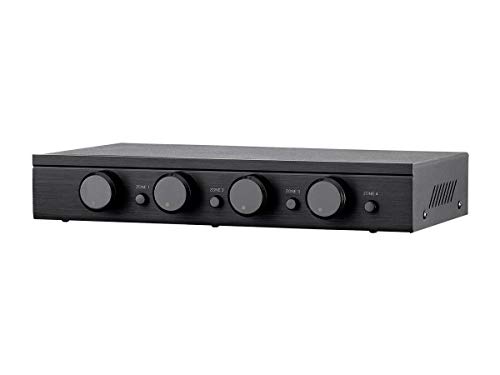
- Four independently switched speaker zones
- Individual volume controls and impedance protection
- 100W continuous per channel; 200W peak
Best For: Multi-room systems using one amplifier
Best Simple Two-Zone Pick
PROZOR 2-Zone Passive Speaker Switch

- Selects Zone A, Zone B, or both
- Passive operation needs no external power
- Supports 150W RMS per channel and 4–16Ω speakers
Best For: Straightforward two-zone audio switching
Best for Six Speaker Pairs
Pyle PSLSW6 6-Channel Selector

- Controls up to six speaker pairs or 12 speakers
- Independent volume controls for each pair
- 100W maximum per channel with overload protection
Best For: Large 8-ohm home audio installations
Best Multi-Room Value – Monoprice 4-Channel Speaker Selector
For distributing one amplifier’s audio across several areas, this Monoprice model is a practical choice among speaker selector switches. It supports up to four speaker zones and includes optional impedance protection to help maintain a consistent load for the amplifier.
Best For: Home theater and multi-room audio setups using up to four speaker zones.
Pros:
- Supports up to four separate speaker zones.
- Handles up to 70 watts per channel with protection enabled or 140 watts without it.
- Optional impedance protection helps keep the amplifier load constant.
- Rugged design from a brand focused on quality control and value.
Cons:
- Maximum power handling depends on whether impedance protection is enabled.
- Designed for zone distribution rather than quick A/B amplifier comparisons.
This is a straightforward option when the priority is sending audio to multiple rooms or speaker zones while retaining impedance-protection flexibility.
Best A/B Flexibility – PROZOR Amp Speaker Switcher
The PROZOR is a versatile choice among speaker selector switches because it can route two amplifiers to one speaker pair or one amplifier to two speaker pairs. Its passive A/B design requires no external power and allows only one selected position at a time.
Best For: Comparing two amplifiers or switching one amplifier between two passive speaker pairs.
Pros:
- Supports both 2-in/1-out and 1-in/2-out configurations.
- Gold-plated banana plug ports accept wire up to 12 gauge.
- Rated for 100W RMS per channel and 200W peak.
- Plug-and-play operation requires no external power.
Cons:
- Only one input or output position can be active at a time.
- It does not support simultaneous playback through both selected paths.
Choose this switcher when simple A/B selection and flexible amplifier-or-speaker routing matter more than multi-zone distribution.
Best Push-Button Zone Control – Pyle 4-Channel Selector
The Pyle PSS4 offers simple push-button control for distributing stereo audio to up to four separate speaker pairs. As speaker selector switches go, it is aimed at users who want a compact, plug-and-play distribution unit with support for speaker wire up to 14 gauge.
Best For: Basic four-pair speaker distribution with convenient front-panel push-button operation.
Pros:
- Connects up to four separate speaker pairs to one stereo system.
- Push-button operation keeps switching simple.
- Handles up to 100 watts per channel with speaker systems rated at a minimum of 8 ohms.
- Accepts speaker wires up to 14 gauge.
Cons:
- Requires speaker systems with a minimum impedance of 8 ohms for the stated handling.
- Supports 14-gauge wire, which is less accommodating than selectors that accept thicker cable.
This model is a sensible fit for straightforward multi-speaker distribution, especially when easy push-button control is the main priority.
Best Passive A/B Design – SOLUPEAK P2 Speaker Switcher
The SOLUPEAK P2 is a compact passive option among speaker selector switches, allowing two amplifiers to share one speaker pair or one amplifier to switch between two pairs. Its one-press A/B control avoids cable swaps, while the manufacturer also specifies precautions for tube-amplifier use.
Best For: Audiophiles comparing amplifiers or alternating between two speaker pairs.
Pros:
- Works in 2-in/1-out or reversible 1-in/2-out configurations.
- Gold-plated banana jacks accept speaker wires up to 12 gauge.
- Passive design requires no external power and is intended to preserve signal integrity.
- Rated for 100W RMS and 200W peak per channel.
Cons:
- In 1-in/2-out mode, only speaker pair A or B can operate at a time.
- Tube amplifiers require standby or power-off precautions before switching.
- Uses banana plugs rather than RCA cables.
With heavy-duty internal wiring and flexible A/B routing, the P2 is well suited to controlled equipment comparisons and simple passive speaker switching.
High-Capacity Choice – Pyle PSS6 6-Channel Speaker Selector
The Pyle PSS6 is a straightforward option for shoppers comparing speaker selector switches for a stereo system with multiple speaker pairs. Its six-channel design, push-button operation, and plug-and-play setup make it practical for managing several connected zones.
Best For: Home stereo systems that need control of up to six separate speaker pairs.
Pros:
- Supports up to six speaker pairs from one stereo system.
- Push-button operation simplifies zone selection.
- Designed for high-power stereo systems and compatible with amplifiers from brands including Denon, Sony, Panasonic, and Yamaha.
Cons:
- The supplied notes specify compatibility with systems up to 100 watts.
- Its six-channel capacity may be more than needed for smaller setups.
Choose the PSS6 when you want broad speaker-pair coverage without a complicated control interface. It is a sensible fit for multi-speaker home audio systems that favor simple physical controls.
Flexible Zone Control – PROZOR 4-Zone Speaker Selector
The PROZOR 4-Zone Speaker Selector is one of the more flexible speaker selector switches for sharing a single amplifier or receiver across multiple rooms. Independent A/B/C/D buttons, a master AMP switch, passive operation, and support for 4–16Ω speakers make it suitable for varied whole-home audio layouts.
Best For: Multi-room systems using up to four pairs of passive speakers.
Pros:
- Provides independent on/off control for four speaker zones.
- Requires no external power adapter.
- Supports up to 150W RMS per channel and 4–16Ω passive speakers.
- Supports speaker-wire runs up to 164 feet or 50 meters.
Cons:
- It is intended for passive speakers, with volume controlled by the amplifier.
- Setup requires turning off the amplifier before connecting wires and selecting zones.
The PROZOR stands out when independent zone control and wiring flexibility matter more than maximum channel count. Its master switch and passive design help keep daily operation simple, while the metal housing and anti-slip feet suit permanent installations.
Maximum Zone Coverage – Pyle PSS8 8-Channel Speaker Selector
The Pyle PSS8 is a high-capacity choice among speaker selector switches, letting one source amplifier manage up to eight speaker pairs. Clearly labeled controls and built-in protection buttons are designed to simplify multi-room operation while helping protect the connected equipment.
Best For: Large home audio systems needing control of up to eight speaker sets.
Pros:
- Controls up to eight speaker pairs from one source amplifier.
- Independent A/B/C/D/E/F/G/H zone selection.
- Built-in protection buttons help safeguard the amplifier and speakers from overload.
- Compatible with stereo receivers or amplifiers up to 100 watts per channel.
Cons:
- Its eight-zone capacity may be excessive for compact audio systems.
- The supplied notes do not specify a passive, no-power design.
The PSS8 is the better fit when eight-zone coverage is the priority. It offers the broadest speaker-pair capacity in this group, with labeled controls and protection features aimed at managing a larger stereo installation.
Best Overall Control – Monoprice SSVC-4.1 4-Channel Speaker Selector
The Monoprice SSVC-4.1 is a versatile choice among speaker selector switches when you want to run multiple speaker pairs from one amplifier. It combines four-zone switching with individual volume controls and automatic impedance protection.
Best For: Multi-room setups that need zone-by-zone switching and volume adjustment from a single amplifier.
Pros:
- Controls up to four speaker zones with individual on/off buttons and volume controls.
- Automatic impedance protection helps support safer multi-speaker operation.
- Handles 100 watts per channel continuously and 200 watts per channel peak.
- Screw-type connectors accept 12–18 AWG speaker wire, while isolated grounds support floating-ground or bridged amplifiers.
Cons:
- Requires a corded connection and is relatively heavy at 6.9 pounds.
- Its impedance requirements should be checked carefully when using multiple 4-ohm or 8-ohm speakers.
With four independently controlled zones, protection circuitry, and noise-free switching, this is a strong all-around option for distributed audio installations where control and compatibility matter.
Best Simple Two-Zone Pick – PROZOR 2-Zone Passive Speaker Switch
The PROZOR 2-Zone is one of the simpler speaker selector switches for choosing between two speaker pairs or switching between amplifier inputs. Its passive design needs no external power and uses independent A/B push buttons.
Best For: Homes, offices, or small distributed-audio systems needing straightforward two-zone selection.
Pros:
- Supports Zone A, Zone B, or both with independent push-button controls.
- Can connect one amplifier to two speaker pairs or two amplifiers to one pair, with a warning to use only one amplifier input at a time.
- Supports up to 150W RMS per channel and 4–16Ω passive speakers.
- Passive, plug-and-play design requires no external power and includes anti-slip feet.
Cons:
- Offers only two zones, fewer than larger multi-channel selectors.
- Spring-clip terminals may be less convenient than screw terminals for some installations.
- When using two amplifiers, only one input switch should be on at a time.
This compact metal switch box keeps setup uncomplicated while providing flexible two-zone control. Its high power rating and broad impedance support make it practical for many passive-speaker systems.
Best for Six Speaker Pairs – Pyle PSLSW6 6-Channel Selector
The Pyle PSLSW6 stands out among speaker selector switches for systems that need to distribute audio to as many as six speaker pairs. It provides independent volume controls, push-button activation, and overload protection for an organized multi-zone setup.
Best For: Home theater or stereo systems requiring control of up to six pairs of 8-ohm speakers.
Pros:
- Controls up to six speaker pairs, or 12 speakers, connected to a stereo system.
- Independent volume controls let you adjust each active pair separately.
- Supports up to 100 watts maximum per channel and includes overload protection circuitry.
- Screw terminals accept speaker wire up to 14 AWG.
Cons:
- Designed for 8-ohm speakers, limiting compatibility compared with selectors supporting broader impedance ranges.
- Its 100-watt maximum per channel may not suit higher-powered amplifier systems.
- The 9.8-pound tabletop unit is less portable than a compact two-zone switch.
For larger home audio installations, the PSLSW6 offers unusually broad zone capacity in a tabletop controller. It is most appropriate when six speaker pairs and independent volume adjustment are more important than compact size.
How We Picked the Best Speaker Selector Switches
We focused on practical features that affect everyday installation and operation: the number of speaker zones, amplifier compatibility, rated power handling, switching flexibility, impedance protection, and available volume controls. We also considered whether each unit is best suited to a basic stereo system, a home theater, or a multi-room installation.
Because product specifications and amplifier requirements vary, treat wattage ratings as a starting point rather than a guarantee of universal compatibility. Always compare the selector’s limits with your receiver or amplifier and speakers.
Quick Comparison
| Setup Need | Recommended Type | Useful Features |
|---|---|---|
| One amplifier and two speaker pairs | Two-zone passive switcher | Simple A/B switching, compact design |
| Several rooms or listening areas | Four- to six-channel selector | Independent zone buttons, impedance protection |
| Large whole-home installation | Eight-channel selector | More output zones and flexible distribution |
| Different volume levels by room | Selector with volume controls | Individual zone attenuation and on/off control |
Key Buying Factors for Speaker Selector Switches
Channel and Zone Count
Choose enough outputs for the speaker pairs you plan to connect now, while allowing some room for expansion. A two-zone model is appropriate for a living room and patio, while four-, six-, or eight-channel units suit broader multi-room systems.
Power Handling and Impedance Protection
Check the selector’s stated power rating and confirm that it supports your amplifier’s output and your speakers’ impedance. Impedance protection is especially important when multiple speaker pairs may play at the same time, since parallel loads can place extra strain on an amplifier.
Independent Controls
Individual on/off buttons let you select zones without unplugging cables. Built-in volume controls are useful when rooms need different listening levels, but they add complexity and should be matched to the speaker and amplifier configuration.
Connection Layout and Installation
Look for clearly labeled terminals, sturdy binding posts or spring connections, and a layout that leaves enough space for your speaker wire. Passive selectors do not require a separate power supply, which simplifies placement, but they cannot replace a dedicated multi-zone amplifier.
Who Should Buy Which Speaker Selector Switches?
Buy a basic two-way selector if you only need to switch between two speaker pairs and want the simplest, least expensive installation. Choose a four-zone model for a typical multi-room home system, or a six- or eight-channel unit when you need more simultaneous areas or future flexibility.
If each room needs its own listening level, prioritize a model with independent volume controls. For home theater or higher-powered systems, focus first on impedance protection, rated power handling, and compatibility with your receiver. Whichever model you choose, connect only the number of speaker pairs your amplifier and selector are designed to support.