Adding a second or third display can make a laptop far more practical for spreadsheets, research, video calls, and creative work. The best laptop screen extenders deliver that extra workspace without requiring a permanent desk setup.
This roundup compares 10 portable models across screen size, resolution, connectivity, weight, adjustability, and laptop compatibility so you can choose a setup that fits your workflow and travel habits.
Best 10 Laptop Screen Extenders Picks for 2026
Best for Vertical Workspace
16-inch 1200P Triple Portable Monitor

- Dual 16-inch 1920×1200 IPS displays
- 16:10 format adds useful vertical space
- Slim aluminum build with two-cable setup
Best For: Document-heavy work, coding, spreadsheets, and web browsing
Best Compact Dual-Screen Option

- 14-inch FHD IPS display with 300-nit brightness
- Rotates 180 degrees with multiple display modes
- Includes USB-C, USB-A, and HDMI cables
Best For: Portable dual-screen productivity and entertainment
Best Ultra-Thin Triple-Screen Pick

- 4 mm single-screen thickness
- One full-featured USB-C connection
- Includes carrying bag and power adapter
Best For: Traveling professionals who want a slim triple-screen workstation
Best Portable Dual-Monitor Pick
Detachable 15.6-Inch FHD Display

- Slim 0.27-inch portable design
- Four display modes with detachable use
- Broad laptop, mobile, and console compatibility
Best For: Traveling users who need a flexible second screen
Best Lightweight Travel Pick
14.2-inch Ultra-Portable Monitor Extender

- Weighs 1.87 pounds and is 0.27 inches thick
- 1080p IPS panel with 300 nits brightness
- Supports portrait, mirror, and extended modes
Best For: Frequent travelers and remote workers prioritizing low weight
Best for Maximum Workspace
ZUMWALT P7 15.6-inch Triple Monitor
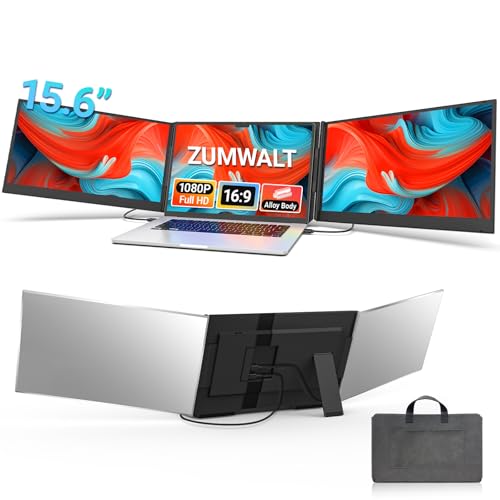
- Two 15.6-inch 1080p displays for expansive workspace
- Triple-screen extend, mirror, and portrait modes
- Aluminum shell, power adapter, cables, and carry bag included
Best For: Professionals needing a large mobile triple-screen workstation
Best Triple-Screen Value – KEFEYA 15.6-inch FHD Triple Monitor
If you want laptop screen extenders for a larger mobile workstation, this KEFEYA model adds two 15.6-inch FHD IPS displays to create a triple-screen setup. Its 0.16-inch-thin design, included carry bag, and multiple connection options make it practical for working or traveling, provided your laptop supports the required video outputs.
Best For: Remote workers, programmers, traders, and travelers who need three screens on the go.
Pros:
- Two 15.6-inch 1920×1080 IPS displays with 300-nit brightness and 100% sRGB color.
- Supports extended, mirrored, landscape, and portrait display modes with 180-degree rotation.
- Includes the needed USB-C and HDMI cables plus a leather carrying bag.
- Works with Windows, Chrome, Android, Linux, Dex, PS4, Xbox, and Switch devices.
Cons:
- Not directly compatible with Mac M1, M2, or M3 chips without a separate H6 adapter.
- USB-A to USB-C connection provides power only.
- At about 3.9 pounds, it is portable but not especially light.
This is a feature-rich choice when maximum screen space matters more than minimal weight. Check your laptop’s USB-C and HDMI capabilities before buying, especially for Mac systems.
Best for Vertical Workspace – 16-inch 1200P Triple Portable Monitor
Among laptop screen extenders, this 16-inch model stands out for its 16:10 1920×1200 resolution, which provides more vertical room than a standard 1080p screen. The dual displays are designed for documents, spreadsheets, coding, and web pages, while the slim aluminum construction supports frequent travel.
Best For: Professionals, students, coders, and content creators who benefit from additional vertical space.
Pros:
- 16-inch IPS screens use 1920×1200 resolution and a 16:10 aspect ratio.
- 350-nit brightness and 178-degree viewing angles support clear viewing.
- Uses two USB-C cables with no driver installation when the laptop has two full-featured USB-C ports.
- Aluminum alloy construction and a 6.5mm-thin screen design help with portability.
Cons:
- The simple two-cable setup requires two full-featured USB-C ports.
- Its 4.6-pound weight may be substantial for some travelers.
- The displays have a glossy finish, which can be more reflective in bright environments.
The higher 1200p resolution is the main reason to choose this extender over typical 1080p alternatives. It is particularly useful for reading and productivity tasks where extra vertical space reduces scrolling.
Best Compact Dual-Screen Option – KEFEYA 14-inch FHD Extender
This KEFEYA is a practical pick among laptop screen extenders for users who want an additional 14-inch screen without moving to a larger triple-monitor system. Its FHD IPS panel, 180-degree rotation, and included cables support flexible use with laptops, phones, consoles, and several operating systems.
Best For: Travelers, remote workers, students, and gamers seeking a relatively compact dual-screen setup.
Pros:
- 14-inch 1920×1080 IPS display with 300-nit brightness and 60Hz refresh rate.
- Supports mirrored, extended, landscape, and portrait display modes.
- Includes Type-C, USB-C-to-USB-A, and HDMI cables for flexible connections.
- Compatible with Windows, Mac M1/M2/M3, Chrome, Linux, Android, PS5, Xbox, and Switch.
Cons:
- At 72% NTSC, its color coverage is more modest than some premium displays.
- HDMI connections require an additional USB-A-to-USB-C cable for power.
- It adds one screen rather than creating a triple-monitor workspace.
Choose this model when portability and broad compatibility are more important than maximum workspace. Its connection flexibility also makes it a convenient option for mixed laptop, mobile, and console use.
Best Standalone Triple-Screen Design – 15.6-inch FHD Extender with Adjustable Stand
This 15.6-inch model is one of the more flexible laptop screen extenders because its adjustable stand supports laptops from 12 to 17.3 inches without attaching directly to the lid. It combines dual additional displays, a thin aluminum body, included carrying bag, and software-based display controls for a portable workstation.
Best For: Traders, designers, remote workers, and frequent travelers who prefer a free-standing triple-screen setup.
Pros:
- 15.6-inch 1920×1080 IPS display with 300-nit brightness and 1000:1 contrast.
- Free-standing adjustable bracket avoids placing stress on the laptop screen.
- Displays fold from 0 to 180 degrees and the unit includes a soft leather carry bag.
- InnovRay software offers brightness, contrast, color-temperature, eye-care, game, and split-screen controls.
Cons:
- Requires two video-output ports, such as two full-function USB-C ports or USB-C plus HDMI.
- MacBook models with standard M1, M2, or M3 chips need an H5 cable for dual-screen functionality.
- The H5 cable is not included and must be obtained separately if required.
The independent stand is the key advantage for users who do not want a monitor mounted to the laptop lid. Confirm your laptop’s port configuration and Mac chip compatibility before purchase.
Best Flexible Triple-Screen Pick – Rotating 15.6-Inch FHD Extender
This laptop screen extender is designed for users who want a flexible triple-screen setup without committing to a fixed arrangement. Its dual detachable 15.6-inch displays support landscape, portrait, and stacked configurations, while 1080p IPS panels provide a clear workspace for multitasking.
Best For: Professionals, presenters, and multitaskers who want adjustable viewing angles, detachable screens, and broad device compatibility.
Pros:
- 235° horizontal and 90° vertical rotation supports multiple layouts.
- 15.6-inch 1080p IPS screens include anti-glare, flicker-free, and low-blue-light features.
- Supports USB-C, USB-A, or HDMI connections and works with Windows, compatible Mac models, Chrome, Android, Linux, and Dex.
- Each detachable side weighs 2.1 pounds and can be used independently.
Cons:
- HDMI use requires an additional USB-A-to-USB-C cable for power.
- Mac compatibility excludes M1, M2, and M3 base-chip models according to the supplied notes.
This is a strong choice when flexibility matters most. The rotating, detachable design makes it useful for desk work, presentations, and travel, though buyers should confirm their laptop’s port and processor compatibility before ordering.
Best Ultra-Thin Triple-Screen Pick – One-Cable 15.6-Inch Extender
This laptop screen extender focuses on portability and simplified cabling. The ultra-thin 15.6-inch triple-screen design can connect through one full-featured USB-C cable after driver installation, making it a practical option for travelers and remote workers who need more workspace on the go.
Best For: Frequent travelers, digital nomads, and users who prioritize a slim carrying profile and a consolidated connection setup.
Pros:
- Single-screen thickness is listed at just 4 mm for easier transport.
- One full-featured USB-C connection can operate both screens after driver installation.
- Includes cables, a power adapter, quick guide, instructions, and carrying bag.
- Compatible with Windows, Mac, Chrome, Android, Linux, Dex, and Switch.
Cons:
- Driver installation is required before use.
- Some laptops may need extra power if the screen blinks or does not operate properly.
- The listed weight is 4 pounds, which may be substantial for some travelers.
This model stands out for its slim design and included travel accessories. It is particularly appealing if you have a full-featured USB-C port, but plan for driver installation and verify whether your laptop can supply enough power.
Best Portable Dual-Monitor Pick – Detachable 15.6-Inch FHD Display
This laptop screen extender is a slim dual-monitor option for users who want extra workspace without a bulky travel setup. Its 15.6-inch 1080p IPS display supports multiple viewing modes, can detach for standalone use, and works with laptops as well as phones, tablets, consoles, and other compatible devices.
Best For: Remote workers and business travelers who need a lightweight, adaptable second-screen solution with broad device support.
Pros:
- 0.27-inch slim profile is designed to fit standard backpacks.
- Supports mirror, extend, portrait, and single-screen modes.
- Detachable display and 360° swivel stand provide flexible positioning.
- Supports Windows, macOS, ChromeOS, Linux, M1/M2/M3 Macs, Android, phones, iPads, Switch, PS4/5, and Xbox.
Cons:
- HDMI plus USB-A is required for devices without a full-featured USB-C port.
- Its 280-nit brightness is more modest than some brighter portable displays.
- PD reverse charging requires a compatible 100W power supply.
This is the most adaptable choice of the three for users who want a portable dual-monitor setup that can also function independently. Its broad compatibility and slim build are useful for travel, while port requirements and power features deserve attention before purchase.
Best Value for Flexible Connectivity – CIDETTY 14-inch FHD Screen Extender
The CIDETTY is a versatile laptop screen extender for shoppers who want a compact 14-inch display with HDMI and USB-C connection options. Its 1080p IPS panel, built-in speakers, and included protective case make it practical for mobile work, entertainment, and compatible gaming devices.
Best For: Travelers and multitaskers who need a portable dual- or triple-screen setup with broad device compatibility.
Pros:
- 14-inch FHD 1080p IPS display with blue-light filtering and anti-glare technology.
- Supports mirror and extended display modes and can expand screen space substantially.
- Includes built-in speakers, protective case, HDMI-to-USB-C cable, and USB-C cables.
- Works with Windows, macOS, Linux, Android, PS, Xbox, and Switch when compatible ports are available.
Cons:
- Not compatible with MacBooks using M1, M2, or M3 chips according to the supplied notes.
- Requires full-featured USB-C or HDMI connections, so port compatibility should be checked first.
Choose the CIDETTY when connection flexibility and included accessories matter more than having the largest possible screen. Verify your laptop’s ports before ordering, particularly for newer MacBooks and Surface devices.
Best Lightweight Travel Pick – 14.2-inch Ultra-Portable Monitor Extender
This laptop screen extender emphasizes portability without giving up a full HD IPS display. At 1.87 pounds and 0.27 inches thick, it is designed for 14- to 17.3-inch laptops and supports direct USB-C setup or HDMI plus USB-A when a full-function USB-C port is unavailable.
Best For: Frequent travelers, remote workers, students, and programmers who want a lightweight second screen.
Pros:
- Lightweight 1.87-pound design with a slim 0.27-inch profile.
- 1080p IPS display with 300 nits brightness and a 0-226-degree adjustable viewing angle.
- Supports extend, mirror, and portrait modes for different workflows.
- Driver-free setup with USB-C or HDMI and USB-A connection options.
Cons:
- Designed for laptops measuring 14 to 17.3 inches, limiting fit for smaller systems.
- Connection requirements vary by laptop port configuration.
For mobile productivity, this model’s low weight and broad angle adjustment are its main advantages. It is a strong fit for users who routinely work away from a desk, provided their laptop falls within the stated size and connectivity range.
Best for Maximum Workspace – ZUMWALT P7 15.6-inch Triple Monitor
The ZUMWALT P7 is a larger laptop screen extender built around a triple-screen workflow. It uses two 15.6-inch 1080p displays, simplified USB-C connections on compatible laptops, and an aluminum shell with a carrying bag for professionals who need expansive multitasking space on the go.
Best For: Professionals who want a large triple-screen setup for multitasking, presentations, coding, or mobile office work.
Pros:
- Two 15.6-inch 1080p displays provide a larger viewing area than smaller extenders.
- Supports extended, mirrored, and portrait display modes.
- Can connect with two USB-C cables when the laptop has full-function USB-C ports.
- Includes cables, power adapter, and carrying bag; aluminum housing adds durability.
Cons:
- At approximately 4 pounds, it is heavier than the other listed options.
- M1, M2, and M3 MacBooks or laptops without full-featured USB-C may require an additional H5-T cable.
- Alternative HDMI and USB-A connection may require external power and driver installation.
Select the ZUMWALT P7 when screen area is the priority. Its dual 15.6-inch panels are well suited to intensive multitasking, but check compatibility and account for the higher weight before choosing it for frequent travel.
How We Picked the Best Laptop Screen Extenders
We focused on portable displays designed to attach directly to laptops, prioritizing models with Full HD or higher resolution, broad laptop-size compatibility, and practical USB-C or HDMI connectivity. We also considered portability, thickness, weight, viewing flexibility, detachable designs, and whether a model supports dual- or triple-screen use.
Because laptop ports and operating systems vary, specifications should be checked carefully before purchase. A display that works through one USB-C cable may require additional cables, adapters, or drivers on another laptop.
Quick Comparison
| What to Compare | Best for | Why it matters |
|---|---|---|
| 14-inch models | Compact travel setups | Lower bulk and easier fit on smaller laptops |
| 15.6-inch models | Comfortable multitasking | More viewing area for documents and side-by-side apps |
| 16-inch or 1200p models | Taller workspaces | Extra vertical pixels can reduce scrolling |
| Detachable monitors | Flexible placement | Can be used independently or positioned at different angles |
| Triple-screen systems | Heavy multitasking | Provides the broadest workspace, usually with more weight and cable management |
Key Buying Factors for Laptop Screen Extenders
Compatibility and Connections
Check the supported laptop-size range first, especially if you use a 13-inch, 14-inch, or unusually thin laptop. USB-C is convenient, but not every USB-C port supports video output. Some computers need HDMI for video plus USB for power, while others may require a DisplayLink driver.
Resolution and Display Quality
1080p is suitable for office work, browsing, messaging, and video calls. A 1200p panel offers additional vertical workspace, which can help with long documents and coding. IPS panels are generally preferable for consistent color and wider viewing angles.
Weight, Thickness, and Stability
Portable screens add weight to your laptop bag and may place extra strain on the computer hinge. Ultra-thin models are easier to travel with, but sturdy mounting hardware and a stable fit matter just as much. Confirm the extender’s weight and maximum laptop thickness before ordering.
Viewing Angles and Adjustability
Rotating or detachable screens offer more flexibility in cramped spaces and collaborative work. Look for adjustable hinges or a design that lets you position displays without blocking your keyboard, webcam, or adjacent ports.
Power and Software Requirements
Some extenders draw power from the laptop, which may reduce battery life. Others use a wall charger or power bank. Review included cables, driver requirements, operating-system support, and the manufacturer’s instructions before relying on the setup for work or travel.
Who Should Buy Which Laptop Screen Extenders?
- Frequent travelers: Choose a lightweight 14-inch or ultra-thin model that fits easily in a laptop sleeve.
- Remote workers: A 15.6-inch Full HD extender provides a comfortable balance of workspace, portability, and readability.
- Researchers and spreadsheet users: Consider a dual- or triple-screen model, or a 1200p display for more usable vertical space.
- Presenters and collaborators: A detachable or rotating design makes it easier to share content and adjust viewing angles.
- Small-laptop owners: Confirm the extender’s minimum size and mounting dimensions so the display does not overhang awkwardly.
- Desk-based power users: Prioritize larger screens, stable hinges, and reliable multi-cable connectivity over the lightest possible design.
The right laptop screen extender depends on your laptop’s ports, screen size, travel needs, and desired number of displays. Verify compatibility and power requirements before choosing the model with the most suitable balance of workspace and portability.