Copying dozens or hundreds of USB drives one at a time wastes labor and makes consistency harder to maintain. The right standalone or PC-based duplicator can produce multiple verified copies simultaneously while simplifying erasure and source management.
This roundup compares 10 USB duplicators for bulk copying, covering compact four-target machines, mid-range office equipment, and high-output systems for demanding production workflows.
Best 10 USB Duplicators for Bulk Copying Picks for 2026
High-Capacity Production Pick

- Copies to up to 47 drives
- Standalone, no computer required
- Supports synchronous and asynchronous modes
Best For: Large USB duplication batches
IT Management Choice
StarTech 1:15 USB Duplicator and Eraser

- Duplicates or erases 15 drives
- Supports sector-by-sector copying
- Includes copy-and-compare verification
Best For: Technicians and IT professionals
Mid-Volume Business Pick

- Supports up to 31 target drives
- Standalone business workflow
- Maintains listed 2GB-per-minute speed
Best For: Medium-to-large business batches
Compact Small-Batch Option
- Copies up to nine drives
- Supports file and sector copying
- Includes two erase functions
Best For: Small teams and portable workflows
High-Volume Standalone Choice

- Standalone operation without a computer or software
- Copies to up to 15 targets at up to 33MB/s
- Supports bit-by-bit, synchronous, and asynchronous modes
Best For: High-volume USB duplication without a computer
Easy Touchscreen Workflow
- Touchscreen controls for copy, compare, format, and erase
- Duplicates USB media at up to 35MB/s
- Supports USB 2.0, 3.0, and 3.1 thumb drives
Best For: Accessible daily duplication and media-management tasks
PC-Based USB 3.0 Workstation
Nexcopy 16-Target USB 3.0 Duplicator

- Offers 16 target USB connections
- Uses USB 3.0 for high-speed copying
- Includes Nexcopy Drive Manager software
Best For: PC-based, multi-target USB 3.0 duplication
Compact 1-to-4 Pick
- Copies up to four USB drives at once
- Standalone and portable design
- Up to 45MB/s with compatible media
Best For: Portable small-batch USB duplication
High-Volume Production Pick

- Copies to 15 target drives
- Asynchronous standalone operation
- Smart Copy, Raw Mode, and secure erase
Best For: Large USB duplication batches
Budget 1-to-2 Pick

- Copies one drive to two targets
- Quick Copy and bit-for-bit modes
- Built-in testing and erase functions
Best For: Small-batch USB duplication and verification
High-Capacity Production Pick – Systor 1 to 47 USB Duplicator
For teams comparing usb duplicators for bulk copying, the Systor SYS-USBD-47 is built for high-volume production, handling up to 47 target drives at once without a computer or software. Its stated 2GB-per-minute speed and bit-by-bit copying make it suited to repeatable duplication jobs.
Best For: Organizations that need to copy many USB drives in a standalone workflow.
Pros:
- Supports duplication to up to 47 USB drives.
- Standalone operation requires no computer or software.
- Offers synchronous and asynchronous copy modes.
- Supports USB Type-C drives with an adapter.
Cons:
- The listed interface is USB 1.1.
- USB Type-C drives require an adapter.
- The advertised rate is up to 2GB per minute, or 33MB per second.
Choose this model when throughput capacity matters more than compact size. Its 47-port layout and standalone design are the main advantages for larger duplication batches.
IT Management Choice – StarTech 1:15 USB Duplicator and Eraser
The StarTech USBDUPE115 combines duplication, drive erasure, and verification in one standalone unit. For usb duplicators for bulk copying, it is a practical option for technicians who also need sector-by-sector copying, overwrite modes, and an LCD status display.
Best For: IT professionals managing boot drives, data distribution, and USB sanitization.
Pros:
- Copies or erases up to 15 USB drives without a computer.
- Supports file-based and sector-by-sector duplication.
- Includes quick erase, single-pass, and three-pass overwrite options.
- Copy-and-compare can verify completed clones.
Cons:
- Asynchronous copying is limited to source content under 128MB.
- External USB devices may require their own power source.
- Its stated copy rate is 1.5GB per minute, below some higher-speed options.
This is the most feature-focused choice in the group. Its LCD, error scanning, verification, and sanitization modes add useful control for professional workflows, though its asynchronous mode has a specific size limitation.
Mid-Volume Business Pick – Systor 1 to 31 USB Duplicator
The Systor SYS-USBD-31 offers a 31-target configuration for businesses that need recurring USB production but do not require the largest available port count. It operates independently of a computer and maintains its stated 2GB-per-minute copying speed as the number of loaded drives increases.
Best For: Businesses producing medium-to-large batches of identical USB drives.
Pros:
- Duplicates to up to 31 USB drives simultaneously.
- Requires no computer or software.
- Performs bit-by-bit copying from the source drive.
- Supports synchronous and asynchronous copy modes.
Cons:
- The listed transfer speed is 33MB per second.
- USB Type-C drive support requires an adapter.
- The product uses a USB 1.1 interface according to the supplied details.
This model balances capacity and footprint within Systor’s lineup. It is a sensible middle ground for business duplication runs where 31 outputs are sufficient and standalone operation is important.
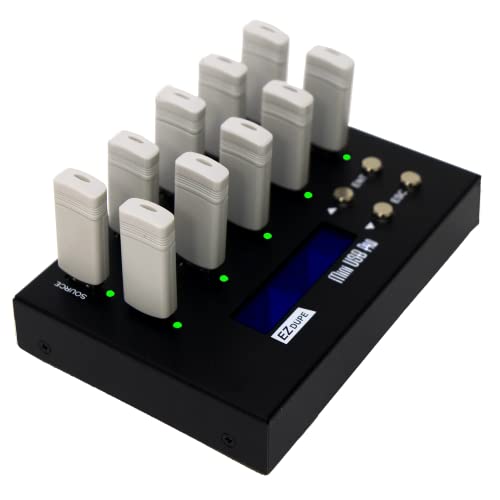
Compact Small-Batch Option – EZ Dupe 1 to 9 USB Duplicator
The EZ Dupe MiniUSB Pro is a compact standalone copier for smaller production runs. It supports up to nine USB targets, offers both essential-file and whole-media copying, and can also sanitize compatible drives, making it a flexible entry point for usb duplicators for bulk copying.
Best For: Small teams that need portable, nine-drive USB duplication and erasure.
Pros:
- Copies to up to nine USB drives simultaneously.
- Supports USB 1.0, 2.0, and 3.0 flash media.
- Offers quick file copying and sector-by-sector whole-media copying.
- Supports two erase functions for data sanitization.
Cons:
- Its nine-drive capacity is lower than the other listed duplicators.
- External hard drives up to 2TB must have their own power source.
- Its stated copy speed is approximately 2GB per minute.
With a small footprint and broad USB media compatibility, this EZ Dupe is well suited to occasional or moderate duplication work. Consider a higher-port model if your regular batches exceed nine targets.
High-Volume Standalone Choice – Systor 1-to-15 USB Duplicator
For teams comparing usb duplicators for bulk copying, the Systor SYS-USBD-15 is a practical standalone option that requires no computer or software. It copies USB drives at up to 33MB per second and maintains the same stated copy speed as the number of loaded drives increases.
Best For: Businesses and users needing standalone, multi-drive USB duplication with support for synchronous and asynchronous copying.
Pros:
- Duplicates one source drive to up to 15 targets.
- Requires no computer or software.
- Supports bit-by-bit copying and USB Type-C drives with an adapter.
- Includes a one-year parts, three-year labor warranty and lifetime technical support.
Cons:
- Uses a USB 2.0 interface.
- USB Type-C drives require an adapter.
The Systor stands out when independent operation and a 15-target workflow matter most. Its 33MB-per-second rate and sanitizing functionality make it suited to repeatable business or personal duplication tasks.
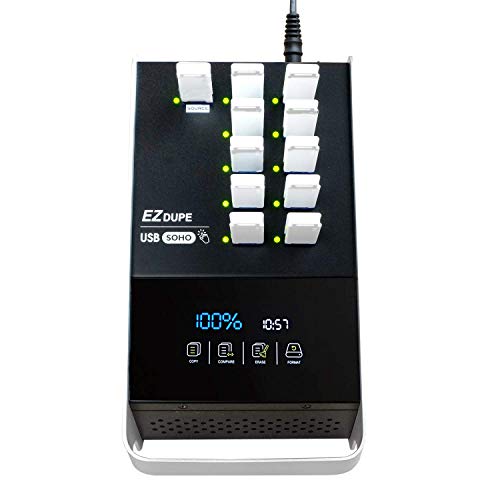
Easy Touchscreen Workflow – EZ Dupe SOHO Touch 1-to-10
The EZ Dupe SOHO Touch is a user-friendly choice for usb duplicators for bulk copying when straightforward controls are important. Its touchscreen menu provides dedicated copy, compare, format, and erase functions, while duplication runs at up to 35MB per second.
Best For: Daily USB duplication, comparison, formatting, and erasing tasks managed through a simple touchscreen interface.
Pros:
- Copies to up to 10 USB targets at up to 35MB per second.
- Touchscreen controls simplify copying, comparing, formatting, and erasing.
- Supports all file formats, file sizes, and USB flash-drive capacities.
- Designed for lightweight and heavy-duty daily operation.
Cons:
- Its 10-target capacity is lower than some larger duplicators.
- Includes a one-year manufacturer warranty.
Choose this model if operator convenience is a priority. The touchscreen and independent interface make routine workflows accessible, while Smart Copy, Strict Compare, and one-touch erase add useful task controls.
PC-Based USB 3.0 Workstation – Nexcopy 16-Target USB 3.0 Duplicator
The Nexcopy SSUSB160PC is a PC-based option for usb duplicators for bulk copying, with 16 target ports and USB 3.0 support. It is designed to take advantage of compatible flash drives’ maximum transfer speeds and includes Nexcopy Drive Manager software.
Best For: PC-based duplication workflows that need 16 USB 3.0 target connections and software-assisted operation.
Pros:
- Provides 16 target USB connections.
- Uses USB 3.0 technology for high-speed copying.
- Includes Nexcopy Drive Manager software.
- Supports copying at a flash drive’s maximum transfer speed.
Cons:
- Requires a PC-based setup rather than standalone operation.
- The supplied notes do not specify a fixed copying speed.
- Weighs 12 pounds.
This Nexcopy model is a strong fit when USB 3.0 connectivity and a 16-target layout outweigh the convenience of a standalone unit. Its PC-based design and included software suit organized, workstation-style duplication.
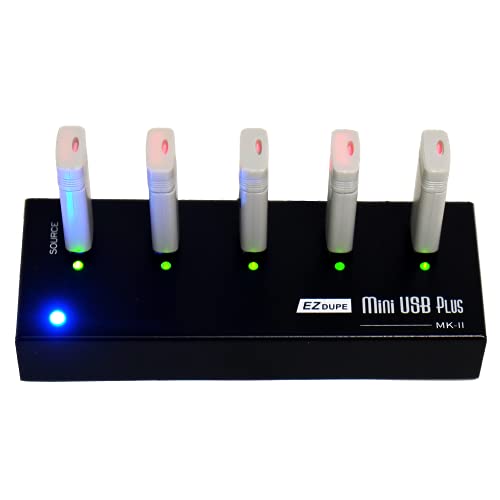
Compact 1-to-4 Pick – EZ Dupe Mini USB Plus MK II
For shoppers comparing usb duplicators for bulk copying, the EZ Dupe Mini USB Plus MK II is a compact standalone option that can copy to four USB drives at once. Its asynchronous operation lets you start new drives without waiting for an entire batch to finish.
Best For: Small offices, technicians, and portable duplication jobs involving up to four USB drives simultaneously.
Pros:
- Copies to up to four USB flash drives simultaneously.
- Standalone operation requires no computer.
- Supports USB 1.0, 2.0, and 3.0 flash drives and USB external storage with its own power source.
- Updated model reaches up to 2.5GB/min or 45MB/s, depending on the media.
Cons:
- Four-target capacity is less suited to large production runs.
- External USB storage requires its own power connection.
This is a practical choice when portability and simple plug-and-use operation matter more than maximum batch size. Its power-bank compatibility also makes it convenient for field use.
High-Volume Production Pick – Vinpower USBDBL 15-Target
Among usb duplicators for bulk copying, the Vinpower USBDBL stands out with 15 target slots for larger duplication runs. It works without a PC and supports both Smart Copy for accessible data and Raw Mode for bit-by-bit duplication.
Best For: Businesses, organizations, and production environments that need to copy many USB drives in a single batch.
Pros:
- Provides 15 target USB slots for high-volume duplication.
- Asynchronous duplication allows drives to copy independently.
- Smart Copy and Raw Mode support different duplication needs.
- Includes secure erase functionality and optional adapters for SD, microSD, and other flash formats.
Cons:
- At 11 pounds, it is considerably less portable than compact models.
- Additional flash-media formats require corresponding adapter modules.
This model is the strongest fit for throughput-focused users. Its large target count and asynchronous workflow can reduce waiting between batches, while secure erase adds a useful maintenance function.
Budget 1-to-2 Pick – BestDuplicator UB300
The BestDuplicator UB300 is a straightforward option for usb duplicators for bulk copying when two target drives per cycle are sufficient. It operates independently of Windows or Mac software and offers both data-only Quick Copy and bit-for-bit Whole Media Copy modes.
Best For: IT departments, schools, and field technicians handling smaller duplication jobs with basic verification and erase tools.
Pros:
- Duplicates one source USB drive to two targets simultaneously.
- Offers Quick Copy and Whole Media Copy modes.
- Includes capacity checks, device information, speed tests, and erase functions.
- Compact design includes an LCD screen and individual port status LEDs.
Cons:
- Only supports two target drives per batch.
- Designed primarily for USB 1.1 and USB 2.0 media.
- Memory-card duplication requires a compatible USB card reader sold separately.
The UB300 makes sense for occasional or moderate-volume copying where a simple control panel and media-testing tools are valuable. It is less appropriate for high-throughput workflows than a multi-target duplicator.
How We Picked the Best USB Duplicators for Bulk Copying
We focused on the factors that matter most when producing multiple USB drives: target capacity, copy speed, supported USB generations, standalone operation, verification features, and ease of use. The selection includes standalone duplicators for repeatable jobs without a computer, touchscreen and LCD-equipped models for simpler operation, portable options for occasional work, and a PC-based unit for users who need computer-managed workflows.
We also considered whether each machine supports drive erasing or sanitizing, since bulk copying often includes reusing media. Stated port counts and throughput are useful comparison points, but real-world speed can vary with the source drive, target media, file sizes, and data type.
Quick Comparison
| Best For | Recommended Type | Why It Matters |
|---|---|---|
| Highest-volume production | 31- or 47-target standalone unit | Copies many drives in one batch and reduces operator time. |
| Small business or office use | 9- to 16-target duplicator | Balances capacity, footprint, and purchase cost. |
| Occasional copying | 2- or 4-target compact model | Uses less space and is easier to store between jobs. |
| Computer-managed workflows | PC-based USB 3.0 duplicator | Fits users who prefer software control and workstation integration. |
Key Buying Factors for USB Duplicators for Bulk Copying
Target Count and Throughput
The number of target ports determines how many drives can be copied per cycle. High-port systems are more efficient for recurring large orders, while smaller machines may be faster to set up for short runs. Check the advertised transfer rate, but treat it as a ceiling rather than a guarantee.
USB Compatibility
Match the duplicator to the media you actually use. USB 3.x support can shorten copy times with compatible drives, while USB 2.0 compatibility may still be important for legacy media. Confirm that the system accepts your preferred flash drives, external storage, and capacity ranges.
Standalone Controls and Verification
Standalone operation avoids tying up a computer and can make repeat jobs more consistent. LCD or touchscreen menus are helpful when operators need to select copy, compare, erase, or other functions quickly. Verification features help identify incomplete or corrupted copies before distribution.
Erasing, Sanitizing, and Reliability
If drives are reused, look for dedicated erase or sanitization modes and understand which standards or erase options are supported. For frequent production, prioritize solid construction, cooling, clear status indicators, and a warranty that matches your workload.
Who Should Buy Which USB Duplicators for Bulk Copying?
Choose a high-capacity Systor system when you regularly produce large batches and labor savings justify a larger desktop footprint. A StarTech, EZ Dupe, Vinpower, or comparable mid-capacity standalone unit is a practical fit for schools, offices, event teams, and small production shops handling recurring but moderate volumes.
For occasional duplication, a compact EZ Dupe Mini or BestDuplicator model can provide the essential function without the size or cost of a larger tower. Choose a PC-based USB 3.0 model when your process depends on computer control, centralized file handling, or integration with an existing workstation. Before buying, estimate your typical batch size, confirm drive compatibility, and compare the cost of unused ports against the time saved on every job.