Polyphonic guitar tuners let you check every string with one strum, making routine tuning faster before rehearsals, recording sessions, and performances. The best models balance clear displays, reliable pitch detection, flexible tuning modes, and a design that suits your setup.
This roundup compares 10 strong options, including clip-on tuners for portability and pedal tuners for always-on visibility and signal-chain integration. Use the guide below to match features such as rechargeable power, strobe accuracy, buffering, and instrument compatibility to the way you play.
Best 10 Polyphonic Guitar Tuners Picks for 2026
Best Polyphonic Clip-On

- Tunes all six strings simultaneously
- Chromatic and ultra-accurate strobe modes
- Adaptive 108-LED display
Best For: Polyphonic clip-on tuning with precision modes
Best Rechargeable Option

- Up to 24 hours per charge
- 360-degree rotating bright display
- Strong, adjustable headstock clamp
Best For: Rechargeable everyday guitar and bass tuning
Best Pedalboard Tuner

- Polyphonic, chromatic, and strobe modes
- Built-in BONAFIDE analog buffer
- 0.5-cent chromatic accuracy
Best For: Pedalboard users needing tuning and tone preservation
Best Simple Clip-On
D'Addario Eclipse Headstock Tuner
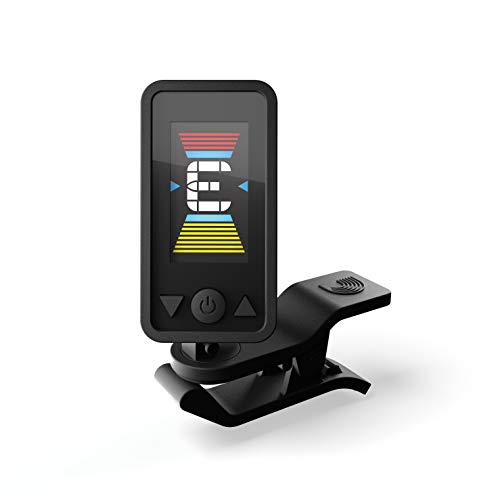
- Full-color adjustable display
- Dual swivels for flexible positioning
- Works with guitar, bass, and ukulele
Best For: Simple, versatile headstock tuning
Best Buffered Polyphonic Pedal

- Fast, accurate polyphonic tuning
- Multiple tuning modes
- Built-in BONAFIDE BUFFER
Best For: Guitarists wanting a compact tuner pedal with buffering
Best Clip-On Multi-Instrument Tuner

- Vibration-based tuning
- Five instrument and chromatic modes
- Color LCD needle display
Best For: Players tuning guitar, bass, ukulele, or violin
Best Compact Polyphonic Tuner

- Polyphonic, chromatic, and strobe modes
- Tunes all strings at once
- Built-in BONAFIDE BUFFER
Best For: Space-conscious pedalboards needing versatile tuning
Compact Clip-On Pick

- Full-color display
- Guitar-and-bass frequency range
- Front- or back-of-headstock mounting
Best For: Lightweight everyday tuning
Stage-Ready Pedal Choice

- Tank-tough stompbox body
- 21-segment high-visibility LED meter
- Silent tuning and drop-tuning support
Best For: Live guitar and bass performance
Precision Polyphonic Pick

- Polyphonic guitar tuning
- ±0.1-cent tuning accuracy
- OLED display with chord finder
Best For: Precise guitar setup and practice
Best Polyphonic Clip-On – TC Electronic POLYTUNE CLIP
The TC Electronic POLYTUNE CLIP is a strong choice for guitarists seeking polyphonic guitar tuners in a compact clip-on format. It can assess all six strings at once, while chromatic and strobe modes provide options for quick checks or highly precise tuning.
Best For: Players who want polyphonic tuning, an adaptive display, and multiple tuning modes in a headstock tuner.
Pros:
- Tunes all six strings simultaneously with poly tune technology.
- Includes chromatic tuning accurate to ±0.5 cent and strobe tuning accurate to ±0.02 cent.
- Bright 108-LED matrix display adapts to the clip’s orientation.
- Offers flat-tuning and capo modes in a durable stainless-steel clip design.
Cons:
- Uses a battery-powered design rather than rechargeable charging.
- Its feature set may be more than needed for basic tuning.
Choose the POLYTUNE CLIP if fast simultaneous string checking and precision strobe tuning matter more than having a pedal-style unit.
Best Rechargeable Option – D'Addario Nexxus 360
The D’Addario Nexxus 360 is a practical alternative for guitarists comparing polyphonic guitar tuners and conventional clip-on models. Its large, bright screen, 360-degree rotation, and rechargeable battery make it convenient for frequent tuning on acoustic or electric guitar.
Best For: Players who prefer a rechargeable clip-on tuner with flexible viewing angles and extended battery life.
Pros:
- Provides up to 24 hours of tuning per charge.
- 360-degree rotating head and bright display support varied viewing positions.
- Strong clamp can mount anywhere on the headstock without slipping.
- Offers adjustable calibration from 415–465 Hz.
Cons:
- It is a standard clip-on tuner rather than a true simultaneous six-string polyphonic tuner.
- Requires access to USB power for recharging.
The Nexxus 360 is best when charging convenience and display flexibility are priorities, even if simultaneous string analysis is not essential.
Best Pedalboard Tuner – TC Electronic POLYTUNE 3
The TC Electronic POLYTUNE 3 combines polyphonic guitar tuners functionality with a pedal-format design and a built-in analog buffer. It is suited to players who want fast all-string tuning while also helping preserve tone across long cable runs or complex pedalboards.
Best For: Electric guitarists building pedalboards who need polyphonic, chromatic, and strobe tuning plus signal buffering.
Pros:
- Supports polyphonic, chromatic, and strobe tuning modes.
- Tunes all strings at once for quick checks.
- Built-in BONAFIDE BUFFER helps preserve tone through long cables and complex pedalboards.
- Chromatic tuning offers 0.5-cent accuracy.
Cons:
- Its pedal-style, corded setup is less portable than a clip-on tuner.
- Designed around 1/4-inch audio connections rather than a simple headstock clip.
If you tune through a pedalboard, the POLYTUNE 3 adds useful signal-path functionality that a basic clip-on tuner cannot provide.
Best Simple Clip-On – D'Addario Eclipse Headstock Tuner
The D’Addario Eclipse is a straightforward headstock tuner for players comparing polyphonic guitar tuners with simple chromatic clip-on options. Its full-color vertical screen, dual swivels, and secure clamp make it easy to position on guitars, basses, and ukuleles.
Best For: Acoustic, electric, bass, and ukulele players who want an adjustable, easy-to-read clip-on tuner.
Pros:
- Full-color vertical display offers flexible viewing angles.
- Dual swivels accommodate left- or right-handed mounting positions.
- Strong clamp is designed to stay secure on the headstock.
- Supports adjustable calibration across 435–450 Hz.
Cons:
- It is a conventional clip-on tuner, not a simultaneous six-string polyphonic model.
- Uses a required CR2 battery rather than a rechargeable power system.
The Eclipse makes sense for players who value uncomplicated, flexible clip-on tuning across several instrument types.
Best Buffered Polyphonic Pedal – POLYTUNE 3 NOIR
The TC Electronic POLYTUNE 3 NOIR is a compact choice for guitarists seeking polyphonic guitar tuners with a built-in tone-preserving tool. Its tiny pedal format combines fast, accurate tuning with multiple tuning modes and a BONAFIDE BUFFER.
Best For: Guitarists who want a small pedal tuner that also helps maintain signal quality through longer cables or pedalboards.
Pros:
- Supports fast, accurate polyphonic tuning.
- Combines multiple tuning modes in one compact unit.
- Includes a built-in BONAFIDE BUFFER for an added tone-management function.
- Small, lightweight design at 1.44 x 0.79 x 0.68 inches and 5.64 ounces.
Cons:
- Its pedal format may be less convenient than a clip-on tuner for casual acoustic use.
- The supplied details do not specify included power accessories.
Choose this model if you want polyphonic tuning in a particularly small pedal and value having the built-in buffer available as part of the same unit.
Best Clip-On Multi-Instrument Tuner – Fender FCT-2
Fender FCT-2 Professional Multi-Instrument Clip-On Tuner for Guitar, Bass, Ukulele, and Violin
Check Price On AmazonThe Fender FCT-2 is a practical clip-on alternative for players comparing polyphonic guitar tuners with versatile instrument tuners. It senses vibrations directly from the instrument and offers dedicated modes for guitar, bass, ukulele, violin, and chromatic tuning.
Best For: Players who use multiple instruments and need a vibration-sensing tuner for loud venues, practice rooms, and everyday setup.
Pros:
- Vibration sensing supports tuning in varied playing environments.
- Color LCD needle display provides quick visual feedback.
- Dedicated modes cover guitar, bass, ukulele, violin, and chromatic tuning.
- Dual-hinge clip adjusts for a comfortable headstock viewing angle.
Cons:
- It is a clip-on tuner rather than a polyphonic pedal tuner.
- The molded-plastic body may feel less substantial than a pedal enclosure.
For players who prioritize flexibility across instruments over simultaneous string tuning, the FCT-2 offers broad mode coverage, a clear display, and convenient headstock mounting.
Best Compact Polyphonic Tuner – POLYTUNE 3 MINI
The TC Electronic POLYTUNE 3 MINI is a compact pedal for guitarists who want polyphonic guitar tuners with several tuning options. It provides polyphonic, chromatic, and strobe modes, along with a built-in BONAFIDE BUFFER to help keep tone crisp through long cables and large pedalboards.
Best For: Guitarists building space-conscious pedalboards who want multiple tuning modes and an integrated buffer.
Pros:
- Tunes all strings at once in polyphonic mode.
- Includes polyphonic, chromatic, and strobe tuning modes.
- Built-in BONAFIDE BUFFER is designed to keep tone crisp through long cables and large pedalboards.
- Compact 9-volt pedal design weighs 100 grams.
Cons:
- Requires a 9-volt power source and is not a clip-on tuner.
- The supplied details do not mention a battery option.
This is a strong fit for a pedalboard-focused setup where quick all-string tuning, strobe precision, and signal buffering matter more than standalone portability.
Compact Clip-On Pick – Snark SN5X
The Snark SN5X is a straightforward clip-on option for players comparing polyphonic guitar tuners with a compact, easy-to-read design. Its full-color display and guitar-and-bass-focused frequency range make it suitable for routine tuning at home, rehearsals, or casual performances.
Best For: Guitarists and bassists who want a lightweight clip-on tuner with a full-color screen.
Pros:
- Full-color display for clear visual feedback.
- Frequency range tailored to guitar and bass.
- Can be mounted on the front or back of the headstock.
- Lightweight 1.58-ounce design.
Cons:
- Plastic body may feel less rugged than a metal pedal-style tuner.
- Its supplied features are centered on standard chromatic clip-on tuning rather than advanced polyphonic functions.
The SN5X focuses on portability and simple operation. Choose it if you value a small headstock-mounted tuner and a color display over stage-oriented pedal construction.
Stage-Ready Pedal Choice – BOSS TU-3
The BOSS TU-3 is built for players who need dependable stage tuning rather than a clip-on format. Its tank-tough stompbox housing, bright 21-segment LED meter, and accurate chromatic tuning make it a strong alternative for guitarists comparing polyphonic guitar tuners for live use.
Best For: Performing guitarists and bassists who need a rugged pedal tuner with silent tuning and high-visibility indicators.
Pros:
- Tank-tough BOSS stompbox construction.
- High-brightness 21-segment LED meter with adjustable brightness.
- Accurate to ±1 cent and includes Accu-Pitch visual confirmation.
- Supports guitar, bass, seven-string guitar, six-string bass, and drop tuning up to six semitones.
Cons:
- Heavier and less compact than a clip-on tuner at 390 grams.
- Requires a 9-volt power source and is designed for pedalboard use.
- Its supplied features describe chromatic and instrument-specific tuning, not polyphonic detection.
The TU-3 is the practical choice when visibility, durability, and signal muting matter during performances. It also supplies power for up to seven BOSS compact effect pedals through a daisy-chain connection.
Precision Polyphonic Pick – Korg AW-OTG-POLY
The Korg AW-OTG-POLY is the most directly aligned with shoppers seeking polyphonic guitar tuners. Its guitar-specific design can display multiple strings, while the OLED screen, chord finder, and ±0.1-cent tuning accuracy add useful detail for precise setup and practice.
Best For: Guitarists who want polyphonic tuning, highly precise readings, and guitar-focused features.
Pros:
- Polyphonic guitar tuner design with an intuitive chord finder function.
- OLED display provides strong visibility.
- Ultra-high tuning precision rated as great as ±0.1 cents.
- Includes a strobe feature, alternate-tuning animations, memory backup, and auto-power-off.
Cons:
- Designed specifically for guitar, so it may be less versatile for other instruments.
- Battery-powered operation requires keeping a suitable battery available.
- Advanced display and tuning functions may be more than beginners need for basic tuning.
The AW-OTG-POLY stands out when simultaneous string checking and fine tuning accuracy are priorities. Its guitar-specific features make it a particularly focused choice for players shopping in this category.
How We Picked These Polyphonic Guitar Tuners
We focused on tuners that offer dependable pitch detection, useful visibility, and practical operation for guitarists. The selection includes dedicated polyphonic models, versatile clip-on chromatic tuners, and pedal-format options for players who prefer footswitch control. We also considered display readability, tuning modes, power requirements, portability, instrument support, and whether a pedal includes signal-chain features such as a buffer.
Because no single tuner suits every setup, the list covers quick practice tools, rechargeable clip-ons, compact pedalboard units, and rugged stage-friendly choices.
Quick Comparison
| Best For | Recommended Type | Key Feature to Look For |
|---|---|---|
| Fast checks between songs | Polyphonic clip-on | Clear display and responsive detection |
| Pedalboards | Polyphonic or chromatic pedal | Readable screen, bypass behavior, and power options |
| Acoustic instruments | Clip-on tuner | Strong vibration sensing and flexible clip |
| Multiple instruments | Multi-instrument clip-on | Broad tuning range and instrument presets |
| Maximum precision | Strobe-capable tuner | Fine resolution and stable pitch readout |
Key Buying Factors for Polyphonic Guitar Tuners
Polyphonic, Chromatic, and Strobe Modes
Polyphonic mode is ideal for quickly spotting strings that are sharp or flat. Chromatic mode is better for tuning one string at a time, alternate tunings, bass, or other instruments. A strobe display can provide more precise visual feedback, although it may take longer to interpret.
Clip-On or Pedal Format
Clip-on tuners are compact, affordable, and useful for acoustic guitars or unplugged practice. Pedal tuners are easier to see onstage and integrate naturally into an electric-guitar signal chain. Check whether a pedal offers true bypass or a buffer if that matters for your rig.
Display Visibility and Accuracy
Look for a bright, high-contrast display if you play under changing stage lights. A wide tuning range and dependable vibration or input sensing are particularly important for lower tunings, bass, and noisy environments.
Power and Durability
Rechargeable clip-ons reduce disposable-battery use but need regular charging. Battery-powered models are convenient as backups. For frequent gigging, prioritize a secure clip, sturdy housing, reliable switches, and easy-to-read feedback.
Who Should Buy Which Polyphonic Guitar Tuners?
- Choose a polyphonic clip-on if you want the fastest way to check all six strings during practice or before a set.
- Choose a rechargeable clip-on if you value cable-free convenience and use a tuner regularly.
- Choose a polyphonic pedal if you play electric guitar onstage and want hands-free operation with a visible display.
- Choose a chromatic pedal if you need a proven pedalboard tuner and do not require simultaneous string checking.
- Choose a multi-instrument clip-on if you switch between guitar, bass, ukulele, violin, or similar instruments.
- Choose a strobe-capable model if precise setup work, recording, or intonation checks are more important than the fastest possible tuning.
Before buying, confirm the tuner supports your instrument’s tuning range, fits your headstock or pedalboard space, and provides enough display contrast for your typical playing environment.