Looking for guitar distortion pedals for hard rock that deliver punch, sustain, and usable tone without turning muddy? This roundup focuses on pedals that can handle everything from classic riffing to heavier modern crunch.
We selected options for different budgets, gain styles, and EQ flexibility so you can find the right pedal for your rig and playing style.
Best 10 Guitar Distortion Pedals for Hard Rock Picks for 2026
Classic Benchmark Distortion
BOSS DS-1 Distortion for Hard Rock

- Hard-edged attack stays clear at high gain
- Smooth sustain suits rhythms and solos
- Tone control covers a wide sound range
Best For: Players who want a classic hard rock distortion with simple, proven versatility
Extreme Value Metal
Behringer UM300 for Aggressive Rock
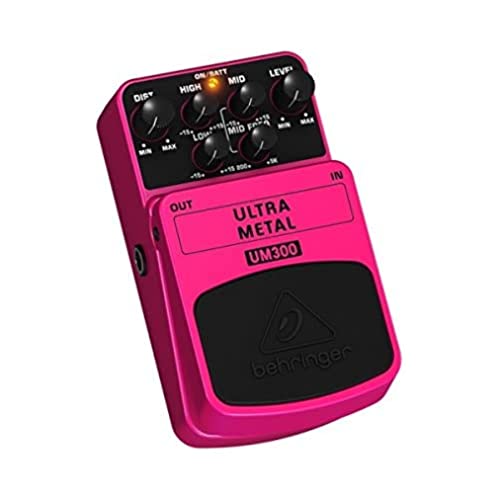
- Built for extreme hard rock and heavy metal distortion
- Multi-gain circuit adds thick sustain
- 3-band EQ gives strong tone shaping
Best For: Players who want an aggressive high-gain pedal with detailed EQ control
Arena Rock Favorite

- Strong for arena rock rhythm and lead tones
- Moves from clean to warm overdrive smoothly
- Can be used as a solo boost
Best For: Players who want a versatile hard rock distortion with classic arena-rock character
High-Gain Stompbox
Boss MT-2 Metal Zone for Heavy Riffs

- Dual-stage gain makes thick, tight distortion
- Smooth sustain works for singing leads
- Designed for heavy rhythms and metal styles
Best For: Players who want a saturated high-gain pedal for heavy hard rock and metal-leaning tones
Modern High-Gain Versatility
JOYO UZI R-03 High-Gain Distortion

- Bias knob blends American and British voicings
- 3-band EQ helps tailor hard rock and metal tones
- Dynamic balance keeps output more consistent at higher gain
Best For: Players who want one flexible high-gain pedal for hard rock and metal
Simple Fender Crunch
Fender Hammertone Distortion Pedal

- Covers light drive to heavy crunch
- Active Bass and Treble EQ for basic shaping
- Top-mounted jacks and true bypass suit pedalboards
Best For: Players who want an easy, compact distortion for hard rock
Budget Multi-Mode Crunch
Donner Morpher Mini Distortion Pedal

- Three modes: Natural, Tight, and Classic Crunch
- High-gain tone suits riffing and shredding
- True bypass in a compact aluminum-alloy enclosure
Best For: Players who want an affordable, multi-mode hard rock distortion
Best with Extra Features

- Three voicings for different high-gain flavors
- 3-band EQ for detailed tone shaping
- True bypass and rugged aluminum housing
Best For: Players who want a modern high-gain pedal with flexible voicings
Classic Heavy Clarity

- Keeps clarity and definition at higher gain
- Six knobs for broad tone shaping
- True bypass with heavy rock, punk, and metal range
Best For: Players who want detailed control and clear note definition
Classic-to-Metal Range
JOYO High Gain Distortion JF-04

- Covers classic rock, hard rock, and heavy metal
- Simple Treble and Mid tone controls
- Analog true-bypass design with metal housing
Best For: Guitarists who want one pedal for classic rock through heavy metal
Classic Benchmark Distortion – BOSS DS-1 Distortion for Hard Rock
If you want guitar distortion pedals for hard rock that deliver a familiar, proven sound, the BOSS DS-1 is an easy benchmark. It brings hard-edged attack and smooth sustain, with a tone control that gives you a wider range of shaping than many players expect from such a simple compact pedal.
Best For: Players who want a classic hard rock distortion that stays clear under heavy gain and can also work as a boost.
Pros:
- Hard-edged attack stays clear even at maximum distortion
- Smooth sustain works well for heavy rhythms and cutting solos
- Wide tone control helps shape a broad range of sounds
- Can function as a booster at low distortion settings
Cons:
- Its character is geared toward a classic voice, not extreme modern metal
- Simple control layout may feel limited if you want deep EQ shaping
For hard rock players who value a pedal with a long track record and useful versatility, the DS-1 remains a practical choice. It preserves the character of different guitars and pickups, and it cleans up well when you roll back the guitar volume.
Extreme Value Metal – Behringer UM300 for Aggressive Rock
Behringer ULTRA METAL UM300 Heavy Metal Distortion Instrument Effect Pedal, Pink
Check Price On AmazonAmong guitar distortion pedals for hard rock, the Behringer ULTRA METAL UM300 is aimed at players who want a much heavier edge. Its multi-gain circuitry is built for super-thick, tube-like distortion and long sustain, while the dedicated distortion, 3-band EQ, and level controls give you direct control over the final sound.
Best For: Hard rock and metal players who want maximum gain and broad tone shaping on a budget-friendly pedal.
Pros:
- Extreme distortion voice designed for hard rock and heavy metal
- Multi-gain circuitry adds thick, tube-like gain and sustain
- 3-band EQ helps shape the tone more precisely
- Status LED provides effect and battery-check feedback
Cons:
- The sound profile is clearly aimed at very heavy styles
- Battery-powered design may be less convenient than board-friendly power options
If your hard rock tones lean heavy and saturated, the UM300 offers a lot of gain and control for the money. It is best treated as a specialized high-gain option rather than a subtle all-purpose distortion.
Arena Rock Favorite – Pro Co RAT2 Distortion Pedal
The Pro Co RAT2 is a strong pick if you want guitar distortion pedals for hard rock that can cover rhythm and lead duties. It excels at arena rock tones, sits in the sweet spot between clean and overdriven, and can also be used as a boost for solos when you need more push.
Best For: Players looking for an arena-rock distortion that can move from warm edge-of-breakup tones to singing leads.
Pros:
- Excels at arena rock rhythm tones and soaring leads
- Bridges the gap from clean to warm overdrive smoothly
- Works as a solo boost when extra kick is needed
Cons:
- Less focused on ultra-saturated modern metal than dedicated high-gain pedals
- No advanced EQ section is listed in the supplied details
For hard rock players who want one distortion pedal that can do a lot, the RAT2 is especially practical. It has a well-known rock-friendly voice and enough flexibility to stay useful across rhythm and lead parts.
High-Gain Stompbox – Boss MT-2 Metal Zone for Heavy Riffs
If your version of guitar distortion pedals for hard rock needs a thicker, more saturated sound, the Boss MT-2 Metal Zone is built for that job. Its dual-stage gain circuit produces tight distortion with smooth sustain, and it is designed to deliver massive sounds at any volume level.
Best For: Players who want a high-gain pedal for heavy rhythms, singing leads, and metal-leaning hard rock tones.
Pros:
- Dual-stage gain circuit creates thick, tight distortion
- Smooth, singing sustain supports leads well
- Delivers massive sounds at any volume level
- Suited to metal styles and heavy rock rhythms
Cons:
- Its voice is centered on high gain rather than classic crunch
- More power draw than some compact pedals listed here
The MT-2 is the most specialized high-gain option in this group, so it makes sense for players who want saturation and sustain first. If your hard rock style pushes toward heavier territory, it offers a focused, powerful sound.
Modern High-Gain Versatility – JOYO UZI R-03 High-Gain Distortion
If you want guitar distortion pedals for hard rock that can move from punchy crunch to saturated lead tones, the JOYO UZI R-03 is built for broad high-gain flexibility. Its Bias knob shifts between American and British voicings, while the 3-band EQ makes it easier to adapt to different amps and pickups without fighting the pedal.
Best For: Players who want one high-gain pedal that can cover modern metal tightness and classic hard rock bite.
Pros:
- Bias control blends American and British voicings for different hard rock flavors
- Gain and volume are designed to stay balanced as you raise distortion
- 3-band EQ offers detailed tone shaping for low, mid, and high frequencies
- Rugged aluminum alloy chassis with adjustable LED lighting modes
Cons:
- Requires a regulated 9V DC power supply; no battery compartment is included
- Voicing and EQ options may take extra dialing-in for simple plug-and-play use
The UZI stands out when you need a hard-rock distortion pedal that can stretch beyond one narrow sound. It is especially appealing if you want active tone shaping and a more modern, high-gain response in a compact, road-ready format.
Simple Fender Crunch – Fender Hammertone Distortion Pedal
The Fender Hammertone Distortion is a straightforward choice if you want guitar distortion pedals for hard rock with an easy-to-use layout and a wide range from light drive to heavier crunch. Its active 2-band Bass and Treble EQ controls make it simple to fit into different rigs, and the top-mounted jacks help save pedalboard space.
Best For: Players who want a compact, no-fuss distortion pedal with basic tone control.
Pros:
- Wide distortion range covers light drive through heavy crunch
- Active Bass and Treble EQ controls add useful tone shaping
- Top-mounted in and out jacks are pedalboard-friendly
- True bypass footswitch helps preserve signal when off
Cons:
- No mid control, so shaping can be less detailed than 3-band designs
- Battery powered design may be less convenient for some board setups
This pedal is a practical fit if you want an uncomplicated distortion that can still cover hard rock basics. It focuses on essential controls rather than deep tweaking, which will suit players who prefer quick setup and simple operation.
Budget Multi-Mode Crunch – Donner Morpher Mini Distortion Pedal
The Donner Morpher Mini is a compact option for guitar distortion pedals for hard rock if you want multiple distortion flavors in one small pedal. Its three modes—Natural, Tight, and Classic Crunch 80s Metal—give it a wider range than a single-voiced stompbox, and the high-gain design is aimed at riffing and lead work.
Best For: Players looking for an affordable high-gain pedal with multiple rock-oriented distortion modes.
Pros:
- Three distortion modes add useful variety for different hard rock styles
- High-gain voicing is described as suitable for shredding and riffing
- True bypass design is intended to keep the signal transparent when off
- Compact aluminum-alloy build is durable and pedalboard-friendly
Cons:
- Power supply is not included
- Needs a 9V DC adapter with at least 500mA, which may limit casual setups
For players who want a small distortion pedal with several usable voices, the Morpher Mini offers a lot of flexibility for the money. It is especially appealing if you want classic crunch and tighter modern distortion options without moving up to a larger multi-control unit.
Best with Extra Features – JOYO Dark Flame R-17
If you’re shopping for guitar distortion pedals for hard rock but lean toward tighter, more modern gain, the JOYO Dark Flame R-17 is built to cover that territory. Its three voicings and 3-band EQ make it easy to shape everything from crushing rhythm tones to cutting lead sounds without leaving the high-gain lane.
Best For: Players who want a modern high-gain pedal with flexible voicings and detailed EQ control.
Pros:
- Three voicings: Dark, Bright, and Off for different gain flavors.
- Analog circuit with separate Low, Mid, and High EQ controls.
- Works well for modern metal, djent, hardcore, and similar heavy styles.
- True bypass helps preserve your dry signal when the pedal is off.
Cons:
- Requires a 9V DC adapter, which is not included.
- Its voicings lean more modern than classic hard rock.
Overall, this is a strong choice if you want a budget-friendly distortion that can be dialed for tight rhythm work or more articulate solos. The extra EQ and voicing options make it more adaptable than a one-setting high-gain box.
Classic Heavy Clarity – AFOT Heavy Metal Distortion
Among guitar distortion pedals for hard rock, this AFOT heavy metal model stands out for its focus on clarity at higher gain settings. With six rotary knobs and independent EQ-style control, it gives you a lot of room to push into rock, punk, and metal while keeping the response organized.
Best For: Players who want a high-gain distortion pedal with lots of tone-shaping control and strong note definition.
Pros:
- Designed to keep clarity and definition even at higher gain.
- Six rotary knobs offer broad control over treble, mid, bass, boost, volume, and distortion.
- Covers heavy blues, hard rock, punk, and high-gain metal tones.
- True bypass helps keep the signal transparent when disengaged.
Cons:
- Power adapter is not included.
- Its heavy-metal voicing may be more aggressive than some classic hard rock players need.
This pedal makes sense if you want a distortion that stays defined while you move across heavier styles. The control layout is especially useful for players who like to experiment with shaping frequency response rather than relying on a fixed sound.
Classic-to-Metal Range – JOYO High Gain Distortion JF-04
If you want guitar distortion pedals for hard rock that can also move into heavier territory, the JOYO JF-04 is a straightforward all-rounder. Its analog circuit and Treble/Mid EQ section make it easy to go from classic rock crunch to thick, aggressive distortion without overcomplicating the setup.
Best For: Guitarists who want one distortion pedal that covers classic rock through heavy metal tones.
Pros:
- Wide gain range spans bluesy crunch, classic rock, and heavy metal.
- Treble and Mid controls make tone shaping simple and useful.
- Analog circuit responds well to picking dynamics and volume changes.
- True bypass and all-metal construction add practical stage value.
Cons:
- Included accessories do not include a power supply or battery.
- It offers fewer tone controls than more feature-heavy high-gain pedals.
This is a good pick if you want a reliable distortion that can live on a hard rock board without boxing you into one sound. It is especially appealing for players who prefer a simple control set and an analog feel.
How We Picked the Best Guitar Distortion Pedals for Hard Rock
For this roundup, we focused on distortion pedals that suit hard rock players first: strong midrange presence, tight low end, responsive gain control, and enough output to push an amp without harsh fizz. We also considered control layout, bypass type, power needs, and how well each pedal can move between classic rock crunch and heavier saturation.
Quick Comparison of Guitar Distortion Pedals for Hard Rock
If you want a simple way to narrow the list, start with the tone shape you need. Some pedals lean toward classic, amp-like drive; others are more aggressive and compressed for thicker modern riffs. EQ controls matter a lot here, especially if you need to tame brightness or add midrange cut for soloing.
Best for Classic Crunch
Choose a more straightforward distortion with simpler controls if you want plug-and-play hard rock tones. These are often the easiest to dial in and pair well with already-overdriven amps.
Best for High-Gain and EQ Shaping
If you want tighter low end and more control over mids and highs, pick a model with a full EQ section. That makes it easier to fit the pedal into a loud band mix and keep palm-muted riffs defined.
Key Buying Factors for Guitar Distortion Pedals for Hard Rock
Gain structure: Hard rock usually sounds best with enough saturation for sustain, but not so much that chord clarity disappears. Look for pedals that stay articulate when the gain is increased.
EQ and voicing: A 3-band EQ, tone knob, or voicing switch can make a major difference. More EQ control helps match the pedal to bright single-coils, darker humbuckers, or a bright amp.
Compression and feel: Some distortion pedals feel tight and compressed, while others respond more openly to picking dynamics. If you play rhythm-heavy hard rock, a tighter feel can help precision; if you want expressiveness, look for more dynamic response.
Noise and output: Higher-gain settings can add hiss, so cleaner circuit design and sensible gain ranges matter. Enough output volume is also important if you want the pedal to serve as a solo boost.
Bypass and practicality: True bypass is useful if you run a simple pedalboard and want to preserve your core signal when the pedal is off. Compact size and standard power compatibility also make life easier on crowded boards.
Who Should Buy Which Guitar Distortion Pedals for Hard Rock?
If you want a straightforward hard-rock pedal that works in most setups, choose a versatile mid-gain option. If your style leans heavier, look for a pedal with stronger EQ control and a tighter low end. Players chasing classic rock-to-hard-rock transition tones should prioritize touch sensitivity and less compressed gain. For budget-conscious buyers, simpler models can still deliver plenty of usable distortion when paired with the right amp.
In short, the best choice depends on how much shaping control you need and whether your priority is classic grind, modern aggression, or a flexible pedal that can cover both.