The best compact MIDI controllers make it easier to produce, perform, and practice without giving up valuable desk or bag space. This roundup compares 10 portable options, from mini keyboards and pad controllers to hardware designed for sequencing.
Whether you need hands-on control for a laptop setup, a travel-friendly songwriting tool, or an affordable first controller, the right choice depends on your preferred playing style, software workflow, and available features.
Best 10 Compact Midi Controllers Picks for 2026
Best All-Arounder

- 25 mini keys, eight MPC pads, and eight assignable knobs
- Color display, DAW controls, chord, scale, and arpeggiator modes
- USB-C, full-size MIDI Out, and extensive software included
Best For: Producers and beat makers needing versatile portable control
Best Sequencer
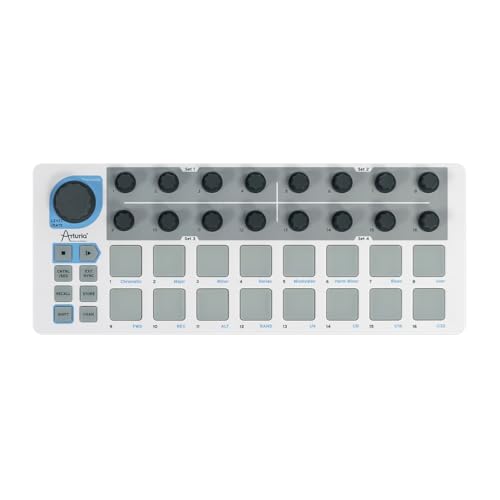
- 16 velocity- and pressure-sensitive pads with 16 encoders
- Controller and step-sequencer modes can run together
- MIDI, USB, and CV connectivity for varied setups
Best For: Electronic musicians building patterns with software or hardware
Best for Creative Workflows
Novation Launchkey Mini 37 MK4

- 37 mini keys provide extra melodic range
- 16 pads offer polyphonic aftertouch and clip-launching functions
- Scale, chord, arp, and broad DAW integration support fast production
Best For: Songwriters and producers wanting expressive, DAW-friendly control
Best for Simplicity

- Lightweight, USB-powered design for mobile setups
- 25-key slim keybed with two touch strips and four buttons
- Includes 500 presets and Ableton Live Lite
Best For: Beginners and mobile musicians seeking simple control
Best Pad Controller

- Eight RGB-backlit MPC-style pads
- Eight assignable Q-Link knobs
- Four programmable presets
Best For: Beat makers and mobile producers who want compact pad-and-knob control
Best Compact Keyboard

- 37-key slim keyboard for two-handed play
- Integrated pads, faders, and mini display
- Arpeggiator and Chord mode included
Best For: Producers seeking a compact keyboard with expanded creative controls
Best Low-Profile Option
Korg nanoKEY2 25-Key MIDI Controller

- Slim 25-key USB-MIDI keyboard
- Velocity-sensitive keys with spaced layout
- Dedicated sustain button
Best For: Laptop users who need simple, portable note entry
Best Overall

- 25 velocity-sensitive mini keys with arpeggiator
- Eight MPC pads and eight assignable knobs
- Includes production software and sound content
Best For: Hands-on beat making and home-studio production
Best for Beginners

- 25 velocity-sensitive mini keys in a portable design
- Includes arpeggiator, programmable banks, and light-up controls
- Adds 40 keyboard-teaching courses and production software
Best For: First-time producers and keyboard learners
Best Minimalist Option

- 25 responsive velocity-sensitive mini keys
- Built-in arpeggiator, sustain, and octave controls
- Eight programmable presets with broad DAW compatibility
Best For: Portable songwriting and straightforward DAW control
Best All-Arounder – Akai MPK Mini IV
The Akai MPK Mini IV is a versatile choice for producers who want compact MIDI controllers with keys, pads, knobs, and a display in one portable unit. Its 25 velocity-sensitive mini keys, MPC pads, arpeggiator, and DAW integration support beat-making, songwriting, and mobile setups.
Best For: Producers and beat makers who want broad hands-on control in a compact keyboard controller.
Pros:
- Combines 25 velocity-sensitive keys, eight MPC pads, eight assignable knobs, and a color screen.
- Includes chord, scale, and arpeggiator tools for developing ideas quickly.
- Offers USB-C, full-size MIDI Out, pre-mapped DAW controls, and substantial included software.
Cons:
- Mini keys may be less suitable for players who prefer a full-size piano-style keybed.
- Its many controls may be more than beginners need for a simple setup.
The MPK Mini IV is the most feature-packed option here, especially for users who want both keyboard performance and pad-based beat production without sacrificing portability.
Best Sequencer – Arturia BeatStep
The Arturia BeatStep is a strong pick among compact MIDI controllers for users who prioritize sequencing and tactile control over a traditional keyboard. Its 16 velocity- and pressure-sensitive pads, 16 encoders, pattern memories, and MIDI, USB, and CV connections make it useful with software and hardware instruments.
Best For: Electronic musicians who want a compact pad controller and step sequencer for studio or live use.
Pros:
- Runs controller and sequencer modes simultaneously.
- Provides 16 pads, 16 encoders, 16 pattern memories, and real-time sequence controls.
- Supports MIDI, USB, and CV connectivity for software, MIDI hardware, and analog gear.
Cons:
- Does not provide a conventional piano-style keyboard.
- Its sequencing-focused workflow may take time to learn.
Choose the BeatStep when pattern creation, clip triggering, and hardware connectivity matter more than playing melodic parts from keys.
Best for Creative Workflows – Novation Launchkey Mini 37 MK4
The Novation Launchkey Mini 37 MK4 gives compact MIDI controllers a little more melodic range with 37 mini synth-action keys. It also adds 16 pads with polyphonic aftertouch, DAW integration, scale and chord modes, an arpeggiator, and step-sequencing features for a broad songwriting workflow.
Best For: Songwriters and Ableton-focused producers who want more keys and expressive pad control in a compact format.
Pros:
- Offers 37 mini keys for a wider playing range than many compact controllers.
- 16 FSR pads support drumming, clip launching, step sequencing, and polyphonic aftertouch.
- Works with major DAWs and includes scale, chord, arpeggiator, and NKS-ready features.
Cons:
- The 37-key layout is larger than the 25-key alternatives in this group.
- Its extensive creative features may be unnecessary for users seeking basic note entry.
The Launchkey Mini 37 MK4 is a well-rounded choice for producers who want compact dimensions but do not want to give up extra keyboard range or expressive pad performance.
Best for Simplicity – Arturia MicroLab Mk3
The Arturia MicroLab Mk3 is a straightforward option for anyone comparing compact MIDI controllers for travel or a small studio. Its 25-key slim keybed, four buttons, two touch strips, USB-C connection, and lightweight design keep the interface focused while included sounds and Ableton Live Lite help you start creating quickly.
Best For: Beginners and mobile musicians who want a simple, lightweight keyboard controller.
Pros:
- Compact, USB-powered design suits mobile music-making and small workspaces.
- Upgraded slim keybed is designed for a responsive playing experience.
- Includes 500 Analog Lab Intro presets and Ableton Live Lite.
Cons:
- Provides fewer physical controls than the other controllers in this roundup.
- Its 25-key layout offers limited range for two-handed parts.
The MicroLab Mk3 is best when portability and ease of use are the priorities. It delivers essential keys and touch control without the more complex pad-and-knob layouts found on larger-featured models.
Best Pad Controller – Akai Professional LPD8
The Akai Professional LPD8 is a practical choice for anyone seeking compact midi controllers focused on beat-making and hands-on software control. Its eight RGB-backlit pads and eight assignable knobs provide tactile access to samples, instruments, effects, and DAW parameters without taking much space in a mobile rig.
Best For: Producers, beat makers, DJs, and musicians who prioritize pads and assignable controls over a traditional keyboard.
Pros:
- Eight responsive RGB-backlit MPC-style pads support sample, loop, and instrument triggering.
- Eight assignable Q-Link knobs provide hands-on control of DAW and plug-in parameters.
- Four programmable presets allow quick recall of custom mappings.
- USB-powered plug-and-play operation works with Mac and PC without an AC adapter.
Cons:
- It does not provide a traditional piano-style keybed.
- Its controls are geared toward pads and knobs rather than expanded keyboard performance.
The LPD8 is especially compelling when portability and beat-oriented control matter most. It is a compact, flexible companion for a laptop-based setup, though keyboard-focused players may want a different controller.
Best Compact Keyboard – Arturia MiniLab 37
The Arturia MiniLab 37 is one of the more versatile compact midi controllers for players who need a keyboard while keeping a desktop setup manageable. Its 37-key slim keybed supports two-handed playing, while integrated pads, faders, a display, arpeggiator, and Chord mode expand its performance and production features.
Best For: Beginners and experienced producers who want a compact keyboard controller with broader performance controls.
Pros:
- Thirty-seven slim keys provide more room for two-handed play than smaller controllers.
- DAW-integrated pads and faders add hands-on production control.
- Built-in arpeggiator, Chord mode, transposition, and custom mappings support creative workflows.
- Lightweight, shallow design suits space-conscious studios and mobile rigs.
Cons:
- Its 37-key format takes more space than ultra-compact controllers.
- The supplied details identify USB connectivity but do not mention standalone operation.
The MiniLab 37 is a strong middle ground for users who have outgrown very small keybeds but still need a compact footprint. It offers substantially more keyboard range and workflow control without moving into a full-size controller format.
Best Low-Profile Option – Korg nanoKEY2 25-Key MIDI Controller
The Korg nanoKEY2 is a straightforward option among compact midi controllers for laptop users who want a slim 25-key USB-MIDI keyboard. Its low-profile design, spaced keys, velocity sensitivity, and sustain button make it suited to entering melodies, chords, and piano parts in a small workspace.
Best For: Laptop musicians who need a simple, low-profile keyboard for note entry and basic performance.
Pros:
- Twenty-five velocity-sensitive keys support expressive note entry.
- Low-profile body is designed for laptop and netbook use.
- Key spacing and width are intended to reduce wrong notes.
- A sustain button is useful for entering piano parts.
Cons:
- It offers a more basic control set than pad-and-knob-oriented controllers.
- The supplied notes describe USB-MIDI connectivity but do not list bundled components.
The nanoKEY2 makes sense when simplicity, portability, and a familiar 25-key layout are more important than extensive DAW controls. It is a practical note-entry companion for a laptop-based music setup.
Best Overall – Akai MPK Mini MK3
The Akai Professional MPK Mini MK3 is a versatile choice among compact midi controllers, combining 25 velocity-sensitive mini keys with MPC-style pads, assignable knobs, and a pitch/modulation thumbstick. It is especially well equipped for beat making, virtual instruments, and home-studio production.
Best For: Producers who want broad hands-on control in a compact controller.
Pros:
- Includes eight velocity-sensitive MPC-style pads with Note Repeat and Full Level.
- Provides eight assignable 360-degree knobs plus a four-way pitch and modulation thumbstick.
- Features a built-in arpeggiator and includes MPC Beats, virtual instruments, and 2GB of sound content.
- Supports NKS integration and includes a choice of Komplete 15 Select bundle.
Cons:
- Its mini keys may be less comfortable for players who prefer a full-size keyboard.
- USB connectivity requires a compatible computer or USB device.
- The larger feature set may be more than beginners need for simple melody input.
With its combination of keys, pads, knobs, software, and performance controls, the MPK Mini MK3 offers the most complete production setup of these options. Choose it when beat programming and plugin control matter as much as portability.
Best for Beginners – Donner N-25
The Donner N-25 is a straightforward option for beginners shopping for compact midi controllers. Its 25 velocity-sensitive mini keys, programmable banks, light-up controls, and included keyboard lessons provide essential tools for learning and basic music production.
Best For: New players who want an approachable controller with learning resources.
Pros:
- Compact 25-key design uses velocity-sensitive mini keys for expressive playing.
- Includes an arpeggiator, sustain, octave controls, tap tempo, and four programmable banks.
- Comes with 40 keyboard-teaching courses and music production software.
- Works with Mac, Windows, iOS, Android, smartphones, tablets, and multiple DAWs.
Cons:
- Offers fewer dedicated performance controls than the Akai MPK Mini MK3.
- Mobile-device connections may require an OTG adapter.
- The listed warranty is 90 days.
The N-25 keeps the layout simple while adding useful beginner support. It is a practical entry point for learning keyboard-based production, particularly if portability and included lessons are higher priorities than extensive pad and knob control.
Best Minimalist Option – Akai LPK25
The Akai Professional LPK25 is a slim, focused choice among compact midi controllers. With 25 responsive mini keys, octave controls, sustain, an arpeggiator, and programmable presets, it delivers core keyboard control without taking much space beside a laptop or studio setup.
Best For: Songwriters and producers who primarily need portable keyboard input.
Pros:
- Responsive velocity-sensitive keys support expressive melodies, bass lines, and songwriting.
- Includes octave up/down buttons, sustain, and a built-in arpeggiator.
- Eight programmable preset slots allow quick recall of custom mappings.
- Offers plug-and-play USB operation and compatibility with popular DAWs.
Cons:
- It does not include the dedicated pads and multiple knobs found on the MPK Mini MK3.
- The controller relies on a USB connection for power and data.
- Its compact key range may require frequent octave changes for larger parts.
The LPK25 is the cleanest choice when keyboard performance is the priority. Its compact footprint and practical control set suit mobile writing, quick DAW input, and setups where extra pads or knobs are unnecessary.
How We Picked These Compact Midi Controllers
We selected these Compact Midi Controllers based on portability, control layout, playing response, connectivity, workflow flexibility, and suitability for different experience levels. The lineup includes 25- and 37-key keyboards, pad-based controllers, and compact sequencer-focused hardware, so you can compare tools designed for melodies, chords, drums, clip launching, and pattern creation.
We also considered practical details such as USB connectivity, velocity sensitivity, software compatibility, onboard controls, and whether each model is better suited to a desktop, travel rig, or live setup. Since MIDI controllers do not generate sound on their own, compatibility with your DAW and virtual instruments remains an important part of the buying decision.
Quick Comparison
| Best For | Recommended Options | What to Look For |
|---|---|---|
| General-purpose mini keyboard | Akai MPK Mini IV, MPK Mini MK3 | Portable keys, pads, knobs, and versatile DAW control |
| More room for melodies and chords | Novation Launchkey Mini 37 MK4, Arturia MiniLab 37 | 37 keys and expanded performance space |
| Beat production | Akai LPD8 | Responsive pads and compact drum-focused control |
| Sequencing and hardware control | Arturia BeatStep | Step sequencing, pads, and hands-on pattern manipulation |
| Maximum portability | Arturia MicroLab Mk3, Korg nanoKEY2, Akai LPK25 | Minimal footprint and easy laptop-bag storage |
| Beginner value | Donner N-25 | Simple layout, velocity-sensitive keys, and accessible operation |
Key Buying Factors for Compact Midi Controllers
Key Count and Playing Style
Twenty-five keys are convenient for bass lines, leads, and basic chord work, but a 37-key controller gives you more range and reduces the need to change octaves. If you mainly program drums or samples, a pad controller may be more useful than a keyboard.
Controls Beyond the Keys
Knobs, pads, buttons, touch strips, and pitch or modulation controls can make a major difference when mixing, shaping virtual instruments, or launching clips. Choose a simpler controller for straightforward note entry, or prioritize hands-on controls if you perform and automate frequently.
Portability and Connectivity
Check the controller’s dimensions, weight, USB connection, and power requirements. USB bus power is convenient for mobile setups, while MIDI or other connection options may matter if you plan to control external hardware. Confirm that the included software and mapping tools support your preferred DAW.
Key Feel and Sensitivity
Velocity-sensitive keys offer more expressive dynamics than basic non-sensitive designs. Mini keys save space but can feel different from full-size keyboards, so consider whether portability or familiar playing comfort is your priority.
Who Should Buy Which Compact Midi Controllers?
Choose the Akai MPK Mini IV or MPK Mini MK3 if you want an all-purpose controller with keys, pads, and knobs in a compact format. Choose the Launchkey Mini 37 MK4 or Arturia MiniLab 37 if extra key range is more important than the smallest footprint.
Choose the Arturia BeatStep for pattern-based production and hardware sequencing, or the Akai LPD8 for a focused drum-pad workflow. The MicroLab Mk3, Korg nanoKEY2, and Akai LPK25 suit travelers and producers who need basic keyboard input with minimal desk space. For a straightforward first controller, the Donner N-25 offers an approachable starting point.