The best compact speaker selector switches make it easier to route one amplifier or receiver to multiple speaker pairs without constantly reconnecting cables. They are useful for home theaters, distributed audio systems, and simple A/B listening setups.
This roundup compares 10 options by zone count, switching flexibility, power ratings, installation style, and ease of use so you can choose a practical match for your system.
Best 10 Compact Speaker Selector Switches Picks for 2026
Six-Zone Push-Button Pick

- Controls up to six speaker pairs
- Push-button plug-and-play operation
- Compact 5.9-by-9.05-by-1.85-inch design
Best For: Multi-pair stereo distribution
Flexible A/B Routing Choice
PROZOR Amp and Speaker Switcher

- Works as 2-in/1-out or 1-in/2-out
- Passive design needs no external power
- Handles up to 12-gauge banana-plug wiring
Best For: Amp or speaker A/B comparisons
Four-Pair Push-Button Value

- Switches up to four speaker pairs
- Accepts speaker wire up to 14 gauge
- Rated 100 watts per channel at 8 ohms minimum
Best For: Simple four-pair stereo selection
Compact Audiophile A/B Switch
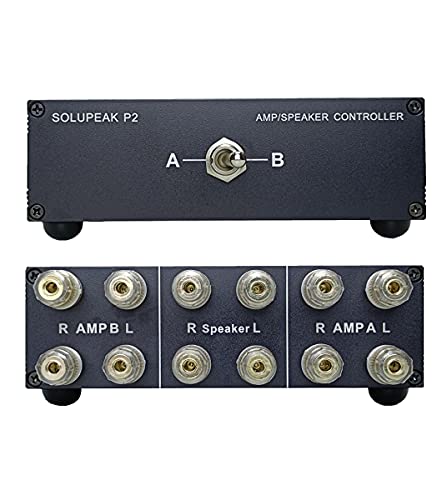
- Supports two amps to one pair or one amp to two pairs
- Passive one-press A/B switching
- Gold-plated jacks accept up to 12-gauge wire
Best For: Quick amp and speaker comparisons
Best Value 4-Zone Pick
Monoprice 4-Channel Speaker Selector

- Distributes audio to four zones
- Optional impedance protection circuit
- Up to 140W per channel without protection
Best For: Four-zone home theater and multi-room audio
Best for Large Multi-Room Systems
Pyle 8-Channel Speaker Selector
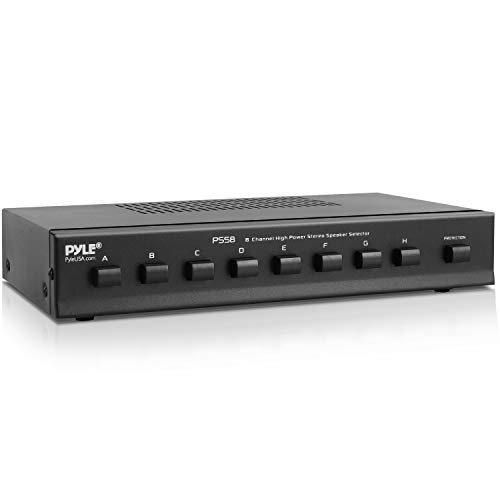
- Supports up to eight speaker pairs
- Independent selection and protection buttons
- Rated for amplifiers up to 100W per channel
Best For: Large multi-room audio installations
Best Compact A/B Option
TENEALAY P21 2-Way Speaker Selector

- Switches two pairs of speakers
- Slim metal tabletop housing
- Supports 8–16-ohm speakers and 80W per channel
Best For: Small stereo and home theater A/B setups
Best Budget 2-Zone Pick
ADWITS 2-Channel Speaker Switcher

- Controls two speaker pairs from one amplifier
- Select either pair or both simultaneously
- Metal housing with 150W RMS per-channel rating
Best For: Simple, budget-friendly two-zone audio setups
Best In-Wall Installation
Pyle PVCS2 A/B Speaker Selector

- Fits standard electrical and gang boxes
- Push-button A, B, or A+B selection
- Includes a Decora-style wall plate
Best For: Clean, permanent two-pair home audio installations
Best for Multi-Room Expansion
PROZOR 4-Zone Speaker Selector

- Connects one amplifier to four speaker pairs
- Independent A/B/C/D zone buttons
- Passive design supports 4–16Ω speakers
Best For: Larger multi-room and distributed-audio systems
Six-Zone Push-Button Pick – Pyle PSS6 6-Channel Selector
For straightforward compact speaker selector switches, the Pyle PSS6 provides push-button control for up to six separate speaker pairs. Its 100-watt power source rating and compact 5.9-by-9.05-by-1.85-inch footprint make it a practical distribution option for compatible stereo setups.
Best For: Users who need to route one stereo system to multiple speaker pairs with simple front-panel operation.
Pros:
- Supports up to six separate speaker pairs.
- Push-button operation and plug-and-play setup.
- Compact black enclosure measuring 5.9 by 9.05 by 1.85 inches.
Cons:
- The notes do not specify impedance requirements or per-channel power handling.
- Its RCA cable/connector specification may require checking compatibility with your speaker wiring.
The PSS6 is a sensible choice when the priority is simple multi-pair speaker distribution in a compact housing. Confirm your amplifier, wiring, and power requirements before installation.
Flexible A/B Routing Choice – PROZOR Amp and Speaker Switcher
Among compact speaker selector switches, the PROZOR stands out for reversible A/B routing: use two amplifiers with one speaker pair, or one amplifier with two speaker pairs. Its passive design needs no external power and uses gold-plated banana plug connections.
Best For: Listeners comparing two amplifiers or switching one amplifier between two speaker pairs without swapping cables.
Pros:
- Supports both 2-in/1-out and 1-in/2-out configurations.
- Passive, plug-and-play operation requires no external power.
- Gold-plated banana plug ports accept up to 12-gauge wire.
- Rated for 100 watts RMS per channel and 200 watts peak.
Cons:
- Only one input or output position can be selected at a time; simultaneous playback is not supported.
- It requires speaker wires with banana plugs.
The PROZOR is well suited to quick A/B comparisons and flexible system routing. Its single-selection design is useful for safe switching, but it should not be treated as a simultaneous distribution box.
Four-Pair Push-Button Value – Pyle PSS4 A/B/C/D Selector
The Pyle PSS4 is a compact speaker selector switch for routing a stereo system to up to four separate speaker pairs. It accepts speaker wires up to 14 gauge and is specified to handle 100 watts per channel with speaker systems rated at a minimum 8-ohm impedance.
Best For: Home stereo users who want simple A/B/C/D speaker-pair selection with clearly stated wiring and impedance guidance.
Pros:
- Supports up to four separate speaker pairs.
- Push-button operation and plug-and-play setup.
- Accepts speaker wires up to 14 gauge.
- Handles 100 watts per channel with minimum 8-ohm speaker systems.
Cons:
- It is specified for speaker systems with a minimum impedance of 8 ohms.
- Its 4.72-by-7.48-by-1.97-inch enclosure is compact but larger than some two-way switchers.
The PSS4 offers a practical balance of straightforward controls and four-pair capacity. It is a better fit for compatible 8-ohm systems than for installations requiring lower-impedance speaker loads.
Compact Audiophile A/B Switch – SOLUPEAK P2 Passive Selector
The SOLUPEAK P2 is a compact passive switcher for comparing two amplifiers with one speaker pair or one amplifier with two speaker pairs. It uses one-press A/B switching, gold-plated banana jacks, and a 100-watt RMS per-channel rating without requiring external power.
Best For: Audiophiles who want quick amplifier or speaker comparisons in a small, passive enclosure.
Pros:
- Supports 2-in/1-out or 1-in/2-out configurations.
- One-press A/B switching avoids frequent cable changes.
- Gold-plated banana jacks accept up to 12-gauge speaker wire.
- Rated for 100 watts RMS and 200 watts peak per channel.
Cons:
- The two speaker outputs cannot operate simultaneously.
- Banana plugs are required; RCA cables are not suitable.
- Tube amplifiers require standby or power-off precautions before switching.
With its small 3.94-by-5.91-by-1.81-inch body and passive signal path, the P2 is tailored to controlled A/B listening rather than multi-room distribution. Follow the stated tube-amplifier precautions when applicable.
Best Value 4-Zone Pick – Monoprice 4-Channel Speaker Selector
For shoppers comparing compact speaker selector switches, the Monoprice 4-Channel Speaker Selector is a straightforward way to distribute audio from one amplifier or receiver to as many as four speaker zones. Its optional impedance protection circuit helps maintain a constant impedance for the amplifier when multiple speakers are active.
Best For: Home theater and multi-room audio setups needing four independently selectable speaker zones.
Pros:
- Supports up to four speaker zones.
- Handles up to 70 watts per channel with protection enabled, or up to 140 watts without it.
- Rugged design offered at a fair price.
Cons:
- Protection-enabled power handling is lower than the maximum rating.
- Designed for four zones, so it offers less expansion than larger selectors.
This is a practical, compact choice when four-zone distribution is enough and amplifier protection is a priority. Confirm your amplifier’s power and speaker requirements before installation.
Best for Large Multi-Room Systems – Pyle 8-Channel Speaker Selector
Among compact speaker selector switches, the Pyle PSS8 stands out for supporting up to eight pairs of speakers from one source amplifier. Clearly labeled controls and individual protection buttons make it easier to manage multiple zones without repeatedly changing connections.
Best For: Multi-room audio systems that need independent control of up to eight speaker pairs.
Pros:
- Controls up to eight speaker pairs.
- Individual selection and protection buttons simplify operation.
- Compatible with stereo receivers or amplifiers up to 100 watts per channel.
Cons:
- Larger systems may require more wiring and careful setup.
- It is intended for eight speaker systems, which may be more capacity than smaller installations need.
The PSS8 is a strong fit when zone capacity matters most. Its eight-channel layout provides substantial flexibility, while the built-in protection controls add a useful safeguard for connected equipment.
Best Compact A/B Option – TENEALAY P21 2-Way Speaker Selector
If you need one of the more compact speaker selector switches for a simple setup, the TENEALAY P21 controls two pairs of speakers connected to a stereo amplifier. Its slim tabletop metal housing requires no extra power supply and accepts speaker wire up to 14 AWG.
Best For: Small home theater or stereo systems switching between two speaker pairs.
Pros:
- Controls two pairs of speakers separately or together.
- Compact slim tabletop design with a metal housing.
- Supports 8–16-ohm speakers and up to 80 watts per channel.
Cons:
- Limited to two speaker pairs.
- Its stated maximum power is lower than some larger selectors.
- No extra power supply is included or required, so operation is limited to passive switching.
The P21 makes sense for listeners who want uncomplicated A/B speaker control without a bulky multi-zone distribution unit. Check speaker impedance and amplifier output before connecting both pairs.
Best Budget 2-Zone Pick – ADWITS 2-Channel Speaker Switcher
A ADWITS 2-Channel Speaker Switcher Selector Box with Terminal Claps 150W RMS per Channel, Black
Check Price On AmazonFor shoppers comparing compact speaker selector switches, the ADWITS 2-Channel Speaker Switcher offers straightforward control of two speaker pairs from one amplifier. Its two rocker switches let you select either pair or both, while the metal housing is suited to residential or commercial distributed-audio setups.
Best For: Budget-conscious users who need simple two-zone speaker switching.
Pros:
- Controls two pairs of speakers from one amplifier.
- Supports either pair separately or both simultaneously.
- Metal housing and two separate rocker switches.
- Rated at 150W RMS per channel and includes a 12-month warranty.
Cons:
- Provides two-zone control rather than four independent zones.
- Uses manual rocker switches instead of push-button or remote control.
The ADWITS is a practical low-cost option when you want uncomplicated two-pair speaker management without adding complexity to a distributed-audio system.
Best In-Wall Installation – Pyle PVCS2 A/B Speaker Selector
Among compact speaker selector switches, the Pyle PVCS2 stands out for users who want a clean wall-mounted installation. It fits standard electrical or gang boxes, uses a Decora-style wall plate, and provides push-button control for two indoor or outdoor speaker pairs.
Best For: Home audio installations that prioritize an unobtrusive in-wall control point.
Pros:
- Fits standard electrical or gang boxes.
- Push buttons select A, B, or both speaker sets.
- Includes a standard-size Decora-style wall plate.
- Handles up to a stated 120-watt power load.
Cons:
- Limited to two speaker pairs.
- Requires in-wall installation rather than simple tabletop placement.
The PVCS2 is a sensible choice when appearance and permanent installation matter more than expandable zone capacity, giving a light-switch-like way to manage two speaker sets.
Best for Multi-Room Expansion – PROZOR 4-Zone Speaker Selector
If you need compact speaker selector switches with more room for expansion, the PROZOR 4-Zone Speaker Selector connects one amplifier or receiver to up to four pairs of passive speakers. Independent A/B/C/D buttons, a master AMP switch, and passive operation make it suitable for multi-room audio without an external power adapter.
Best For: Whole-home, patio, shop, or studio systems requiring up to four independently selectable speaker zones.
Pros:
- Supports up to four pairs of passive speakers.
- Independent A/B/C/D buttons allow flexible zone control.
- Includes a master AMP switch for overall control.
- Supports 4–16Ω speakers and up to 150W RMS per channel.
Cons:
- Designed for passive speakers and does not provide volume control.
- Requires careful power-off wiring and setup.
- More capacity than needed for a basic two-zone system.
The PROZOR offers the strongest expansion potential in this group. Its passive design, long-distance wiring support, and four-zone layout make it a practical option for larger distributed-audio installations.
How We Picked These Compact Speaker Selector Switches
We focused on selector boxes designed for passive speaker systems, prioritizing useful channel layouts, clearly labeled controls, stated power capacity, and compatibility with typical home stereo or theater receivers. The list includes two-way A/B units, multi-channel selectors, and models with independent zone buttons.
Because specifications and installation requirements vary, treat published wattage as a guideline rather than a guarantee. Your amplifier’s impedance limits, speaker wiring, and whether multiple zones play simultaneously all affect safe operation.
Quick Comparison
- Two-way selectors: Best for switching between two speaker pairs or two amplifier/speaker paths.
- Four-zone models: A strong fit for homes needing independent control of several speaker pairs.
- Six- to eight-channel units: Better for larger distributed-audio installations with many connected pairs.
- In-wall selectors: Useful when you want controls integrated into a room rather than placed on a shelf.
- Higher-rated models: Consider these when your speakers or amplifier operate at greater output levels, while still confirming impedance compatibility.
Key Buying Factors for Compact Speaker Selector Switches
Zone and Channel Count
Choose a selector with enough outputs for every speaker pair you plan to connect. Extra capacity can help with future expansion, but unused channels may add cost and cable clutter.
Power and Impedance Handling
Check the selector’s rated wattage per channel and compare it with your amplifier and speakers. More importantly, verify whether the unit maintains a safe impedance load when multiple pairs are active. Some selectors include impedance protection, while simpler passive switchers may not.
Independent Controls
Individual A/B/C/D buttons let you activate zones separately. This is more convenient than a basic shared switch when different rooms need to play independently.
Connections and Installation
Look for terminals that accept your preferred speaker wire and a layout that leaves enough room for cable routing. Desktop boxes are easiest to access, while in-wall models provide a cleaner permanent installation but require compatible wall boxes and careful wiring.
System Compatibility
These products are generally passive and do not replace an amplifier or multi-zone receiver. Confirm whether your setup uses one amplifier feeding several speaker pairs, multiple amplifier inputs, or a source-and-zone arrangement before buying.
Who Should Buy Which Compact Speaker Selector Switches?
Choose a two-way switcher if you only need to alternate between two pairs of speakers or compare two listening zones. A four-channel model is a practical middle ground for homes with several rooms. Six- and eight-channel selectors make more sense for larger whole-home systems, provided the amplifier can safely support the connected load.
For a tidy finished installation, an in-wall selector is the better choice. For flexible placement and easier troubleshooting, use a desktop unit with accessible terminals and clearly marked buttons. If several rooms will operate at once, prioritize independent zone controls and impedance protection over the smallest possible enclosure.