Choosing the right DI box can make an acoustic-electric guitar sound clearer, louder, and far more consistent on stage or in the studio.
This roundup covers 10 options for players who want better tone shaping, cleaner signal transfer, and fewer problems with hum, feedback, and weak output.
Best 10 Di Boxes for Acoustic Electric Guitars Picks for 2026
Premium Acoustic Preamp DI

- Adjustable gain for passive and active pickups
- 5-band EQ with tunable notch and midrange
- XLR and 1/4" outputs with phase inversion
Best For: Players who want detailed tone control and feedback management
Rugged Passive DI
Radial Pro DI Passive Direct Box

- Passive mono DI with custom transformer
- Rugged I-beam construction
- Converts unbalanced signals to balanced mic level
Best For: Simple, durable direct injection on stage or in the studio
Feature-Packed Acoustic Preamp DI
L.R. Baggs Venue DI Acoustic Guitar Preamp and DI
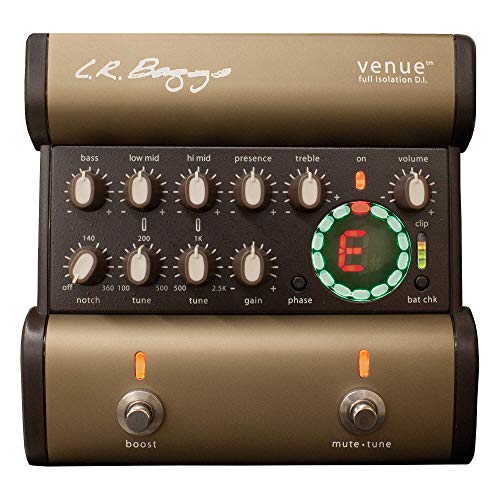
- 5-band EQ with tunable low-mid and high-mid bands
- Built-in chromatic tuner with mute/tune footswitch
- Adjustable volume boost for live use
Best For: Players who want an all-in-one acoustic preamp and DI
Budget Passive Direct Box
Whirlwind IMP 2 1-Channel Passive Instrument Direct Box
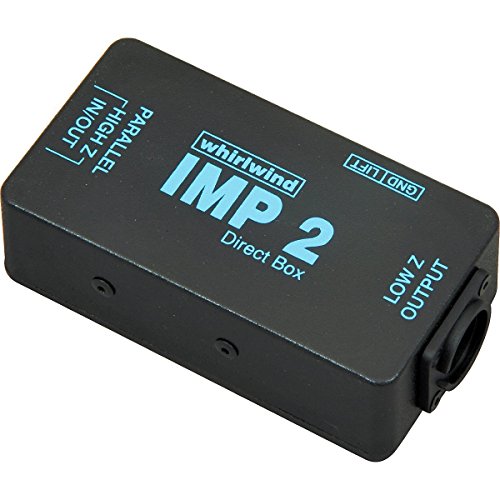
- Economical direct box with compact footprint
- Converts unbalanced signals to balanced mic level
- Uses Whirlwind's TRHL transformer
Best For: Basic, affordable signal conversion for acoustic-electric rigs
Compact Preamp DI for Acoustic/Electric
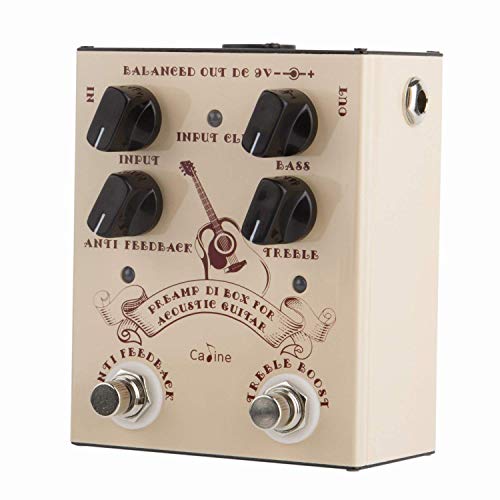
- True-bypass preamp DI with anti-feedback foot switch
- Higher boost function for extra output
- Compact, corded 9V pedal-style format
Best For: Acoustic-electric players who want a compact powered DI with feedback control
Audiophile Parametric DI Box

- Class A FET input with very low noise
- 5-band EQ plus notch, mid, and phase controls
- Includes 2 instrument cables
Best For: Guitarists who want extensive EQ control and included cables
Passive Road-Ready DI Box

- Passive DI with no external power required
- Converts unbalanced 1/4-inch TS to balanced XLR
- Metal housing built for live-performance use
Best For: Players who want a simple passive DI for direct mixer or PA connection
Acoustic-Electric Preamp DI
AMUMU GLORIFIER Acoustic Guitar Preamp DI Direct Input Box
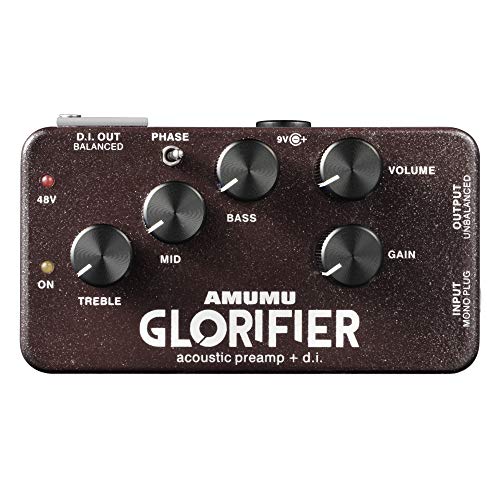
- +/-20 dB gain and 3-band EQ
- Phase switch helps cut feedback
- Works with battery, DC adapter, or phantom power
Best For: Players who want an active acoustic DI with onboard EQ and flexible power.
Passive Hum Eliminator DI
Donner Special-Ⅰ Passive DI Box for Stage and Studio

- Passive transformer design for signal matching
- Ground lift switch reduces hum and buzz
- Thru output supports amp plus PA routing
Best For: Guitarists who want a simple passive DI with hum reduction and clean signal matching.
Universal Stage/Studio DI
PRORECK DC21 Passive DI Box for Guitar & Bass

- Impedance transformer for precise matching
- Ground lift and isolation help kill hum
- Thru/direct outputs suit live and studio use
Best For: Players who need a versatile passive DI for guitars, bass, keyboards, and routing.
Premium Acoustic Preamp DI – LR Baggs Para Acoustic D.I.
If you want a flexible DI box for acoustic electric guitars, the LR Baggs Para Acoustic D.I. is built for players who need control over gain, EQ, and feedback on stage or in the studio. Its 5-band EQ, tunable notch, phase inversion, and dual outputs make it a strong all-in-one front end for acoustic pickups.
Best For: Acoustic players who need detailed tone shaping and reliable feedback control
Pros:
- Adjustable gain works with both passive and active pickups
- 5-band EQ includes tunable notch and midrange bands
- Phase inversion helps with sound shaping and feedback control
- XLR and 1/4" outputs add flexible connectivity
Cons:
- More control than a basic direct box, so it may be more than some players need
- Requires 9V battery or 48V phantom power
Overall, this is a feature-rich choice for players who want more than a simple signal match. If your priority is dialing in acoustic-electric tone and managing feedback, it offers a practical and well-equipped solution.
Rugged Passive DI – Radial Pro DI Passive Direct Box
For a straightforward DI box for acoustic electric guitars, the Radial Pro DI focuses on passive reliability and tough construction. Its custom transformer and rugged I-beam build make it a practical pick for live or studio use when you want a simple balanced signal path.
Best For: Players and techs who want a durable passive DI for stage or studio use
Pros:
- Passive mono direct box with custom transformer
- Rugged I-beam construction for durability
- Works with acoustic guitars, bass, keyboards, and other instruments
- Converts unbalanced instrument or line signals to balanced mic level
Cons:
- No built-in EQ or tone-shaping controls
- Designed as a basic passive DI rather than an all-in-one preamp
This is the kind of DI that appeals to players who value simplicity and durability over extra features. If you just need a dependable way to feed an acoustic-electric guitar into a mixer or snake, it covers the essentials well.
Feature-Packed Acoustic Preamp DI – L.R. Baggs Venue DI Acoustic Guitar Preamp and DI
The L.R. Baggs Venue DI is a strong option if you want a DI box for acoustic electric guitars with more onboard control. It combines adjustable gain, a 5-band EQ, a tunable notch filter, a chromatic tuner, and a footswitchable volume boost in a compact format.
Best For: Players who want a compact preamp DI with tuning and boost functions
Pros:
- Adjustable gain supports both passive and active pickups
- 5-band EQ includes tunable low-mid and high-mid bands
- Built-in chromatic tuner with footswitch mute/tune function
- Volume boost footswitch adds performance flexibility
Cons:
- Battery-powered design may not suit everyone
- Larger than a simple passive DI
This model makes sense for acoustic players who want practical performance tools in one box. If your setup benefits from tuning, EQ shaping, and feedback control without adding extra pedals, it is an efficient stage-friendly choice.
Budget Passive Direct Box – Whirlwind IMP 2 1-Channel Passive Instrument Direct Box
If you need a no-frills DI box for acoustic electric guitars, the Whirlwind IMP 2 keeps the job simple and affordable. It uses an inline transformer to convert an unbalanced instrument or line signal into a balanced mic-level signal, making it a practical pick for basic live or studio routing.
Best For: Budget-minded players who want a simple, durable passive DI
Pros:
- Economical direct box with a compact footprint
- Converts unbalanced instrument or line signals to balanced mic level
- Uses Whirlwind’s TRHL transformer
- Stainless steel construction supports durability
Cons:
- No onboard EQ or advanced tone controls
- Best suited to basic signal conversion rather than feature-heavy setups
This is a straightforward utility DI for players who want dependable conversion without extras. For acoustic-electric guitar setups where simplicity and price matter most, it delivers the core function clearly.
Compact Preamp DI for Acoustic/Electric – Caline CP-40
If you’re comparing DI boxes for acoustic electric guitars, the Caline CP-40 is a compact preamp DI built around simple controls and a true-bypass layout. It adds a higher boost option, includes an anti-feedback foot switch, and runs from 9V power, making it a practical stage-friendly choice for players who want a straightforward signal boost and direct output.
Best For: Acoustic-electric players who want a small, powered DI box with feedback control and a simple knob-based layout.
Pros:
- True-bypass design with an anti-feedback foot switch
- Higher boost function for extra output
- Compact footprint and light weight
- Simple 1/4-inch audio jack connection
Cons:
- Requires 9V corded power
- Single-unit design with no extra accessories listed
Overall, the CP-40 is a no-frills option for players who value convenience, footswitch control, and a compact pedal-style format. It fits best when you want an acoustic DI that is easy to place on a board and keep the setup simple.
Audiophile Parametric DI Box – LR Baggs Para DI
For players shopping DI boxes for acoustic electric guitars, the LR Baggs Para DI stands out with a class A FET input and a full control set aimed at shaping plugged-in acoustic tone. Its 5-band EQ, tunable notch filter, sweepable mid EQ, and phase inversion switch make it a strong choice when you need detailed control and low-noise performance.
Best For: Guitarists who want a feature-rich direct box with extensive EQ control and included instrument cables.
Pros:
- Discrete pure class A FET input for low-noise, audiophile-quality sound
- 5-band EQ with treble, presence, bass, notch filter, and sweepable mids
- Phase inversion switch for added control
- Includes 2 instrument cables
Cons:
- Larger and heavier than compact pedal-style options
- More controls may be more than some players need
As a direct box for acoustic-electric use, the Para DI is built for detailed tone shaping rather than minimal setup. If you want more than a simple DI and prefer strong EQ flexibility, this model is the most adjustable option in this group.
Passive Road-Ready DI Box – Hosa DIB-443 Sidekick
Among DI boxes for acoustic electric guitars, the Hosa DIB-443 Sidekick is the simplest option here: a passive direct box that converts unbalanced 1/4-inch TS signals to balanced XLR output. It does not need external power, and its metal construction is aimed at reducing noise and handling live performance use.
Best For: Players who want a passive, no-power DI box for straightforward guitar-to-PA connections.
Pros:
- Passive design requires no external power
- Converts 1/4-inch TS to balanced XLR3M
- Helps reduce hum and noise on long cable runs
- Metal build is designed for road use
Cons:
- No EQ, boost, or tone-shaping controls
- Less flexible than active preamp DI boxes
This is the most basic pick in the lineup, but that can be an advantage if you only need clean signal conversion and reliable construction. For straightforward stage and mixer hookup, the DIB-443 keeps the process simple.
Acoustic-Electric Preamp DI – AMUMU GLORIFIER Acoustic Guitar Preamp DI Direct Input Box
If you want one of the more feature-rich di boxes for acoustic electric guitars, the AMUMU GLORIFIER is built for players who need onboard tone shaping before the signal hits a mixer, PA, or recording interface. It handles piezo, magnetic, under-saddle, and microphone pickups, and its preamp section gives you gain and EQ control to dial in a cleaner stage or studio sound.
Best For: Players who want an active acoustic DI with onboard EQ, phase control, and flexible power options.
Pros:
- +/-20 dB gain control with a 3-band EQ for shaping acoustic tone
- Phase switch helps reduce feedback and can add warmth and body
- Supports 9V DC, 48V phantom power, or 9V battery operation
- Converts unbalanced 1/4″ input to balanced XLR output, with a separate 1/4″ output
Cons:
- More involved than a simple passive direct box
- Battery or external power is required for operation
The GLORIFIER makes sense if you want practical control over gain, EQ, and feedback right at the instrument. It is a strong choice for acoustic-electric players who need an all-in-one preamp and DI solution.
Passive Hum Eliminator DI – Donner Special-Ⅰ Passive DI Box for Stage and Studio
For straightforward signal routing, this Donner option fits the needs of players comparing di boxes for acoustic electric guitars without wanting onboard preamp controls. It is a passive direct box designed for stage and studio use, with transformer isolation, a ground lift switch, and a thru path for sending the instrument to an amp while feeding a balanced signal to a mixer or PA.
Best For: Guitarists who want a simple passive DI with hum reduction and clean signal matching.
Pros:
- Passive transformer-based design for impedance and signal matching
- Ground lift switch helps eliminate hum and buzz from ground loops
- Thru output lets you send signal to an amp and PA at the same time
- Compact build for stage and studio use
Cons:
- No onboard EQ or gain controls
- Best suited to players who do not need active preamp features
This is a practical pick if your main goal is clean balanced output and fewer noise issues. It keeps the setup simple while still covering the basics for live and recording use.
Universal Stage/Studio DI – PRORECK DC21 Passive DI Box for Guitar & Bass
The PRORECK DC21 is a useful choice if you need one of the more versatile di boxes for acoustic electric guitars, along with other instruments and audio sources. Its passive transformer design focuses on impedance matching, balanced/unbalanced conversion, and ground isolation, making it suitable for live shows, recording setups, and general audio routing.
Best For: Players who need a versatile passive DI for guitars, bass, keyboards, and studio or live routing.
Pros:
- Built-in impedance transformer for precise signal matching
- Ground lift and isolation transformer help eliminate hum and buzz
- Thru/direct output supports both stage amps and balanced mixer feeds
- Compatible with guitars, basses, keyboards, effect processors, and more
Cons:
- No onboard tone shaping or gain control
- Passive design means it is mainly focused on routing and noise control
The DC21 is a strong utility DI if you want one box that can handle several sources beyond acoustic guitar. It keeps the signal path simple while covering the core job of getting a clean balanced feed to your PA or recorder.
How We Picked the Best Di Boxes for Acoustic Electric Guitars
For Di Boxes for Acoustic Electric Guitars, we focused on real-world usefulness: clean signal handling, balanced XLR output, ground-lift and pad features, EQ flexibility, build quality, and whether the unit fits direct-to-mixer, stage, or pedalboard setups. We also favored models that suit both passive and active pickup systems.
Quick Comparison
Passive DI boxes are usually the simplest and most rugged choice when you want dependable conversion and minimal color. Preamp DI models add useful tone control, often making them the better fit for under-saddle pickups, piezo systems, and players who need quick EQ correction before the signal reaches the front of house.
Key Buying Factors for Di Boxes for Acoustic Electric Guitars
EQ and Tone Shaping
Acoustic-electric guitars often benefit from some midrange control, high-end smoothing, or low-end cleanup. If your pickup sounds brittle, nasal, or boomy, a DI with onboard EQ can help more than a plain passive box.
Impedance and Pickup Type
Piezo pickups typically sound best when they see a proper high-impedance input. If your guitar loses body or sounds thin, check that the DI or preamp is a good match for your pickup system.
Noise Control
Look for ground-lift switches, phase controls, and pad options when possible. These features help reduce hum, tame hot signals, and solve common live-sound problems quickly.
Portability Vs. Control
If you want a simple grab-and-go solution, a passive DI is usually enough. If you need more stage control, a preamp DI is often worth the extra size and cost.
Who Should Buy Which Di Boxes for Acoustic Electric Guitars?
Players who want the most straightforward setup should lean toward a passive box. Gigging acoustic players who need shaping and feedback management should consider a preamp DI. If you play larger venues, switch between different pickups, or want more consistency from show to show, the extra controls can be a major advantage. For most buyers, the best choice depends less on brand and more on whether the unit solves your specific signal, tone, and noise issues.