Finding a dependable beginner flute does not require spending hundreds of dollars on a professional model. The best flutes under $300 can provide a practical starting point for students, hobbyists, and developing players when the design, included accessories, and setup are carefully matched to the buyer.
This roundup compares 10 affordable options, from closed-hole C flutes with complete starter kits to open-hole student instruments and a Native American-style G flute. Use the guide below to narrow your choices by playability, configuration, materials, and intended use.
Best 10 Flutes Under 300 Picks for 2026
Best Beginner Kit
EastRock 16-Key Closed-Hole C Flute

- Beginner-friendly closed-hole C flute
- Includes case, stand, and cleaning kit
- Offset G and split E key
Best For: Kids, beginners, and students needing a complete starter setup
Best Folk-Style Pick

- Warm, resonant western red cedar
- Concert 440 Hz tuning
- Instruction book included
Best For: Beginners wanting a mellow Native American-style G flute
Best Complete Outfit
Glory 16-Key Closed-Hole C Flute

- Hard-shell case and care accessories included
- Beginner-friendly closed-hole design
- Cupronickel body with leather pads
Best For: Students and gift buyers seeking a ready-to-play starter outfit
Best Open-Hole Kit

- Open-hole 16-key C-flute design
- Includes hard case, stand, and cleaning kit
- 12-month warranty included
Best For: Students wanting an open-hole flute and full accessory package
Best for Easy Setup
Mendini 16-Key Closed-Hole C Flute

- Beginner-friendly closed-hole design
- Includes stand, case, lesson book, and cleaning kit
- Offset G and split E keys for easier high notes
Best For: First-time players building a complete practice setup
Best for Advancing Players
Cecilio 17-Key Open-Hole C Flute

- Open-hole 17-key design for technique development
- B-foot joint and beveled embouchure
- Includes case, stand, and maintenance accessories
Best For: Intermediate players, school band, and performance practice
Best Value Practice Set
YANASON 16-Key Nickel-Plated C Flute
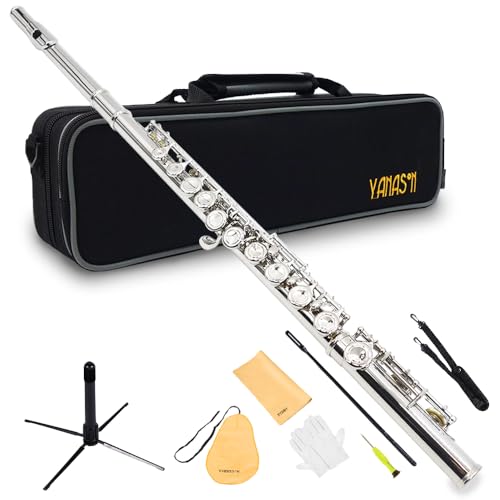
- Beginner-friendly closed-hole configuration
- Nickel-plated body resists oxidation
- Includes stand, case, tuning rod, and cleaning kit
Best For: Students and beginners practicing at home or in school
Best Ergonomic Starter Set
INEFFA 16-Key Closed-Hole C Flute

- Ergonomic offset G key with split E mechanism
- Closed-hole design for beginner technique
- Includes case, cleaning supplies, and gloves
Best For: Beginners and students seeking comfort and a complete starter kit
Best Value Practice Flute
POGOLAB 16-Key Closed-Hole C Flute

- Beginner-friendly beveled embouchure hole
- Clear, focused sound profile
- Includes carry bag, strap, and cleaning kit
Best For: Students and beginners focused on everyday practice and easy playability
Best Upgrade-Friendly Option

- Beginner-friendly closed-hole 16-key layout
- Factory pre-tuned with inspection stated
- Includes case, cleaning kit, and tuning rod
Best For: Beginners and students wanting a practical flute with a listed upgrade path
Best Beginner Kit – EastRock 16-Key Closed-Hole C Flute
For shoppers comparing flutes under 300, the EastRock offers a beginner-oriented closed-hole C-flute setup with a case, stand, and cleaning kit. Its offset G and split E key layout, beveled embouchure hole, and nickel-plated cupronickel body are designed to make starting and practicing more approachable.
Best For: Beginners, kids, and students who want a complete C-flute package.
Pros:
- Closed-hole 16-key design with offset G and split E key.
- Includes a case, stand, and cleaning kit.
- Double-bladder pads and an undercut beveled embouchure hole support comfortable playing and clear sound.
- Cupronickel body and polished nickel-plated finish.
Cons:
- The supplied notes do not specify whether the case is hard-shell.
- At about 1 kg, it may feel substantial for some younger players.
Overall, this is a practical starter bundle for players who value beginner-friendly features and included accessories over a minimalist flute-only purchase.
Best Folk-Style Pick – Stellar Basic G Cedar Flute
Among flutes under 300, the Stellar Basic G stands apart from standard band-style C flutes with its Native American-style design and warm cedar construction. It is tuned to concert 440 Hz and includes an instruction book, making it a straightforward option for beginners drawn to a mellow, meditative sound.
Best For: Beginners seeking a warm, mellow G flute for relaxed or meditative playing.
Pros:
- Locally sourced western red cedar provides a warm, resonant voice.
- Concert 440 Hz tuning works with other instruments.
- Instruction book supports new players.
- Handmade by a small family-owned business.
Cons:
- Flute bag is not included.
- Its G key and Native American-style format may not suit shoppers seeking a conventional school-band flute.
This is a focused choice for buyers who prioritize characterful wood tone and an accessible learning experience rather than a broad accessory package.
Best Complete Outfit – Glory 16-Key Closed-Hole C Flute
Glory Closed Hole C Flute With Case, Tuning Rod,Joint Grease and Cloth, Gloves, Nickel Silver
Check Price On AmazonThe Glory 16-key closed-hole C flute is a useful contender in the flutes under 300 category for students who want the essentials included. It comes with a hard-shell case, tuning rod, cork grease, cloth, and gloves, while its closed-hole layout and leather pads are intended to support accessible playability.
Best For: Students and gift buyers who want a ready-to-use beginner C-flute outfit.
Pros:
- Complete package includes a hard-shell case and maintenance accessories.
- Closed-hole 16-key design is easier for beginners to cover.
- Cupronickel body is described as durable and tarnish-resistant.
- Airtight leather pads support responsive low notes and playability.
Cons:
- The supplied details do not mention a stand.
- The listed finish and color descriptions are somewhat inconsistent, using both nickel silver and “Niclel Silver.”
With its protective case and basic care supplies, the Glory is especially convenient when you want one purchase that covers a student’s initial setup and maintenance needs.
Best Open-Hole Kit – Eastar EFL-2 16-Key C Flute
For players specifically looking at open-hole flutes under 300, the Eastar EFL-2 combines a 16-key C-flute design with a broad accessory kit. Its cupronickel body, offset G, split E key, beveled embouchure, and bright, clear sound profile make it suited to beginners and students who want room to develop their technique.
Best For: Beginners and students wanting an open-hole flute with extensive included accessories.
Pros:
- Open-hole 16-key C-flute design with offset G and split E key.
- Includes a hard case, stand, cleaning kit, adjustment screws, and gloves.
- Beveled embouchure and double-bladder pads are designed for comfortable playing and airtightness.
- Includes a 12-month product warranty and customer support.
Cons:
- Open-hole keys can require more precise finger coverage than closed-hole models.
- The bright, clear sound may not appeal to players seeking a warmer tone.
- At about 1 kg, it may be relatively heavy for some younger beginners.
This model is a strong fit when an open-hole layout and generous starter bundle matter more than choosing the simplest possible beginner design.
Best for Easy Setup – Mendini 16-Key Closed-Hole C Flute
If you’re comparing flutes under 300, this Mendini closed-hole C flute is a practical starter kit with an accessible design and useful accessories. Its copper-nickel alloy body, offset G key, and split E key are geared toward comfortable beginner practice.
Best For: Beginners who want a complete flute kit for lessons, home practice, orchestra, or school use.
Pros:
- Closed-hole 16-key design is approachable for new players.
- Offset G key and split E key support easier high-note playing.
- Includes a case, stand, cleaning supplies, gloves, lesson book, and maintenance accessories.
- Double bladder pads help reduce air leakage.
Cons:
- The gold finish may not suit players seeking a traditional silver appearance.
- Its beginner-focused closed-hole design may offer less room for advanced technique development than an open-hole model.
With its bright sound profile and extensive starter accessories, this Mendini is a sensible choice for first-time players seeking convenience in one package.
Best for Advancing Players – Cecilio 17-Key Open-Hole C Flute
Among flutes under 300, this Cecilio open-hole model stands out for players ready to develop more precise technique. It combines a 17-key C design with a B-foot joint, offset G key, split E key, and beveled embouchure.
Best For: Intermediate flutists, school band members, and hobbyists practicing or performing across classical and contemporary styles.
Pros:
- Open-hole design supports enhanced technique and tone control.
- B-foot joint provides a useful option for advancing players.
- Undercut beveled embouchure offers responsive tonal control.
- Includes a hard case, stand, cleaning supplies, grease, screwdriver, and gloves.
Cons:
- Open-hole keys can be less forgiving for beginners than closed-hole keys.
- The supplied details list fewer included accessories than some beginner-focused kits.
This is the strongest fit in the group for musicians moving beyond basic instruction and seeking more flexibility in technique, tone, and performance use.
Best Value Practice Set – YANASON 16-Key Nickel-Plated C Flute
For shoppers exploring flutes under 300, the YANASON 16-key closed-hole C flute offers a straightforward package for regular practice. Its nickel-plated copper-nickel alloy body, offset G key, and split E key are designed for clear tone and accessible handling.
Best For: Beginner and student players, including children and adults, who need a portable flute set for classes, rehearsals, or performances.
Pros:
- Closed-hole 16-key configuration is suitable for beginners.
- Nickel plating helps resist oxidation and discoloration.
- Offset G key and split E key support comfortable playing and high E notes.
- Includes a case, foldable stand, gloves, tuning rod, and cleaning kit.
Cons:
- The supplied warranty description is limited to three months.
- Its painted silver finish may be less traditional than a polished finish.
With its portable accessories and beginner-oriented key layout, this YANASON provides a practical option for students who want a ready-to-use instrument for daily practice.
Best Ergonomic Starter Set – INEFFA 16-Key Closed-Hole C Flute
For shoppers comparing flutes under 300, the INEFFA offers a beginner-friendly 16-key closed-hole design with an ergonomic offset G key and split E mechanism. Its nickel-plated cupronickel body, hand-polished headjoint, and included accessories make it a practical starter package.
Best For: Beginners and students moving toward intermediate-level playing who want an ergonomic design and a complete accessory kit.
Pros:
- Offset G key and split E mechanism can help reduce finger strain.
- Closed-hole keys support straightforward technique development.
- Includes a hardshell case, cleaning rod, polishing cloth, and gloves.
- Precision pads are designed for an airtight seal and accurate intonation.
Cons:
- The nickel-plated finish produces a bright tone rather than the warmer response associated with silver-plated instruments.
- Its 16-key closed-hole layout may be less suitable for players specifically seeking an advanced open-hole configuration.
The INEFFA stands out as a well-equipped entry-level choice, particularly for players who value comfort and included maintenance supplies. Its one-year manufacturer warranty and stated bright, warm, clear sound profile add practical reassurance for new musicians.
Best Value Practice Flute – POGOLAB 16-Key Closed-Hole C Flute
Among flutes under 300, the POGOLAB is geared toward students and beginners who want a polished nickel-plated C flute with a practical carrying kit. Its beveled embouchure hole, integrated key design, and adjustable screws focus on accessible playability and everyday practice.
Best For: Beginners and students who want a clear, focused sound, durable construction, and basic maintenance accessories.
Pros:
- The beveled embouchure hole is designed to make producing a clear sound easier.
- Integrated keys and leather pads are intended to improve pitch stability and reduce air leakage.
- Includes a carry bag, strap, cleaning kit, probe rod, and gloves.
- Anti-oxidation treatment and stainless steel springs support regular use.
Cons:
- The closed-hole student design may not satisfy players looking for open-hole performance features.
- Its sound profile is described as clear and focused, so players seeking a notably rich, warm tone may prefer another option.
POGOLAB is a sensible practice-oriented pick for a new player who prioritizes ease of sound production and a useful set of accessories. Adjustable key screws also provide some flexibility for fit and maintenance over time.
Best Upgrade-Friendly Option – 16-Key Nickel-Plated C Flute
For buyers browsing flutes under 300, this 16-key closed-hole C flute offers a nickel-plated version aimed at beginners and students, with a silver-plated alternative listed for more advanced needs. The nickel model combines a bright, warm sound profile with factory pre-tuning and a complete care kit.
Best For: Beginners, school-band players, and intermediate musicians who want a closed-hole flute with an upgrade path between nickel- and silver-plated versions.
Pros:
- Standard 16-key closed-hole layout is designed for accessible finger positioning.
- Includes a case, cleaning rod, cloth, gloves, and tuning rod.
- Factory pre-tuned and inspected for pitch calibration before use.
- Nickel plating is intended to resist corrosion and wear.
Cons:
- The nickel-plated model is positioned as the economical option, while the richer-resonance silver-plated version is a separate choice.
- Closed-hole keys may be limiting for players specifically seeking open-hole technique.
This model is appealing when flexibility matters: the nickel version keeps the initial setup approachable, while the listed silver-plated option provides a potential upgrade for more advanced playing. For a beginner, the ready-to-play setup and included maintenance tools add convenience.
How We Picked the Best Flutes Under 300
We focused on the features that matter most to new and improving players: key configuration, flute material, included accessories, portability, and suitability for lessons or regular practice. Most selections are closed-hole C flutes, a common choice for beginners because the covered keys make it easier to produce notes while developing finger placement and breath control.
We also included open-hole models for players who want a more advanced layout, plus a Native American-style G flute for shoppers seeking a different playing experience. Product kits were considered more useful when they included practical items such as a case, cleaning rod, cloth, stand, gloves, or tuning accessories.
Quick Comparison
| Type | Best suited to | What to look for |
|---|---|---|
| Closed-hole C flute | Beginners and school players | Reliable key action, comfortable ergonomics, and a complete case or cleaning kit |
| Open-hole C flute | Intermediate players and advancing students | Correct hand position, quality pads, offset G, split E, or B-foot features |
| Native American-style G flute | Hobbyists and folk-music players | Playing style, included learning materials, wood construction, and storage |
Key Buying Factors for Flutes Under 300
Choose the Right Key System
Closed-hole models are generally the easiest place to start. Open-hole flutes can offer a more traditional advanced configuration, but they require accurate finger coverage and may take longer to feel comfortable. A beginner should not choose open holes simply because they appear more professional.
Check the Construction and Finish
Nickel-plated or nickel-silver instruments are common in this price range and can be suitable for practice and early lessons. Inspect the pads, joints, rods, and key alignment when the flute arrives. Smooth assembly and keys that return cleanly are more important than appearance alone.
Value the Complete Package
A case protects the instrument during transport, while a cleaning rod and cloth help manage moisture after playing. Stands, gloves, grease, and tuning accessories can reduce additional costs, but they should not outweigh poor fit or inconsistent key action.
Consider Setup and Support
Budget flutes may benefit from inspection or adjustment by a music teacher or repair technician. Confirm the seller’s return policy, especially when buying a first instrument online, and make sure replacement pads or service are reasonably available.
Who Should Buy Which Flutes Under 300?
Choose a closed-hole C flute for a child, first-time player, or school-band student who wants the most approachable setup. A bundled EastRock, Glory, YANASON, POGOLAB, professional-style, or similar 16-key model may be a practical starting point when accessories are important.
Consider the Eastar or another open-hole model if the player is ready to learn an open-hole layout. The Cecilio 17-key flute is better suited to an advancing student who understands the additional configuration and wants features such as a B-foot joint, offset G, or split E key.
For folk, meditation, or non-orchestral playing, the Stellar Native American-style G flute offers a distinct alternative to a standard orchestral C flute. Whichever model you choose, prioritize comfortable handling, a returnable purchase, and professional setup if notes do not speak cleanly out of the box.