Aftertouch adds another layer of control to a MIDI performance, letting you shape modulation, vibrato, filters, and other effects without lifting your fingers from the keys or pads. The right controller can make software instruments feel more responsive while fitting your preferred workflow.
This roundup compares 10 MIDI controllers with aftertouch, from compact pad and mini-key options to full-size 61-key workstations with sequencing, DAW integration, and performance controls.
Best 10 Midi Controllers with Aftertouch Picks for 2026
Best Sequencing Workstation

- 37-key velocity-sensitive keyboard with aftertouch
- Polyphonic sequencer, arpeggiator, and drum sequencing
- CV, Gate, MIDI, sync, and USB connectivity
Best For: Performers building complex hardware and DAW arrangements
Best Portable Pad Controller
Mini Wireless MIDI Pad Controller

- 16 RGB velocity-sensitive pads with aftertouch
- Bluetooth MIDI, USB MIDI, and up to 15-hour battery
- Customizable through PC software or mobile app
Best For: Mobile beat makers, DJs, and live sample triggering
Best Compact Keyboard Sequencer
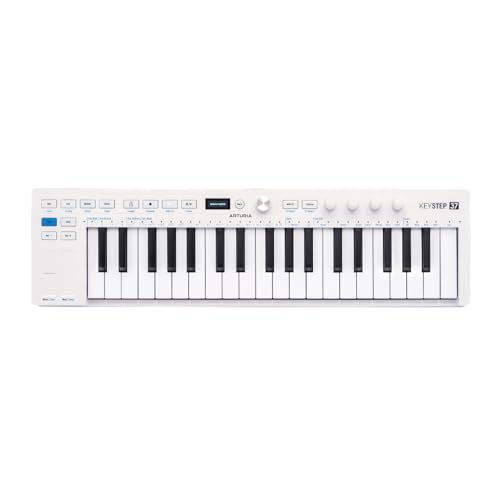
- 37-key Slimkey keyboard with aftertouch
- Arpeggiator, chord and scale modes, and 64-step sequencer
- USB-C, MIDI DIN, sync, pedal, and configurable CV outputs
Best For: Producers combining expressive keyboard playing with modular control
Best Ultra-Portable Polyphonic Keyboard

- 37 full-size keys with configurable polyphonic aftertouch
- Ultra-thin aluminum body weighing 1.9 pounds
- Plug-and-play support for computers and mobile devices
Best For: Mobile musicians needing expressive full-size keys in a slim design
Best All-Around Control
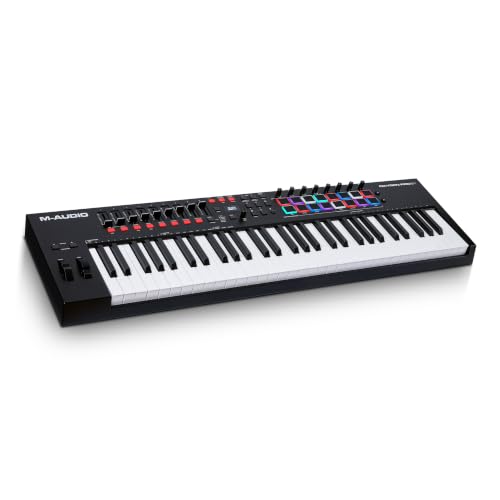
- 61 semi-weighted aftertouch keys
- 16 RGB pads, 8 knobs, and 9 faders
- Includes DAW tools and production software
Best For: Full-featured music production setups
Best Classic Hands-On Layout

- 49 semi-weighted keys with aftertouch
- 9 faders, 8 encoders, and 16 buttons
- LCD feedback, pads, USB, and MIDI Out
Best For: Hands-on DAW and MIDI control
Best for Polyphonic Pad Aftertouch

- 16 pads with polyphonic aftertouch
- 61 semi-weighted keys and 9 faders
- Scale, Chord, Arp, and broad DAW integration
Best For: Expressive pads and modern creative workflows
Premium Keybed Control

- 49 keys with aftertouch
- 12 pressure-sensitive pads
- Nine assignable encoders
Best For: Expressive keyboard performance and hands-on studio control
Compact Creative Control
Novation Launchkey Mini 37 MK4

- 16 pads with polyphonic aftertouch
- 37 mini synth-action keys
- Scale, Chord, and Arpeggiator modes
Best For: Portable electronic production and expressive pad performance
Standalone Studio Flexibility

- 37-key, three-octave layout
- CV/Gate and MIDI I/O
- Built-in 64-step sequencer
Best For: DAW production and compact hardware-integrated setups
Best Sequencing Workstation – Arturia KeyStep Pro
The Arturia KeyStep Pro is a strong choice among midi controllers with aftertouch for performers who want keyboard control, sequencing, arpeggiation, and extensive hardware connectivity in one unit. Its 37 velocity-sensitive Slimkeys and aftertouch support add expressive control, while CV, Gate, MIDI, and USB connections suit hybrid setups.
Best For: Performers and producers building complex hardware, Eurorack, and DAW-based arrangements.
Pros:
- Combines a keyboard, sequencer, arpeggiator, and drum sequencer.
- Offers 4 CV/Gate/Mod outputs and 8 dedicated drum Gate outputs.
- Supports polyphonic sequencing, pattern chaining, Scenes mode, and Chord mode.
- Includes 37 velocity-sensitive keys with aftertouch.
Cons:
- Its extensive feature set may be more than beginners need.
- At 5.9 pounds, it is less travel-focused than compact controllers.
The KeyStep Pro stands out when sequencing and broad connectivity matter as much as playing feel. Choose it for an integrated performance hub rather than a simple USB keyboard.
Best Portable Pad Controller – Mini Wireless MIDI Pad Controller
This compact pad unit is one of the more travel-friendly midi controllers with aftertouch, combining 16 RGB velocity-sensitive pads with Bluetooth and USB MIDI. Its rechargeable battery, customizable mappings, and expandable pad banks make it practical for beat making, sample triggering, and mobile performance.
Best For: Mobile producers, DJs, and beginners who want expressive pad control without cables.
Pros:
- Provides 16 RGB velocity-sensitive pads with aftertouch.
- Supports Bluetooth MIDI and USB MIDI across computers and mobile devices.
- Offers up to 15 hours of battery use.
- Includes customizable mappings, velocity curves, commands, and lighting.
Cons:
- Its 16-pad layout is less suitable for full keyboard playing.
- App or software setup may be needed for deeper customization.
For portable beat production, this controller delivers expressive pad performance in a small package. Its wireless operation and app-based customization are especially useful for mobile workflows and live triggering.
Best Compact Keyboard Sequencer – Arturia KeyStep mk2
The Arturia KeyStep mk2 is a compact keyboard option for shoppers comparing midi controllers with aftertouch and built-in creative tools. Its 37-note Slimkey keyboard, chord and scale modes, arpeggiator, polyphonic sequencer, and configurable CV outputs support both expressive playing and hardware control.
Best For: Producers who want a lightweight keyboard controller with sequencing and modular-synth connectivity.
Pros:
- Includes a 37-note velocity-sensitive Slimkey keyboard with aftertouch.
- Features chord and scale modes, a 16-mode arpeggiator, and a polyphonic 64-step sequencer.
- Provides USB-C MIDI, MIDI DIN, sync I/O, and pedal input.
- Four CV outputs can be configured for velocity, aftertouch, mod wheel, and more.
Cons:
- The feature-rich workflow may take time to learn.
- Its listed compatibility details emphasize Windows 10, so verify your setup before buying.
KeyStep mk2 balances portability with hands-on composition tools and flexible hardware control. It is a practical middle ground for musicians who need more than a basic MIDI keyboard but less emphasis on large-scale sequencing.
Best Ultra-Portable Polyphonic Keyboard – CME Xkey 37 LE
The CME Xkey 37 LE is a slim, lightweight option among midi controllers with aftertouch, using 37 full-size velocity-sensitive keys and polyphonic aftertouch in an aluminum frame. It is designed for plug-and-play use with computers and mobile devices, while the Xkey Plus app allows mapping for DAWs, instruments, and plugins.
Best For: Mobile musicians who prioritize full-size keys, polyphonic aftertouch, and minimal bulk.
Pros:
- Offers 37 full-size velocity-sensitive keys with configurable polyphonic aftertouch.
- Uses an ultra-thin aluminum design weighing less than 2 pounds.
- Works with Windows, macOS, iOS, Linux, and Android without drivers.
- Includes a 3-year warranty and Xkey Plus mapping software.
Cons:
- The Xcable is not included.
- Its compact keyboard format does not provide built-in sequencing or pads.
The Xkey 37 LE is a compelling travel keyboard when expressive polyphonic aftertouch matters more than onboard production features. Its low weight and broad device compatibility make it easy to add to a mobile setup.
Best All-Around Control – M-Audio Oxygen Pro 61
The M-AUDIO Oxygen Pro 61 is a versatile choice among midi controllers with aftertouch, combining 61 semi-weighted, velocity-sensitive keys with assignable zones. Its pads, faders, knobs, DAW mapping, and bundled software make it practical for composing, beat production, and hands-on virtual instrument control.
Best For: Producers who want a full-size controller with aftertouch, extensive controls, drum pads, and included music-production software.
Pros:
- 61 semi-weighted keys include aftertouch and assignable zones.
- Offers 16 RGB pads, 8 knobs, and 9 assignable faders.
- Includes NKS integration, DAW auto-mapping, and Smart Chord and Smart Scale modes.
- Comes with MPC Beats, Ableton Live Lite, AIR instruments, and MPC Expansion packs.
Cons:
- Its 61-key design and 10.6-pound weight require substantial workspace.
- The controller has a single USB port.
Choose the Oxygen Pro 61 if you want aftertouch alongside a broad set of tactile controls. It is especially compelling when bundled software and integrated production features matter as much as the keyboard itself.
Best Classic Hands-On Layout – Samson Graphite 49
Samson Graphite 49 Key USB MIDI DJ Keyboard Controller w/Aftertouch/Fader/Pads
Check Price On AmazonThe Samson Graphite 49 is a straightforward option among midi controllers with aftertouch, pairing 49 semi-weighted keys with programmable faders, encoders, buttons, and trigger pads. Its LCD display and traditional MIDI Out add useful control and connectivity for computer-based setups.
Best For: Players who want a 49-key aftertouch controller with physical DAW controls, pads, a display, and MIDI Out.
Pros:
- 49 semi-weighted keys support aftertouch.
- Provides 9 programmable faders, 8 encoders, and 16 buttons.
- Includes four velocity-sensitive trigger pads with two banks.
- Large LCD gives real-time feedback, and traditional MIDI Out is included.
Cons:
- Has fewer trigger pads than the other controllers in this roundup.
- The supplied notes identify it as a 2012 model.
The Graphite 49 focuses on practical, physical control rather than newer workflow features. It is a sensible fit if you prefer a compact 49-key format and need both USB and traditional MIDI connectivity.
Best for Polyphonic Pad Aftertouch – Novation Launchkey 61 MK4
The Novation Launchkey 61 MK4 stands out among midi controllers with aftertouch through its 16 responsive FSR pads with polyphonic aftertouch. It also combines 61 semi-weighted keys, broad DAW integration, scale and chord modes, an arpeggiator, and NKS support for a modern creative workflow.
Best For: Producers who want polyphonic aftertouch on pads for expressive drumming, clip launching, sequencing, and chord triggering.
Pros:
- 16 FSR pads provide polyphonic aftertouch and multiple creative functions.
- Includes 61 semi-weighted keys, 9 faders, pitch and modulation wheels, and an OLED display.
- Works with major DAWs including Ableton Live, Logic, Cubase, Reason, Reaper, FL Studio, and Ardour.
- Offers Scale, Chord, and Arp features plus NKS integration.
Cons:
- The supplied notes specify aftertouch for the pads, not the keyboard keys.
- It uses a single USB port.
The Launchkey 61 MK4 is the strongest match when expressive pad performance is the priority. Its polyphonic pad aftertouch and creative sequencing features give it a distinct advantage for clip-based and beat-oriented production.
Premium Keybed Control – Arturia KeyLab mk3 49
The Arturia KeyLab mk3 49 is a strong choice for musicians who want midi controllers with aftertouch, a full-size 49-key layout, and hands-on controls for software instruments and mixing. Its pressure-sensitive pads, assignable encoders, and pedal inputs make it suited to expressive keyboard performance and studio control.
Best For: Keyboard players who want an expressive 49-key controller with broad hands-on control.
Pros:
- 49 keys with aftertouch for more expressive playing.
- Includes 12 pressure-sensitive performance pads.
- Nine assignable encoders provide tactile parameter control.
- Sustain and auxiliary pedal inputs expand performance options.
Cons:
- Its 49-key design takes more space than a mini controller.
- At 6.2 kg, it is less convenient for frequent transport.
The KeyLab mk3 49 prioritizes a substantial playing surface and extensive physical control. Choose it when expressive keys and studio-oriented controls matter more than compact portability.
Compact Creative Control – Novation Launchkey Mini 37 MK4
The Novation Launchkey Mini 37 MK4 combines 37 mini synth-action keys with 16 pads featuring polyphonic aftertouch, making it a versatile pick among midi controllers with aftertouch. Scale and Chord modes, an arpeggiator, an OLED display, and broad DAW compatibility support fast composing and performance in a compact format.
Best For: Mobile producers and electronic musicians who want compact keys, expressive pads, and creative sequencing tools.
Pros:
- 16 FSR pads support polyphonic aftertouch.
- 37 mini keys provide three octaves in a compact design.
- Includes Scale, Chord, and Arpeggiator modes.
- Works with major DAWs including Ableton Live, Logic, Cubase, and FL Studio.
Cons:
- Mini keys may feel less suitable for players who prefer full-size keys.
- The plastic construction may feel less substantial than larger controllers.
The Launchkey Mini 37 MK4 is built around portability and creative workflow features. Its polyphonic-aftertouch pads are especially useful for expressive drum parts, clip launching, and performance control.
Standalone Studio Flexibility – Akai MPK Mini Plus 37
The Akai Professional MPK Mini Plus is a practical option for producers seeking midi controllers with aftertouch-style expressive pad control alongside a 37-key layout, sequencing, and hardware connectivity. Its MPC pads, eight assignable knobs, CV/Gate, MIDI I/O, and built-in 64-step sequencer support both computer-based and hardware-focused workflows.
Best For: Producers who want a compact controller for DAW work, beat making, and connecting external hardware.
Pros:
- 37-key layout covers three full octaves.
- Eight RGB MPC pads support dynamic performance and music creation.
- CV/Gate and MIDI I/O connect modular gear, synthesizers, and sound modules.
- Built-in 64-step sequencer supports drum and melodic or chord tracks.
Cons:
- The supplied notes do not specify aftertouch for the keys or pads.
- Its extensive feature set may be more than needed for basic DAW control.
- It uses plastic construction rather than a metal chassis.
The MPK Mini Plus stands out for connectivity and sequencing rather than a clearly specified aftertouch implementation. It is a compelling fit when integrating hardware instruments and creating beats are higher priorities than confirmed aftertouch.
How We Picked the Best Midi Controllers with Aftertouch
We selected controllers across several common studio and performance needs, including keyboard range, portability, pad-based beat making, sequencing, DAW control, and hardware integration. We also considered whether aftertouch is suited to the instrument’s design: polyphonic aftertouch can provide independent expression across multiple keys or pads, while channel aftertouch applies pressure data more broadly.
Because these models cover different price tiers and formats, the best choice depends less on having the most controls and more on matching the controller to your playing style, software, available space, and setup.
Quick Comparison
| Best For | Look For |
|---|---|
| Live sequencing and hardware setups | Dedicated sequencer, MIDI ports, CV/Gate, and reliable transport controls |
| Beat making | Velocity-sensitive RGB pads, pad aftertouch, and flexible mapping |
| DAW-based production | Deep software integration, faders, knobs, and programmable buttons |
| Portable music making | Compact dimensions, USB power, Bluetooth, or a lightweight design |
| Expressive keyboard performance | Full-size keys, suitable key action, and polyphonic or channel aftertouch |
Key Buying Factors for Midi Controllers with Aftertouch
Aftertouch Type
Check whether the controller offers channel or polyphonic aftertouch. Polyphonic aftertouch is more precise for expressive chords and layered performances, but it may cost more and require compatible software instruments. Also confirm that your DAW or virtual instrument can receive and map the aftertouch data you intend to use.
Key Count and Playing Feel
Compact 25- or 37-key controllers are easier to carry and can be practical for electronic music, while 49- and 61-key models provide more room for two-handed parts and broad arrangements. Key size, velocity response, synth action, and octave controls matter just as much as the number of keys.
Controls and Connectivity
Knobs, faders, pads, screens, transport buttons, and programmable controls can speed up production. For hardware users, standard MIDI, USB, CV/Gate, and sync connections may be essential. If you perform with a tablet or phone, check Bluetooth compatibility, power requirements, and the included cables.
Software Integration
A controller with dedicated DAW scripts can be faster to use than one that relies entirely on manual MIDI mapping. Confirm support for your preferred DAW and look at the included instruments, effects, and bundled software before comparing prices.
Who Should Buy Which Midi Controllers with Aftertouch?
Choose a compact mini-key or pad controller if portability, mobile production, and quick beat programming are your priorities. A 37-key model is a useful middle ground for producers who want more melodic range without a large desktop footprint.
Choose a 49- or 61-key controller if you regularly play piano-style parts, need broader octave coverage, or want more hands-on mixing controls. For live electronic performance and hardware rigs, prioritize sequencing and physical MIDI connectivity. If expressive sound design is the main goal, focus on reliable aftertouch response, polyphonic capability where available, and software that can turn pressure into meaningful musical changes.