The best MIDI keyboards for production make it easier to play ideas, control software instruments, and build complete arrangements without relying entirely on a computer mouse.
We selected 10 controllers spanning compact 25-key models, versatile 37- and 49-key options, and full-size 88-key keyboards, with attention to playability, controls, software support, portability, and value.
Best 10 Midi Keyboards for Production Picks for 2026
Best All-Rounder

- 25 velocity-sensitive mini keys with Chord, Scale, and Arpeggiator modes
- Eight RGB MPC pads plus eight assignable 360-degree knobs
- USB-C, full-size MIDI Out, display, and extensive software bundle
Best For: Compact beat making and versatile mobile production
Best Workflow-Friendly Pick

- 25 velocity-sensitive slim keys with arpeggiator
- 16 RGB pads, eight encoders, and four faders for hands-on control
- Includes Ableton Live Lite, Analog Lab Intro, and UVI Model D
Best For: Accessible instrument control and compact DAW workflows
Best for Clip Launching
Novation Launchkey Mini 25 MK4
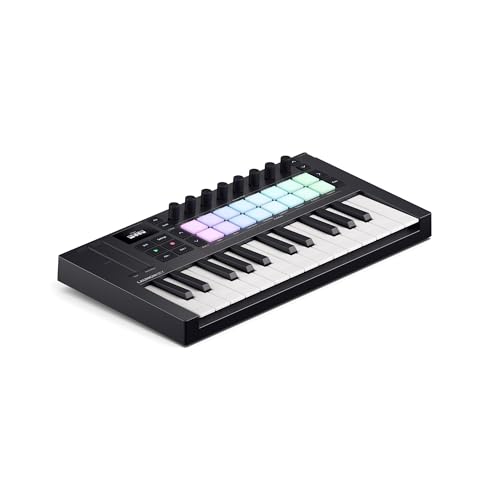
- 16 FSR pads with polyphonic aftertouch for clips, drums, and sequencing
- Scale, Chord, and arpeggiator tools support fast idea generation
- Broad DAW support, OLED display, USB-C, and 3.5mm MIDI
Best For: Clip launching, live workflows, and expressive pad performance
Best for Full-Size Keys

- 49 full-size velocity-sensitive keys for broader playing range
- Pitch/modulation wheels, sustain input, fader, and transport controls
- Plug-and-play USB operation with a useful included software suite
Best For: Piano-style playing and melody-focused studio production
Best All-Arounder

- 37 keys with pads, knobs, and DAW transport controls
- Built-in sequencer plus CV/Gate and MIDI I/O
- Includes MPC Beats, Splice access, and Komplete bundle choice
Best For: Producers wanting one versatile controller for software and hardware
Best for Piano-Style Playing

- 88 full-size velocity-sensitive semi-weighted keys
- Pitch/modulation wheels and essential DAW controls
- Includes a useful collection of production software
Best For: Composers and players needing a full piano-range controller
Best Compact Option

- Portable 25-key controller with velocity-sensitive mini keys
- Built-in arpeggiator, clock, and octave controls
- Eight programmable presets and broad DAW compatibility
Best For: Mobile producers and small-space music setups
Best All-Around

- 49 velocity-sensitive keys with pads, faders, and encoders
- Scale, Chord, and Arpeggiator modes support composition
- Includes Analog Lab V and additional production software
Best For: Producers wanting a full-size controller for composing and mixing
Best Compact Control

- Compact 25-key controller with eight MPC-style pads
- Eight knobs plus pitch/modulation thumbstick add hands-on control
- Includes MPC Beats, instruments, sounds, and NKS support
Best For: Beat makers and home producers working in limited space
Best Beginner Value
Donner N-25 Mini MIDI Keyboard

- Portable 25-key controller with velocity-sensitive mini keys
- Includes arpeggiator, programmable banks, and pitch-bend control
- Adds 40 teaching courses for learning arrangement basics
Best For: Beginners seeking an affordable, portable learning setup
Best All-Rounder – Akai MPK Mini IV
The Akai Professional MPK Mini IV is a versatile choice for anyone comparing midi keyboards for production. Its 25 velocity-sensitive mini keys, MPC pads, assignable knobs, display, and DAW controls cover beat making, synth parts, sample triggering, and portable production.
Best For: Producers who want a compact controller with substantial beat-making and hands-on control features.
Pros:
- Eight velocity- and pressure-sensitive MPC pads with RGB feedback support expressive finger drumming.
- Eight assignable 360-degree knobs, a full-color screen, and push-turn encoder provide hands-on navigation.
- Chord, Scale, and advanced Arpeggiator modes encourage fast songwriting and jamming.
- Includes a broad software bundle, DAW integration, USB-C, and full-size MIDI Out.
Cons:
- The 25 mini keys offer less playing space than a full-size keyboard.
- Its many controls may be more than beginners need for a basic keyboard setup.
Choose the MPK Mini IV if you want one compact controller to handle keys, pads, parameters, and performance tools. It is especially compelling for beat-focused producers and mobile setups.
Best Workflow-Friendly Pick – Arturia MiniLab 3
The Arturia MiniLab 3 is a streamlined option among midi keyboards for production, combining 25 velocity-sensitive keys with pads, encoders, faders, a display, and a clickable browsing knob. Its layout is designed to keep common instrument and track controls within reach.
Best For: Producers seeking an approachable all-in-one controller for software instruments, drums, and mixing tasks.
Pros:
- Eight rotary encoders and four faders support hands-on parameter and track control.
- Two banks of eight velocity- and pressure-sensitive RGB pads are useful for drums and triggering.
- Includes a built-in arpeggiator, pitch and modulation touch controls, and a mini display.
- Software includes Ableton Live Lite, Analog Lab Intro, and UVI Model D.
Cons:
- It has 25 slim synth-action keys rather than full-size keys.
- The supplied details list USB connectivity, without the expanded MIDI Out and mobile connectivity described for some alternatives.
The MiniLab 3 makes a strong case for producers who value a tidy, mouse-light workflow. Its combination of pads, faders, browsing controls, and bundled software gives beginners a practical starting point.
Best for Clip Launching – Novation Launchkey Mini 25 MK4
The Novation Launchkey Mini 25 MK4 stands out among midi keyboards for production with 16 responsive FSR pads, broad DAW integration, and performance-focused creative tools. It combines a compact 25-key layout with clip launching, step sequencing, chord triggering, and expressive pad control.
Best For: Ableton and multi-DAW users who want a compact controller for clips, drums, chords, and live ideas.
Pros:
- Sixteen pads with polyphonic aftertouch support drumming, clip launching, step sequencing, and chord triggering.
- Works with major DAWs including Ableton Live, Logic, Cubase, Reason, Reaper, FL Studio, and Ardour.
- Scale Mode, Chord Mode, and creative arpeggiator functions help generate parts quickly.
- Includes an OLED display, USB-C, 3.5mm MIDI connectivity, and a useful software bundle.
Cons:
- The mini 25-key format is less suitable for extended two-handed piano playing.
- Its strongest clip and DAW features may be unnecessary for users focused mainly on traditional keyboard performance.
The Launchkey Mini 25 MK4 is a particularly capable choice for arrangement and performance-oriented production. Pick it when pads and DAW interaction matter as much as playing notes.
Best for Full-Size Keys – M-Audio Keystation 49 MK3
The M-Audio Keystation 49 MK3 is a straightforward alternative in the midi keyboards for production category, prioritizing 49 full-size velocity-sensitive keys over pads and extensive onboard controls. It adds a volume fader, transport buttons, pitch and modulation wheels, and sustain-pedal input for expressive software instrument performance.
Best For: Producers and players who need more keyboard range and a familiar full-size playing feel.
Pros:
- Forty-nine full-size velocity-sensitive keys provide more room for melodies, chords, and two-handed parts.
- Pitch and modulation wheels, octave buttons, and sustain input support expressive playing.
- Volume, transport, and directional controls offer basic DAW operation from the keyboard.
- Plug-and-play USB setup works with Mac and PC without drivers or a separate power supply.
Cons:
- It does not include drum pads, knobs, or an onboard arpeggiator in the supplied features.
- Its larger 49-key design is less portable than the 25-key controllers in this roundup.
- iOS use requires an Apple to USB Camera Adapter sold separately.
The Keystation 49 MK3 is the practical pick when key range and playing comfort come first. It is less feature-packed for beat making, but its full-size keyboard and bundled software suit melody- and piano-focused production.
Best All-Arounder – Akai MPK Mini Plus 37-Key
For producers who want more room than a compact mini keyboard without moving to a full-size controller, the Akai Professional MPK Mini Plus is a flexible choice among MIDI keyboards for production. Its 37-key layout, pads, knobs, sequencer, and broad connectivity support both in-the-box workflows and external gear.
Best For: Producers who need a versatile controller for melodies, chords, beats, DAW control, and hardware integration.
Pros:
- 37 velocity-sensitive keys provide three full octaves for melodic and harmonic parts.
- Includes eight RGB MPC pads, eight assignable rotary knobs, and DAW transport controls.
- Built-in 64-step sequencer and CV/Gate plus MIDI I/O support computer-free and hardware-based production.
- Includes MPC Beats, two months of Splice, and a choice of Komplete 15 Select NKS bundle.
Cons:
- Its 37-key range is more limited than an 88-key controller for extended piano parts.
- The broad feature set may be more than needed for producers seeking a simple keyboard.
The MPK Mini Plus stands out as the most complete option here for hands-on production. It balances portability with useful sequencing, performance controls, and connections for expanding beyond software instruments.
Best for Piano-Style Playing – M-Audio Keystation 88 MK3
The M-AUDIO Keystation 88 MK3 is a straightforward pick among MIDI keyboards for production when a full piano-style range matters most. Its 88 full-size semi-weighted keys, pitch and modulation wheels, and essential transport controls make it suitable for playing virtual instruments across a large range.
Best For: Producers, composers, and keyboardists who prioritize full-size keys and extended playing range.
Pros:
- 88 full-size, velocity-sensitive semi-weighted keys support expressive performances.
- Includes pitch and modulation wheels, volume fader, transport buttons, and sustain pedal input.
- Plug-and-play USB connectivity works with Mac or PC without drivers or a separate power supply.
- Includes MPC Beats, Ableton Live Lite, Mini Grand, Xpand!2, TouchLoops, and Velvet.
Cons:
- The 54.24-inch width and 13.8-pound weight require considerably more space than compact controllers.
- It has fewer built-in performance controls than the Akai MPK Mini Plus.
Choose the Keystation 88 MK3 when natural playing space and full-range composition outweigh portability. It is a practical centerpiece for a desk, studio, or stage setup, especially when paired with virtual instruments.
Best Compact Option – Akai LPK25 25-Key
The Akai Professional LPK25 is a compact, easy-to-carry choice among MIDI keyboards for production. Its 25 velocity-sensitive mini keys, USB-powered setup, arpeggiator, and programmable presets cover essential songwriting, beat-making, and software-instrument duties without taking much desk space.
Best For: Mobile producers, beginners, and creators who need a small controller for melodies, bass lines, and basic DAW workflows.
Pros:
- Compact 25-key design weighs about 0.48 kg and fits easily beside other studio gear.
- Velocity-sensitive keys, octave buttons, and a sustain button support expressive playing.
- Built-in arpeggiator and clock add creative sequencing options through one USB connection.
- Eight programmable preset slots and broad compatibility with popular DAWs simplify setup.
Cons:
- 25 mini keys provide less playing range and a smaller feel than full-size keyboards.
- Its control set is more limited for detailed mixing and hardware integration.
The LPK25 is a sensible space-saving controller for producers who value portability and quick setup. It handles core note input and creative arpeggiation well, but users needing extensive keys or dedicated mixing controls should consider a larger model.
Best All-Around – Arturia KeyLab Essential mk3
The Arturia KeyLab Essential mk3 is a strong choice for producers who want full-size playing space and hands-on DAW control. With 49 velocity-sensitive keys, pads, faders, encoders, creative modes, and extensive included software, it is one of the more versatile midi keyboards for production in this group.
Best For: Producers who want a full-size controller for composing, arranging, and mixing.
Pros:
- 49 velocity-sensitive synth-action keys provide more room for melodies and chords.
- Scale Mode, Chord Mode, and the arpeggiator make composition and beat-making more approachable.
- Custom integration supports Ableton Live, Logic Pro, FL Studio, Cubase, and Bitwig Studio.
- Includes Analog Lab V, two piano instruments, Loopcloud, and Melodics access.
Cons:
- The larger 49-key design takes up more desk space than compact controllers.
- Its broad feature set may be more than beginners need for simple setups.
Choose the KeyLab Essential mk3 if you want a controller that can cover playing, sound selection, drum programming, and DAW control without immediately needing extra hardware.
Best Compact Control – Akai MPK Mini MK3
The Akai Professional MPK Mini MK3 packs beat-making and virtual-instrument control into a compact 25-key format. Its mini velocity-sensitive keys, MPC-style pads, assignable knobs, thumbstick, and arpeggiator make it a practical pick among midi keyboards for production when desk space is limited.
Best For: Beat makers, home studios, and producers who need portable hands-on control.
Pros:
- Eight velocity-sensitive MPC pads include Note Repeat and Full Level for drum programming.
- Eight assignable knobs are useful for adjusting plugins, mixing, and synth parameters.
- The four-way thumbstick combines pitch and modulation control in a compact design.
- Includes MPC Beats, virtual instruments, sound content, NKS support, and a Splice trial.
Cons:
- Its 25 mini keys offer less range than a full-size controller.
- USB connectivity means it requires a compatible USB setup for operation.
The MPK Mini MK3 is a particularly sensible choice for producers focused on drums, samples, and software instruments rather than extended keyboard performances.
Best Beginner Value – Donner N-25 Mini MIDI Keyboard
The Donner N-25 is a compact, beginner-oriented controller with 25 velocity-sensitive mini keys and straightforward production tools. Its programmable banks, arpeggiator, pitch-bend rocker, light-up buttons, and included lessons make it an accessible entry point into midi keyboards for production.
Best For: Beginners who want a small controller with built-in learning resources.
Pros:
- Compact and lightweight design works with Mac, Windows, iOS, Android, smartphones, and tablets.
- Includes an arpeggiator, sustain, octave controls, tap tempo, and four programmable banks.
- Comes with 40 keyboard-teaching courses aimed at arrangement beginners through advanced learners.
- Supports several DAWs, including Cubase LE, Live, Logic Pro, Pro Tools, and Studio One.
Cons:
- The 25 mini-key layout is less suitable for two-handed performances.
- The included warranty is 90 days, shorter than many controller warranties.
For a first controller or portable setup, the N-25 offers useful essentials and learning material without the broader control surface of larger production keyboards.
How We Picked the Best Midi Keyboards for Production
We compared these controllers by considering the features that matter most in a real studio or mobile setup: key count, velocity sensitivity, control layout, portability, software compatibility, connectivity, and overall workflow value. Compact models are useful for travel, beat-making, and limited desk space, while larger keyboards provide a more natural range for chords, bass lines, and two-handed playing.
We also considered whether each keyboard suits beginners, experienced producers, or players who want a more traditional piano-style experience. Features such as pads, knobs, transport controls, arpeggiators, bundled software, and DAW integration can make a meaningful difference, but only when they support the way you actually work.
Quick Comparison
- Best for compact setups: 25-key controllers such as the Akai MPK Mini IV, Arturia MiniLab 3, and Novation Launchkey Mini 25 MK4.
- Best middle ground: 37-key and 49-key models offer more playing room without taking up as much space as a full-size keyboard.
- Best for piano-style production: 88-key options provide the widest range and a more familiar layout for trained pianists.
- Best for simple beginner setups: Straightforward controllers with velocity-sensitive keys and USB connectivity are easy to add to almost any computer-based studio.
Key Buying Factors for Midi Keyboards for Production
Key Count and Portability
Choose 25 keys if desk space and portability are priorities. A 37- or 49-key keyboard is usually more comfortable for melodies and layered chords, while 88 keys are better for piano-focused playing. Remember that larger models are harder to move and may require a dedicated stand or larger workstation.
Controls and Workflow
Knobs, pads, pitch controls, transport buttons, and arpeggiators can speed up beat programming and instrument control. If you mainly record piano parts, prioritize key range and feel. If you produce electronic music, hands-on pads and knobs may be more valuable than additional keys.
Compatibility and Software
USB MIDI support works with most modern DAWs, but check your computer’s ports and operating system before buying. Bundled instruments and production software can add substantial value, particularly for beginners building their first virtual-instrument library.
Playing Feel
Velocity sensitivity is important for expressive dynamics. Mini keys save space but may feel cramped for pianists, whereas full-size keys are generally more natural for detailed performances. Most controllers in this category are not weighted digital pianos, so set expectations accordingly.
Who Should Buy Which Midi Keyboards for Production?
Choose a compact 25-key model if you make beats, travel frequently, or need a controller for a crowded desk. Step up to a 37- or 49-key keyboard if you want a flexible all-purpose controller for melodies, chords, and software instruments. Choose an 88-key model if piano technique, broad playing range, and two-handed performances are central to your production.
Beginners should prioritize an intuitive layout, velocity-sensitive keys, reliable USB connectivity, and useful included software over a long list of advanced features. More experienced producers should focus on DAW integration, control density, key feel, and whether the keyboard complements the instruments and workflow they already use.