The best MIDI keyboards with pads combine playable keys with hands-on beat-making controls, making them useful for producing, performing, and sketching ideas without reaching for a separate drum controller.
We selected 10 compact controllers spanning budget-friendly models, wireless options, USB-C designs, and more advanced units with expanded keys, knobs, displays, and performance features.
Best 10 Midi Keyboards with Pads Picks for 2026
Best Overall

- 25 velocity-sensitive mini keys and eight MPC-style pads
- Eight assignable knobs plus arpeggiator and thumbstick control
- Includes MPC Beats, instruments, and sound content
Best For: Beat makers and compact home studios
Best Wireless Value
Wireless 25-Key RGB Pad Controller

- Battery-powered wireless controller for portable production
- Eight RGB pads and 25 keys feature velocity and aftertouch
- Offers USB, Bluetooth, and multiple wireless connection methods
Best For: Mobile producers and flexible wireless setups
Best for More Keys

- 32 velocity-sensitive semi-weighted mini keys
- Eight RGB pads, four knobs, and four faders
- DAW auto-mapping, Smart modes, MIDI Out, and software included
Best For: Producers needing expanded compact control
Best Portable Feature Set

- Bluetooth controller with a stated 16-hour battery life
- Eight RGB pads, eight encoders, and capacitive touch strips
- Works with Windows, Mac OS, Android, and iOS
Best For: Mobile producers using multiple devices
Versatile Studio Pick

- 37 keys for expanded melodic range
- 8 RGB MPC pads with performance modes
- USB, MIDI, and CV/Gate connectivity
Best For: Producers wanting extra keys and hardware integration
Portable Budget Pick
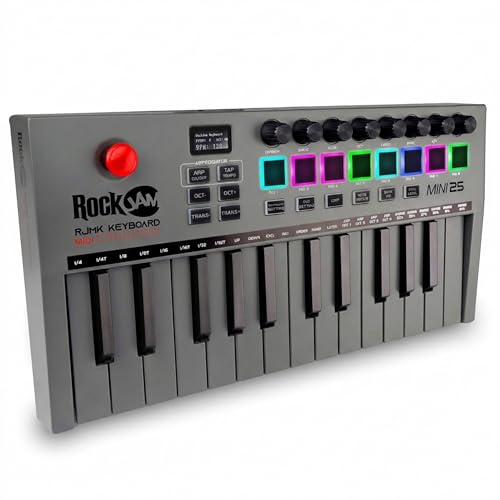
- 8 backlit pads with note repeat
- Rechargeable and weighs 1.8 pounds
- Bluetooth MIDI and USB connectivity
Best For: Beginners and mobile beat-makers
Modern Beat-Making Pick

- 8 pressure-sensitive RGB MPC pads
- Color screen and push/turn encoder
- USB-C and mapped DAW controls
Best For: Beat-makers seeking a compact modern workflow
Wireless Beatmaking Pick
M-VAVE K5 25-Key MIDI Keyboard
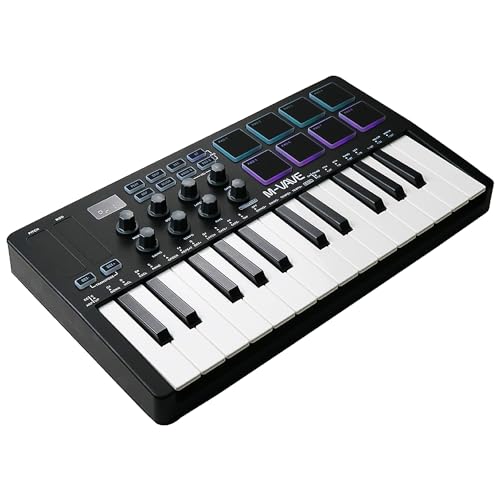
- 8 RGB velocity-sensitive drum pads
- Bluetooth with about 16-hour battery life
- Includes knobs, touch bars, and MPC software
Best For: Portable beatmaking and wireless music production
Learning-Focused Controller
Donner DMK 25 Pro MIDI Keyboard

- 8 drum pads with smart scale modes
- Includes 40 teaching courses and four DAW software options
- USB-C, OLED display, wheels, and transport controls
Best For: Beginners learning production and composition
Colorful Portable Option
M-VAVE K5 Red 25-Key MIDI Keyboard

- 8 RGB velocity-sensitive backlit pads
- Bluetooth, USB, and about 16-hour battery life
- 8 encoders plus 2 touch strips for plugin control
Best For: Mobile producers seeking a compact wireless controller
Best Overall – Akai MPK Mini MK3
The Akai MPK Mini MK3 is a strong all-around choice among MIDI keyboards with pads, combining 25 velocity-sensitive mini keys with eight MPC-style pads. Its compact USB-powered design suits home studios, beat making, virtual instruments, and DAW control.
Best For: Beat makers and home-studio producers who want dependable pads, hands-on controls, and a broad software bundle.
Pros:
- Eight velocity-sensitive MPC-style pads include Note Repeat and Full Level.
- Eight assignable 360-degree knobs provide tactile plugin and mixing control.
- Includes an arpeggiator, pitch/modulation thumbstick, MPC Beats, virtual instruments, and sound content.
Cons:
- It has only 25 mini keys.
- Connectivity is USB rather than wireless.
The MPK Mini MK3 offers a particularly complete feature set for compact beat production. Choose it if the MPC-style pad workflow and included software matter more than a larger keybed or wireless operation.
Best Wireless Value – Wireless 25-Key RGB Pad Controller
This wireless 25-key controller is a flexible option among MIDI keyboards with pads, pairing velocity-sensitive keys with eight RGB backlit pads and wireless connectivity. Its portable format and smart chord and scale features can help streamline mobile music creation.
Best For: Producers who want wireless portability, RGB pads, and compatibility with computers, tablets, and smartphones.
Pros:
- Supports battery-powered wireless use for creating music away from a desk.
- Eight RGB backlit pads and 25 keys offer velocity and aftertouch features.
- Provides USB, Bluetooth, direct wireless, and wireless MIDI connection options.
- Smart chord and scale features can assist beginners and experienced users.
Cons:
- The supplied notes do not specify battery life.
- It includes only a USB cable and user manual, without a listed software bundle.
With multiple connection methods and a portable design, this controller is well suited to flexible setups. It is a practical pick when wireless operation and RGB pad feedback are priorities.
Best for More Keys – M-Audio Oxygen Pro Mini 32
The M-Audio Oxygen Pro Mini 32 expands on the compact MIDI keyboard format with 32 velocity-sensitive semi-weighted mini keys and eight RGB pads. It also adds four knobs, four faders, DAW auto-mapping, and dedicated performance tools for more detailed production control.
Best For: Producers who want more keys and broader DAW control without moving to a full-size controller.
Pros:
- Provides 32 velocity-sensitive semi-weighted mini keys.
- Eight RGB velocity-sensitive pads support Note Repeat, clip launching, and triggering.
- Four knobs and four faders add hands-on control for instruments, effects, and DAWs.
- Includes Smart Chord, Smart Scale, arpeggiator, pitch/modulation wheels, MIDI Out, and bundled software.
Cons:
- It is USB-powered rather than wireless.
- The mini-key format may be less suitable for players wanting full-size keys.
This is the most control-focused option in the group, with eight pads plus faders and a larger 32-key range. Consider it when DAW integration and extra physical controls are more important than maximum portability.
Best Portable Feature Set – M-VAVE K5
The M-VAVE K5 combines 25 velocity-sensitive keys with eight RGB backlit pads, eight rotary encoders, and touch strips. As one of the more travel-friendly MIDI keyboards with pads, it supports Bluetooth and USB connections across Windows, Mac OS, Android, and iOS setups.
Best For: Producers who want a compact wireless controller with broad device compatibility and performance-oriented controls.
Pros:
- Built-in 2,000 mAh battery is specified for about 16 hours of use.
- Eight RGB velocity-sensitive pads and eight assignable rotary encoders support production control.
- Capacitive touch strips provide pitch-bend control.
- Supports Bluetooth and USB with Windows, Mac OS, Android, and iOS compatibility.
Cons:
- It has only 25 mini keys.
- The supplied notes do not detail the included software titles.
The K5 stands out for combining wireless portability, touch-strip control, and wide platform support in a compact chassis. It is a strong fit for producers who move between mobile devices and desktop DAWs.
Versatile Studio Pick – Akai MPK Mini Plus 37-Key
The Akai MPK Mini Plus is a strong choice among midi keyboards with pads when you want more room for melodic playing without giving up beat-making controls. Its 37-key layout, eight RGB MPC pads, assignable knobs, and USB, MIDI, and CV/Gate connectivity suit both computer-based production and hardware setups.
Best For: Producers who need three octaves, pad performance, and flexible connections for studio or modular gear.
Pros:
- 37 velocity-sensitive keys provide three full octaves for melodies, chords, and harmonies.
- Eight RGB MPC pads support dynamic finger drumming, with Chord and Scale modes for easier performance.
- Built-in 64-step sequencer, CV/Gate, MIDI I/O, and eight assignable knobs expand hands-on control.
Cons:
- Larger than a typical 25-key mini controller.
- Its broad feature set may be more than beginners need for basic beat programming.
The MPK Mini Plus is the most expandable option here, particularly if you expect to connect external synths or modular equipment. Choose it when keyboard range and connectivity matter as much as pads.
Portable Budget Pick – RockJam RJMK25 25-Key
The RockJam RJMK25 keeps the core features of midi keyboards with pads in a compact, travel-friendly package. It combines 25 velocity-sensitive mini keys with eight backlit drum pads, eight assignable knobs, Bluetooth MIDI, and a rechargeable battery for flexible beat-making on the go.
Best For: Beginners and mobile producers who want a lightweight controller with pads and wireless connectivity.
Pros:
- Eight backlit MPC-style pads include note repeat for beats, samples, and finger drumming.
- Rechargeable battery and compact 1.8-pound design are convenient for travel.
- Bluetooth MIDI, USB, and broad DAW compatibility support flexible setups.
Cons:
- 25 mini keys offer less playing range than the 37-key Akai model.
- Its compact layout may feel limiting for extended piano-style parts.
The RJMK25 is a practical entry point if portability and simple beat control are priorities. Its rechargeable design and Bluetooth support make it especially appealing for producers who do not want to stay tethered to a desk.
Modern Beat-Making Pick – Akai MPK Mini IV
The Akai MPK Mini IV is a modern option among midi keyboards with pads, pairing 25 velocity-sensitive mini keys with pressure-sensitive RGB MPC pads and a full-color display. USB-C, a push/turn encoder, mapped DAW controls, and included software make it suited to quick production workflows.
Best For: Beat-makers and producers who want current Akai pad performance, visual feedback, and streamlined DAW control.
Pros:
- Eight velocity- and pressure-sensitive MPC pads provide expressive finger drumming with RGB feedback.
- Full-color screen, push/turn encoder, and eight assignable knobs improve hands-on navigation.
- Includes Ableton Live Lite 12, instrument software, Melodics access, Splice access, and NKS integration.
Cons:
- Its 25 mini keys provide less range than a 37-key controller.
- USB-C connectivity may require an adapter for some older setups.
The MPK Mini IV is a compelling choice for creators who prioritize pad expression and an efficient modern interface. It is particularly well suited to compact studios, travel rigs, and producers who want included software to start quickly.
Wireless Beatmaking Pick – M-VAVE K5 25-Key MIDI Keyboard
For shoppers comparing midi keyboards with pads, the M-VAVE K5 combines a 25-key velocity-sensitive semi-weighted keybed with eight RGB drum pads, eight knobs, and wireless connectivity. Its compact design and built-in battery make it practical for mobile production, while smart chord and scale features add performance flexibility.
Best For: Portable beatmaking and producers who want wireless control with included MPC software.
Pros:
- Eight velocity-sensitive RGB pads support expressive beat creation and sample triggering.
- Bluetooth connectivity and a 2,000 mAh battery provide about 16 hours of portable use.
- Includes eight assignable knobs, two touch bars, and MPC beat software.
- Works with Windows, Mac, Android, iOS, and numerous major DAWs.
Cons:
- The 25 mini-key layout offers less range than a full-size keyboard.
- It requires a computer or compatible mobile device and music software for production.
The K5 is a feature-rich option when pads and portability matter as much as keys. It stands out for wireless operation, long stated battery life, and a broad control layout in a small chassis.
Learning-Focused Controller – Donner DMK 25 Pro MIDI Keyboard
The Donner DMK 25 Pro is one of the more teaching-oriented midi keyboards with pads, pairing eight drum pads with smart scales, arpeggio, note repeat, and chord functions. Its OLED display, touch control, and USB-C connection suit beginners and mobile producers who want guided features in a compact controller.
Best For: Beginners who want built-in composition tools, teaching courses, and broad DAW compatibility.
Pros:
- Eight drum pads support beat production alongside the 25-key controller.
- Smart dynamic scale mode and 16 scale tones simplify melodies, bass lines, and leads.
- Includes arpeggio, note repeat, chord functions, four DAW software options, and 40 teaching courses.
- USB-C connectivity, an OLED display, four assignable wheels, and transport controls add workflow flexibility.
Cons:
- It does not produce sound on its own and must connect to a phone or computer running DAW software.
- Mobile use may require a separately purchased adapter for interfaces other than the included USB-C setup.
The DMK 25 Pro is a strong choice for users who value guided learning and smart performance modes. Its feature set is especially useful for getting started, though it remains dependent on external software for sound.
Colorful Portable Option – M-VAVE K5 Red 25-Key MIDI Keyboard
The red M-VAVE K5 is a compact choice among midi keyboards with pads, offering 25 velocity-sensitive keys, eight RGB backlit pads, eight assignable encoders, and two touch strips. Bluetooth and a built-in battery make it suitable for composing away from the studio, while smart chord and scale functions support performance and practice.
Best For: Mobile producers who want a compact red controller with wireless operation and hands-on plugin control.
Pros:
- Eight RGB backlit velocity-sensitive pads provide visual and expressive beat control.
- Bluetooth and USB connectivity support Windows, Mac, Android, and iOS devices.
- The 2,000 mAh battery is rated for about 16 hours of wireless use.
- Eight rotary encoders and two capacitive touch strips offer control over mixing and synth parameters.
Cons:
- The 25-key mini format is compact but limited for players needing a wider keyboard range.
- As a MIDI controller, it relies on compatible production software or devices to generate sound.
This version delivers the same practical portable feature set in a distinctive red finish. It is a sensible fit for producers who prioritize pads, wireless convenience, and compact plugin control over a larger keybed.
How We Picked the Best Midi Keyboards with Pads
We focused on the features that most affect everyday workflow: key count and feel, pad quantity and responsiveness, control layout, connectivity, portability, software compatibility, and overall value. The lineup includes familiar Akai, M-Audio, Donner, RockJam, and M-VAVE options, with models suited to beginners, mobile producers, beat makers, and performers.
Because specifications and bundles can vary by seller, confirm the included software, wireless accessories, operating-system support, and exact keybed description before purchasing.
Quick Comparison
| Best For | What to Look For |
|---|---|
| Beginners | Simple USB setup, included software, and clearly labeled controls |
| Beat makers | Responsive backlit pads, pad modes, and easy drum-programming access |
| Portable production | 25 or 32 keys, lightweight construction, and USB-C or Bluetooth connectivity |
| More melodic range | 37 keys, octave controls, and a comfortable pitch or modulation interface |
| Live performance | Reliable mapping, sturdy controls, low setup friction, and useful displays |
Key Buying Factors for Midi Keyboards with Pads
Keys and Playing Feel
Twenty-five keys are highly portable but may require frequent octave shifting. A 32- or 37-key controller gives melodies and chord voicings more room. Check whether the keys are velocity-sensitive, semi-weighted, or described only as dynamic, since these terms affect expressive control and playing comfort.
Pads and Performance Controls
Eight pads are enough for basic drum patterns, clip triggering, and sample hits. Look for backlighting, velocity sensitivity, pad-bank switching, and a layout that is easy to reach while playing. Knobs, buttons, arpeggiators, scales, and OLED displays can speed up editing, but they are most valuable when your software maps them reliably.
Connectivity and Compatibility
USB is the simplest choice for a computer or tablet setup. USB-C may reduce cable clutter with newer devices, while Bluetooth can help with wireless workflows but may introduce pairing or latency considerations. Confirm your DAW, device, and required adapters are supported.
Size, Power, and Software
Measure your workspace before choosing a controller, particularly if it includes 37 keys. Also check whether it draws power over USB, uses batteries, or requires an adapter. Bundled virtual instruments and DAW software can add meaningful value for new producers.
Who Should Buy Which Midi Keyboards with Pads?
Choose a compact 25-key model if portability, desk space, and beat creation matter most. Beginners should prioritize straightforward mapping and an included software package. Producers who want more melodic freedom should consider a 32- or 37-key option. Wireless models suit mobile setups, while USB-C controllers are a practical match for newer laptops and tablets. If live performance is the priority, favor sturdy construction, responsive pads, dedicated controls, and dependable compatibility over the highest feature count.