Multitrack looping can turn a single idea into a full performance, whether you play guitar, sing, beatbox, or build layered arrangements on stage. The best units make it easy to capture parts quickly, keep timing tight, and manage multiple phrases without slowing you down.
Below, we focus on multitrack loop stations that offer the right mix of hands-on control, storage, inputs, and live reliability for different types of creators.
Best 10 Multitrack Loop Stations Picks for 2026
Tabletop Performance Hub
Boss RC-505 Mk2 Tabletop Looper

- Five stereo tracks for layered live looping
- Two XLR mic inputs with phantom power
- Rhythm generator and tabletop controls
Best For: Tabletop performers who need five-track control and vocal-ready inputs.
Portable Dual-Mode Choice
Sheeran Looper + Dual Track Pedal

- Single and dual-track looping modes
- Stores up to 128 loops and 3+ hours of audio
- USB audio interface for recording and streaming
Best For: Gigging players and streamers who want a rugged, portable dual-track looper.
Compact Hands-On Station

- Two stereo tracks with fingertip controls
- Four input FX and four track FX
- 64 phrase memories plus USB audio/MIDI
Best For: Club performers and beatboxers who want compact tabletop looping with effects.
Budget Dual-Track Workhorse

- Dual-track looping with SERIAL and FREE modes
- 100 drum rhythms with 16 kit styles
- 99 project storage spaces plus MIDI I/O
Best For: Players who want an affordable dual-track looper with rhythms and MIDI.
Premium Multitrack Looper

- Five stereo phrase tracks with dedicated faders
- 49 Input FX and 53 Track FX for live shaping
- Two XLR inputs plus flexible USB/DAW integration
Best For: Vocalists and live loop performers who want deep control
Budget-Friendly Triple-Loop Pedal
Donner Triple Looper Guitar Pedal

- Three loop slots with 90 minutes total recording time
- Bright screen and one-footswitch control simplify use
- Unlimited overdubs plus auto-save for sketching ideas
Best For: Players who want simple looping with multiple saved sections
Loop Station Bundle with Balanced Cable

- Five stereo tracks with dedicated faders
- 32-bit audio processing and four effects per section
- Includes a 10-foot balanced TRS cable
Best For: Buyers who want the RC-505MKII with a balanced cable
Flagship Multitrack Looping
Boss RC-600 Loop Station Pedal
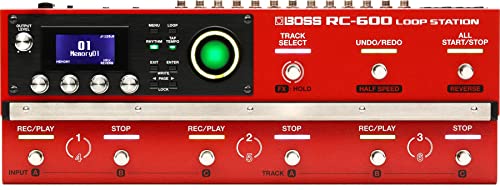
- Six stereo phrase tracks
- Two XLR mic inputs with phantom power
- 99 phrase memory presets
Best For: Players who need flexible stereo looping and pro-style input options
Classic Twin-Track
BOSS RC-30 Loop Station Twin Guitar Pedal

- Two synchronized stereo tracks
- Up to three hours of stereo recording
- Built-in effects for loops
Best For: Guitarists who want a simple twin-track looper with hands-on control
Performance Bundle Multitrack
Boss RC-600 Loop Station Pedal Bundle

- Assignable control for track operations and FX
- 49 input effects and 53 track effects
- Includes cables, picks, and cloth
Best For: Performers who want the RC-600 with included setup accessories
Tabletop Performance Hub – Boss RC-505 Mk2 Tabletop Looper
If you’re comparing multitrack loop stations for hands-on performance, the Boss RC-505 Mk2 is built for tabletop control and live layering. It gives you five stereo tracks, dual XLR mic inputs with phantom power, and two stereo line input pairs, so it fits vocalists, beatboxers, and players who want a central looping rig.
Best For: Tabletop performers who want five-track looping, mic inputs, and physical controls for live set building.
Pros:
- Five stereo tracks provide more layering space than basic dual-track loopers.
- Two XLR mic inputs with phantom power make it practical for vocals and beatboxing.
- Two stereo line input pairs expand connection options for instruments and external sources.
- Includes rhythm generator and physical button/knob controls for performance use.
Cons:
- It is a tabletop unit, so it is not as compact as a floor pedal looper.
- Uses corded power instead of battery operation.
Overall, the RC-505 Mk2 stands out when you want a tactile multitrack loop station with broad input flexibility and enough tracks to build full arrangements live. It is especially compelling for performers who prefer hands-on control over footswitch-based operation.
Portable Dual-Mode Choice – Sheeran Looper + Dual Track Pedal
For buyers looking at multitrack loop stations in a portable pedal format, the Sheeran Looper + focuses on simple operation and performance-ready storage. It offers single and dual-track looper modes, 32-bit audio, internal storage for up to 128 loops, and USB audio interface support for recording or streaming.
Best For: Gigging players and streamers who want a rugged dual-track looper with storage and USB connectivity.
Pros:
- Four looping modes give you flexible workflow options for different performances.
- Can save up to 128 loops with over 3 hours of total audio on internal storage.
- Functions as a 2-in/2-out USB audio interface for DAW recording and live streams.
- Steel chassis and battery power make it suitable for mobile use.
Cons:
- Only two tracks, so it is less expansive than larger tabletop multitrack loop stations.
- Requires 4 AA batteries for portable operation under typical use.
This is a strong choice if you want a looper that is easy to carry, simple to run, and ready for saving and transferring loops. It trades deep track count for portability, recording convenience, and performance-focused design.
Compact Hands-On Station – BOSS RC-202 Loop Station
The BOSS RC-202 is a compact tabletop option for buyers who want multitrack loop stations with fingertip control instead of foot operation. It offers two simultaneous stereo phrase tracks, four input FX, four track FX, 64 phrase memories, and USB audio/MIDI integration for club-style looping and electronic performance.
Best For: Club performers, electronic musicians, and beatboxers who want a compact two-track tabletop looper.
Pros:
- Two stereo phrase tracks with dedicated controls and loop status indicators.
- Four input FX and four track FX can run simultaneously for more creative processing.
- 64 phrase memories help store loops, settings, and performance variations.
- USB audio/MIDI and optional external control expand setup flexibility.
Cons:
- Only two tracks, so it is less expansive than higher-track loop stations.
- Uses corded power, so it is not designed for battery use.
For users who value compact size and detailed control, the RC-202 offers a capable feature set without taking over a desk or performance table. It is a good fit when you want a compact station that still gives you layered effects and memory storage.
Budget Dual-Track Workhorse – VALETON VLP-200 Stereo Looper
If you want multitrack loop stations with extra drum features at a lower profile, the VALETON VLP-200 combines dual-track stereo looping with built-in rhythms. It supports two collaboration modes, manual or auto recording, 99 project storage spaces, MIDI in/out, and 100 stereo drum rhythms sampled at 24-bit/48 kHz.
Best For: Players who want an affordable dual-track looper with drum rhythms and MIDI sync options.
Pros:
- Dual-track looping with SERIAL and FREE collaboration modes.
- Includes 100 stereo drum rhythms across 16 drum kit styles.
- 99 project storage spaces give you room to save multiple ideas.
- MIDI and CTRL interfaces support syncing and tap tempo control.
Cons:
- Only two loop tracks, so it is less capable than larger multitrack loop stations.
- Uses physical button control rather than a more elaborate hands-on interface.
The VLP-200 is a practical option if you want looping plus built-in rhythm support without moving to a larger workstation. Its storage, drum machine, and MIDI connectivity make it useful for songwriting and compact live setups.
Premium Multitrack Looper – Boss RC-505 MkII Loop Station
If you want multitrack loop stations built for hands-on performance, the Boss RC-505 MkII gives you five phrase tracks, dedicated track controls, and plenty of real-time routing and FX options. It’s designed for live looping, vocal work, and studio-style creativity, with faders that offer finer adjustment and a workflow that stays responsive while you perform.
Best For: Vocalists, beatboxers, and looping performers who want deep control and multiple onboard effects.
Pros:
- Five simultaneous stereo phrase tracks with dedicated controls and independent faders
- 49 Input FX and 53 Track FX types, with up to four active in each section
- Two XLR mic inputs plus two mono/stereo line input pairs for flexible routing
- Mark Back, assignable buttons, and external control jacks support performance use
Cons:
- More complex than a simple looper, so it may take time to learn
- Best suited to users who will actually use its deeper FX and routing options
The RC-505 MkII is the most feature-rich option here, especially if you want a looper that behaves like a performance hub rather than a basic pedal. Its strength is control: more tracks, more FX, and more ways to shape a loop in real time.
Budget-Friendly Triple-Loop Pedal – Donner Triple Looper Guitar Pedal
For players looking at multitrack loop stations without a steep learning curve, the Donner Triple Looper keeps things simple with three loop slots, a bright screen, and one-footswitch control. It’s a practical choice for practicing ideas, building song sections, or layering parts when you want straightforward looping on a compact pedal.
Best For: Guitarists and bass players who want an easy, compact looper with multiple saved loops.
Pros:
- Three independent loop slots with up to 90 minutes total recording time
- Bright screen makes loop status and timing easy to follow
- Unlimited overdubs support layered arrangements
- Auto-save helps preserve ideas when powered off
Cons:
- Only one footswitch, so it’s less flexible than larger performance loopers
- Power supply is not included
- More basic than multitrack units with track-level controls and onboard FX banks
The Triple Looper is a sensible pick if you want an uncomplicated looping pedal that still gives you multiple loop memories and reliable overdubbing. It won’t replace a full performance station, but it covers the essentials cleanly.
Loop Station Bundle with Balanced Cable – BOSS RC-505MKII Bundle
BOSS RC-505MKII Loop Station and Hosa CSS-110 10' TRS to TRS Balanced Interconnect Cable Bundle
Check Price On AmazonThis bundle is a strong fit for buyers comparing multitrack loop stations and wanting a ready-to-connect setup. You get the BOSS RC-505MKII with five simultaneous stereo phrase tracks, dedicated controls, and onboard input and track FX, plus a 10-foot balanced TRS cable for pro audio connections.
Best For: Loop performers who want the RC-505MKII plus a balanced cable in one package.
Pros:
- Five simultaneous stereo phrase tracks with independent volume faders
- 32-bit AD/DA and 32-bit floating-point processing
- Input FX and track FX sections with four simultaneous effects each
- Includes a 10-foot TRS to TRS balanced interconnect cable
Cons:
- The bundle focuses on the looper plus cable, not a larger accessory kit
- Like the standalone unit, it is aimed at users who need advanced looping controls
If you already know you want the RC-505MKII, this bundle adds a practical cable right away and keeps the purchase focused. It’s a good value choice when balanced connectivity matters and you want to start building loops immediately.
Flagship Multitrack Looping – Boss RC-600 Loop Station Pedal
If you want multitrack loop stations with serious routing and performance control, the Boss RC-600 is built for larger setups. It offers six stereo phrase tracks, two XLR mic inputs with phantom power, and two stereo instrument/line input pairs, making it a strong fit for players who need to capture multiple sources at once.
Best For: Guitarists, singers, and loop performers who need a highly flexible stereo looper with pro-style input options.
Pros:
- Six stereo phrase tracks for expanded looping control
- Two XLR microphone inputs with phantom power
- Two stereo instrument/line input pairs for flexible connections
- Includes 99 phrase memory presets and a rhythm guide
Cons:
- Larger footprint than simpler loop pedals
- May be more than casual users need
Overall, the RC-600 is aimed at players who want deep control, high-fidelity stereo looping, and room to build complex performances. If your priority is a feature-rich multitrack looper rather than a basic pedal, this one stands out.
Classic Twin-Track – BOSS RC-30 Loop Station Twin Guitar Pedal
The BOSS RC-30 is a straightforward option in multitrack loop stations for players who want twin-track stereo looping without a complicated layout. It combines two synchronized stereo tracks, dedicated volume faders, and track-select buttons with built-in effects and generous onboard memory.
Best For: Guitarists who want a reliable twin-track looper with simple hands-on control.
Pros:
- Two synchronized stereo tracks with dedicated volume faders
- Up to three hours of stereo recording time
- 99 onboard memory phrases for storing loops
- Built-in effects for processing loops
Cons:
- Only two tracks compared with newer larger loop stations
- Less expanded input flexibility than higher-end models
For players who value a clear layout and dependable stereo looping, the RC-30 covers the essentials well. It is a practical choice if you want multitrack looping features without moving into a much larger performance unit.
Performance Bundle Multitrack – Boss RC-600 Loop Station Pedal Bundle
This bundle is a practical way to get one of the most capable multitrack loop stations along with basic setup accessories. It centers on the RC-600’s assignable control options, two XLR mic inputs, two mono/stereo input pairs, and a large collection of input and track effects.
Best For: Performers who want the RC-600 plus included cables and accessories in one package.
Pros:
- Assignable footswitch and pedal control for track operations and FX
- 49 input effects and 53 track effects
- Two XLR mic inputs and two mono/stereo input pairs
- Includes instrument cable, patch cable, picks, and polishing cloth
Cons:
- Bundle adds accessories, not a simpler pedal layout
- Still a full-size unit that takes up significant space
If you want the RC-600’s deeper looping and routing features with a few useful extras in the box, this bundle makes sense. It is a performance-focused choice for players who plan to use the pedal’s broader control and effects options right away.
How We Picked These Multitrack Loop Stations
We prioritized real-world usability first: track count, phrase memory, overdub behavior, connectivity, and how well each unit supports performance-style looping. We also looked for models that fit different workflows, from tabletop vocal stations to pedalboard-friendly options for guitar and bass.
Because Multitrack Loop Stations are used in everything from rehearsal rooms to gigs, we gave extra weight to build quality, ease of operation, and features that reduce menu-diving during a live set.
Quick Comparison
If you want the simplest setup, look for fewer tracks and a straightforward control layout. If you need more arrangement control, choose a unit with more stereo tracks, deeper memory, and flexible I/O. Tabletop models usually suit vocalists and beatmakers, while pedal units are often better for players who want hands-free operation.
Key Buying Factors for Multitrack Loop Stations
Track Count and Layer Control
More tracks help you build complex songs, but only if the interface stays manageable. Two-track units are great for focused looping, while four- or six-track designs are better when you want sections, transitions, and multiple instruments.
Inputs, Outputs, and Connectivity
Check whether the unit supports microphones, instruments, line-level gear, or stereo sources. USB audio, MIDI, and balanced outputs can be especially useful for recording, syncing, and clean live signal routing.
Memory and Storage
Phrase memory matters if you want to save ideas, recall songs, or switch between sets. Higher storage counts are a plus for performers who build many loops over time or need backup options.
Hands-Free Vs. Tabletop Workflow
Pedal-based Multitrack Loop Stations suit guitarists and multi-instrumentalists who need foot control. Tabletop designs are usually better for vocal looping, studio sketching, and performers who want direct access to buttons and screens.
Who Should Buy Which Multitrack Loop Stations?
Choose a compact dual-track model if you want a simple, portable entry point. Go with a more advanced pedal or tabletop station if you need multiple stereo tracks, stronger memory management, or live arrangement control. If you perform with vocals and instruments together, prioritize flexible inputs and intuitive switching over the highest track count alone.
For most buyers, the best Multitrack Loop Stations are the ones that match how you actually perform: quick to start, easy to stop, and reliable enough to trust in front of an audience.