Choosing the right stage monitor can make vocals, instruments, and cues easier to hear without overwhelming the rest of the mix. The best option depends on your venue, performer count, power needs, and whether you prefer floor wedges, powered speakers, or in-ear monitoring.
We’ve gathered 10 stage-monitoring options for rehearsals, live performances, DJ setups, worship spaces, and music production, with practical guidance to help you match the design to your workflow.
Best 10 Stage Monitors for Music Picks for 2026
Best Value Pair
Seismic Audio SA-10MT Stage Monitors
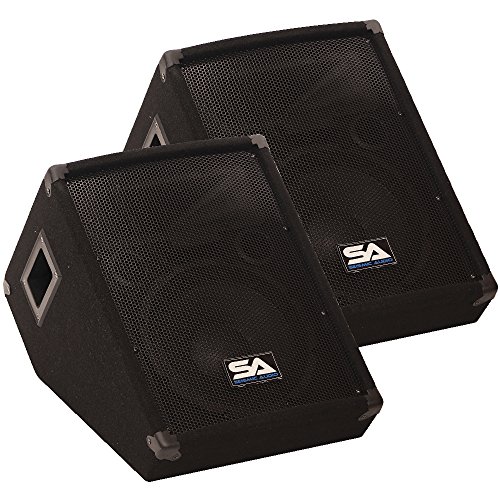
- Matched pair of 10-inch wedge monitors
- 150 watts RMS per speaker
- Titanium horn with XLR and Aux connectivity
Best For: Bands needing two passive floor monitors
Best Compact Powered Option
Alto TX408 Powered Stage Monitor

- 350-watt powered 8-inch speaker
- Built-in two-channel mixer
- Bluetooth and wedge-monitor positioning
Best For: Small gigs, home studios, and mobile DJs
Best Traditional Floor Wedge

- 12-inch two-way passive monitor
- 300-watt program, 600-watt peak handling
- 97 dB sensitivity and built-in pole socket
Best For: Amplified band and sound-reinforcement systems
Best Mid-Size Powered Monitor

- 350-watt powered 10-inch speaker
- Floor-wedge and pole-mount operation
- Mixer, Bluetooth, and wireless linking
Best For: Mid-sized gigs, clubs, and mobile DJ setups
Best Studio Monitor Upgrade

- 5.25-inch woofer and silk-dome tweeter
- 80-watt Class AB amplification
- XLR, 1/4-inch, and RCA inputs
Best For: Home studios and near-field mixing
Best Full-Size PA System

- 2400-watt peak output and 131dB SPL
- 15-inch subwoofer with six HF drivers
- Bluetooth DSP and feedback suppression
Best For: Large venues, festivals, and touring bands
Best Compact Stereo Pair

- 3.5-inch Kevlar woofers
- Stereo pair with active and passive speakers
- Front headphone output and flexible inputs
Best For: Desktop production, streaming, and podcasting
Portable PA Pick

- 50-watt compact monitor with a 3-channel mixer
- USB MP3 playback and Bluetooth streaming
- Useful for vocals, keyboards, rehearsals, and small live setups
Best For: Portable, multi-purpose monitoring with built-in playback
Wireless Practice Pick

- 2.4GHz wireless monitoring with under-5ms latency
- 40–60-foot open-space operating range
- Over eight hours of battery life and 12 channel banks
Best For: Personal guitar practice and cable-free monitoring
Studio Accuracy Pick

- Powered 5-inch near-field monitor with 82 watts
- Boundary EQ helps with desktop and wall placement
- Balanced XLR and 1/4-inch TRS inputs
Best For: Home-studio production, mixing, and detailed near-field listening
Best Value Pair – Seismic Audio SA-10MT Stage Monitors
Seismic Audio - SA-10MT - Pair of 10" Floor / Stage Monitors Wedge Style with Titanium Horn
Check Price On AmazonIf you need stage monitors for music without buying two separate cabinets, the Seismic Audio SA-10MT supplies a matched pair of wedge-style monitors. Each 10-inch, two-way speaker is rated at 150 watts RMS and uses a titanium compression horn for live-performance monitoring.
Best For: Bands, venues, and performers who need two wired floor monitors for live music events.
Pros:
- Includes two wedge-style stage monitors.
- 10-inch woofer with a 40-ounce magnet and 2-inch voice coil.
- Titanium compression horn and XLR/Aux connectivity.
Cons:
- Not waterproof or water resistant.
- Passive design requires an external amplifier.
- At 44 pounds per listed product package, portability may be limited.
The SA-10MT is a practical choice when a setup needs two conventional floor wedges and external amplification is already available. Its pair-focused package makes it especially useful for small bands and shared vocal or instrument monitoring.
Best Compact Powered Option – Alto TX408 Powered Stage Monitor
The Alto TX408 is a compact powered speaker suited to stage monitors for music, small gigs, DJs, and presentations. Its 8-inch woofer, 350-watt bi-amplified system, built-in mixer, and Bluetooth support make it easy to use when space and setup time matter.
Best For: Small live performances, home studios, mobile DJs, and intimate venues needing a compact powered monitor.
Pros:
- 350 watts of bi-amplified Class-D power.
- Built-in two-channel mixer for microphone, line, and Bluetooth inputs.
- Wedge-monitor placement and 36 mm pole socket support flexible setup.
- Bluetooth streaming and True Wireless Stereo capability.
Cons:
- 8-inch woofer provides less low-frequency scale than the larger models here.
- Not waterproof or water resistant.
- Bluetooth range is listed at 75 feet, so wired connections may be preferable for critical monitoring.
The TX408 stands out for convenient, self-contained operation. It is a strong fit for performers who want a small powered wedge with mixing and wireless playback features rather than a traditional passive cabinet.
Best Traditional Floor Wedge – Yamaha BR12M 12-Inch Monitor
The Yamaha BR12M is a traditional passive floor monitor for music reinforcement and stage monitoring. Its 12-inch woofer, 1-inch compression driver, 90-by-40-degree horn, and 300-watt program rating are designed for performers who want a larger-format wedge with an external amplifier and mixer.
Best For: Bands, sound-reinforcement systems, and venues that already use external amplification.
Pros:
- 12-inch woofer for a larger monitor format.
- 300-watt program and 600-watt peak power handling.
- 97 dB sensitivity for efficient output.
- Built-in pole socket, handles, corner protectors, and protection circuitry.
Cons:
- Passive speaker requires a compatible amplifier.
- At 15.6 kg, it is heavier than the compact powered Alto model.
- No wireless connectivity is provided.
The BR12M is a sensible pick for a conventional, high-output monitoring rig. Its 12-inch format and durable handling features favor installed or regularly transported setups where an amplifier rack is already part of the system.
Best Mid-Size Powered Monitor – Alto TX410 Stage Monitor
The Alto TX410 combines a 10-inch driver with 350 watts of bi-amplified power, making it a versatile option among stage monitors for music. It can serve as a floor wedge or pole-mounted speaker and adds a two-channel mixer, Bluetooth, and wireless speaker-linking features for flexible event setups.
Best For: Mid-sized performances, clubs, rehearsal spaces, mobile DJs, and presenters who want powered monitoring with straightforward controls.
Pros:
- 350-watt bi-amplified system with a 10-inch LF driver.
- Designed for both floor-monitor and pole-mounted use.
- Two-channel mixer accepts microphone, line-level, and Bluetooth sources.
- Bluetooth True Wireless Stereo and wireless loudspeaker linking support.
Cons:
- Not waterproof or water resistant.
- Requires corded power for operation.
- Wireless range is listed at up to 30 meters, which may vary by environment.
The TX410 offers a useful middle ground between compact portability and larger monitor coverage. It is particularly appealing when one powered cabinet must handle monitoring, playback, or small-venue sound reinforcement without a separate amplifier.
Best Studio Monitor Upgrade – PreSonus Eris E5
If you want stage monitors for music practice, production, or mix checking at a desktop, the PreSonus Eris E5 offers a practical near-field setup. Its 5.25-inch woofer, silk-dome tweeter, 80-watt Class AB amplification, and flexible balanced inputs make it well suited to detailed listening in smaller monitoring environments.
Best For: Home studios, mixing, and near-field music monitoring.
Pros:
- 5.25-inch woven composite woofer delivers solid low-end sound with minimal bass distortion.
- Silk-dome tweeter provides balanced high-frequency sound while reducing harshness.
- XLR, 1/4-inch, and RCA inputs support a range of studio and playback equipment.
- Acoustic tuning controls help adapt the monitor to its environment.
Cons:
- This is a single monitor, so a stereo setup requires another unit.
- Its tabletop near-field design is intended for close listening rather than large venues.
- The monitor is wired and not waterproof.
The Eris E5 is a strong choice when accuracy and connection flexibility matter more than portability. It is especially appealing for producers who want a compact monitor with useful room-adjustment controls and substantial included software.
Best Full-Size PA System – NBVOICE PRX ONE
For shoppers seeking stage monitors for music in larger live settings, the NBVOICE PRX ONE is a high-output PA system built for coverage and touring use. It combines a 15-inch subwoofer, 2400-watt peak output, Bluetooth DSP control, multiple inputs, and a road-ready enclosure for events, bands, and outdoor performances.
Best For: Large venues, outdoor events, touring bands, and high-volume live sound.
Pros:
- 2400-watt peak output and 131dB SPL are designed for large crowds and spaces up to 5,000 square feet.
- 15-inch subwoofer and six high-frequency drivers support powerful lows and vocal clarity.
- Bluetooth DSP control includes presets, effects, compression, and automatic feedback suppression.
- Birch plywood construction, casters, handles, and a stated seven-year warranty support touring use.
Cons:
- At approximately 128 pounds, this system is considerably less portable than compact monitors.
- Its large enclosure requires more storage and setup space.
- The listed 2400-watt figure is peak output, not continuous power.
The PRX ONE is best viewed as a complete live PA solution rather than a small personal monitor. Its output, connectivity, control features, and included touring components make it a compelling option when reach and durability are priorities.
Best Compact Stereo Pair – M-AUDIO BX3
The M-AUDIO BX3 is a compact stereo pair for desktop listeners who need stage monitors for music production, streaming, podcasting, or general playback. Its 3.5-inch Kevlar woofers, silk-dome tweeters, wired connectivity, and front headphone access make it convenient for small workspaces.
Best For: Desktop music production, streaming, gaming, and podcasting.
Pros:
- Supplied as a stereo pair with one active and one passive speaker.
- 3.5-inch Kevlar woofers and silk-dome tweeters provide punchy lows and clear highs.
- Rear 1/4-inch, 1/8-inch, and RCA inputs offer broad connection flexibility.
- Front headphone and auxiliary access supports quiet, convenient sessions.
Cons:
- The compact 3.5-inch woofers provide less low-end scale than larger monitors.
- These tabletop speakers are not intended for large live venues.
- They require wired connections and are not water resistant.
The BX3 makes sense when desk space, simple setup, and stereo listening are more important than maximum output. It is a versatile entry-level option for creators who want more capable monitoring than typical computer speakers.
Portable PA Pick – Behringer EUROLIVE B105D
For musicians who need versatile stage monitors for music, the Behringer EUROLIVE B105D combines a 50-watt amplifier, a three-channel mixer, and multiple playback options in a compact cabinet. It can support vocal and keyboard monitoring, live performance, home recording, and multimedia use.
Best For: Musicians seeking a compact, multi-purpose monitor with Bluetooth and USB playback.
Pros:
- 50-watt output in a lightweight 8.2-pound design.
- Three-channel mixer with three-band EQ.
- Built-in MP3 player and Bluetooth audio streaming.
- Suitable for vocal, keyboard, live-performance, and home-studio monitoring.
Cons:
- Its 5-inch woofer is geared toward compact monitoring rather than large-scale sound reinforcement.
- It requires corded electric power.
- It is not water resistant.
The B105D is a practical choice when portability and input flexibility matter more than maximum output. Its integrated media features make it especially convenient for rehearsals, presentations, and small monitoring setups.
Wireless Practice Pick – JOYO JW-07 Wireless IEM
The JOYO JW-07 takes a different approach to stage monitors for music by sending a monitor signal to in-ear receivers rather than a floor speaker. Its 2.4GHz wireless connection, low latency, and compact clip-on design suit personal practice, guitar monitoring, studio work, DJ use, and live performance.
Best For: Guitarists and performers who want cable-free personal monitoring during practice or performance.
Pros:
- Under-5ms latency supports near-real-time monitoring.
- 40–60-foot operating range in open space.
- Frequency hopping helps reduce interference.
- Built-in battery provides over eight hours of use per charge.
Cons:
- One transmitter cannot connect to multiple receivers.
- The supplied compatibility notes specifically identify guitar use, so broader instrument compatibility may require verification.
- It is an in-ear system rather than a conventional floor monitor speaker.
With 12 channel banks and automatic pairing, the JW-07 is designed for convenient individual monitoring. It is a strong fit for players who prioritize mobility and low-latency feedback over room-filling sound.
Studio Accuracy Pick – JBL Professional 305P MkII
The JBL Professional 305P MkII is a powered near-field monitor for listeners who need detailed sound while producing or mixing music. Its 5-inch woofer, updated transducers, boundary EQ, and balanced inputs make it a strong candidate for desktop studios and other controlled listening spaces.
Best For: Home-studio producers and mixers seeking a detailed, wired near-field monitor.
Pros:
- 82 watts of integrated Class-D amplification.
- Balanced XLR and 1/4-inch TRS inputs with selectable sensitivity.
- Boundary EQ helps restore neutral low-frequency response near walls or work surfaces.
- Broad sweet spot supports listening and mixing away from the central axis.
Cons:
- Sold individually, so stereo monitoring requires two speakers.
- Wired only, with no wireless communication.
- Designed for near-field and studio use rather than portable stage monitoring.
The 305P MkII is best viewed as a precision-oriented studio monitor rather than a compact PA wedge. Its placement controls and flexible balanced connectivity make it well suited to careful music production and desktop listening.
How We Picked These Stage Monitors for Music
We selected products across several monitoring categories rather than treating every speaker as interchangeable. The roundup includes passive floor wedges, powered PA speakers, compact PA monitors, nearfield studio monitors, and a wireless in-ear monitoring system. We considered speaker size, amplification, portability, connectivity, monitoring purpose, and the type of user each product is likely to serve.
Specifications such as power ratings and maximum sound-pressure levels can be useful, but they do not tell the whole story. Usability, placement, frequency balance, setup requirements, and compatibility with a mixer or sound system also matter when choosing a monitor.
Quick Comparison
| Monitor type | Best suited to | Main advantage | Key limitation |
|---|---|---|---|
| Passive floor wedge | Band and vocal monitoring | Works with an existing amplifier or PA system | Requires external amplification |
| Powered PA monitor | Live performers and small venues | Simple all-in-one setup | Needs nearby AC power |
| Compact PA speaker | Speech, solo acts, and portable use | Lightweight and flexible | Less headroom than larger systems |
| Studio monitor | Recording, editing, and mixing | Nearfield detail and stereo listening | Not designed for loud stage coverage |
| Wireless IEM | Performers needing personal mixes | Reduces stage clutter and feedback risk | Requires careful frequency and fit management |
Key Buying Factors for Stage Monitors for Music
Choose the Right Monitor Format
Floor wedges project sound toward performers from the stage, while powered PA speakers simplify connection by combining the amplifier and cabinet. Studio monitors are intended for close-range listening and should not automatically be substituted for live-performance wedges. In-ear monitors are a different approach that delivers a personal feed directly to the performer.
Check Power, Sensitivity, and Headroom
Look beyond headline wattage. A monitor needs enough usable output to remain clear beside drums, guitar amplifiers, and front-of-house volume. Larger drivers often provide stronger low-frequency presence, while smaller cabinets may be easier to transport and position. Keep the system within its clean operating range to reduce distortion and feedback.
Review Inputs and System Compatibility
Confirm whether the monitor accepts the connections provided by your mixer, interface, or wireless system. Passive speakers need a correctly matched amplifier; powered models need AC outlets and generally connect directly to a mixer output. If Bluetooth, MP3 playback, or DSP control is included, treat those features as conveniences rather than substitutes for proper signal routing.
Consider Placement and Feedback Control
Place a wedge in the performer’s coverage pattern and point its microphone away from the speaker whenever possible. Equalization, gain structure, and microphone choice have a major effect on feedback. For multiple performers, make sure the mixer can provide enough independent monitor mixes.
Who Should Buy Which Stage Monitors for Music?
- Choose a passive wedge if you already own suitable amplification and want a conventional band-monitor setup.
- Choose a powered PA monitor for fast setup at rehearsals, small venues, presentations, or solo performances.
- Choose a larger powered speaker when you need more output and low-end authority for louder stages or full-band use.
- Choose a studio monitor for desktop music production, mixing, and nearfield playback rather than live stage monitoring.
- Choose wireless in-ear monitoring if performers need personal mixes, reduced stage volume, and freedom to move around.
The best Stage Monitors for Music are the ones that fit the signal chain, venue size, and listening position. Prioritize clear output, reliable connections, and enough headroom for your loudest real-world performance.