Large rooms need more than a compact subwoofer to deliver convincing movie effects, music impact, and even bass coverage. The right model combines sufficient output with a cabinet and driver size suited to your listening space.
This roundup compares 10 powered subwoofers across sealed and ported designs, including 8-, 10-, 12-, and 15-inch options. Use the buying guide below to narrow the choices by room size, listening goals, placement, and budget.
Best 10 Subwoofers for Large Rooms Picks for 2026
Room-Filling Precision

- 12-inch high-excursion driver
- 325W RMS with over 820W peak power
- App-based DSP and room tuning
Best For: Compact, tunable bass for music and home theater
Practical Theater Bass

- 10-inch front-firing IMG woofer
- 300W peak all-digital amplifier
- RCA line and LFE inputs
Best For: Straightforward home theater and gaming bass
Compact Everyday Upgrade

- 8-inch woofer with Advanced YST II
- 100W dynamic power
- Compact 12-by-14-by-12-inch cabinet
Best For: Compact systems and everyday home entertainment
High-Impact 12-Inch Bass

- 12-inch copper-spun front-firing woofer
- 400W dynamic amplifier power
- Line and LFE receiver inputs
Best For: Powerful music and home theater bass
Premium Large-Room Power

- 15-inch driver with 1,000-watt Class D amplifier
- Bass reaches 20Hz at -6dB
- Suited to spaces up to 800 square feet
Best For: Premium home theaters and large listening spaces
High-Output Home Theater Value

- 12-inch high-excursion spun-copper woofer
- 400-watt maximum acoustic output
- Bass-reflex enclosure with rear-firing port
Best For: Room-filling home theater bass
Compact Bass Upgrade
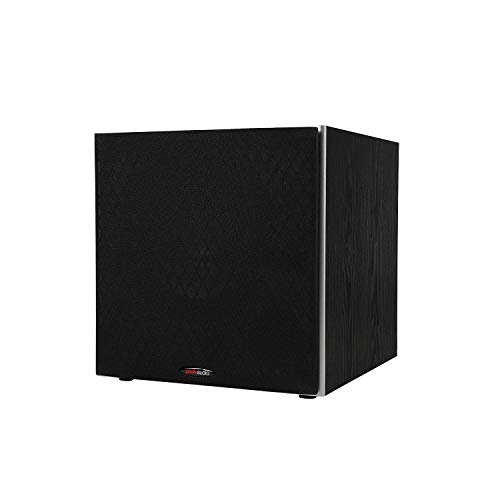
- 10-inch woofer with up to 100 watts
- 80-160Hz adjustable crossover
- Speaker-level and line-level connections
Best For: Small-to-mid-size rooms and entry-level systems
High-Output Pick
Rock Shaker 10-Inch Powered Subwoofer

- 10-inch woofer with 300W RMS output
- Adjustable volume, crossover, and phase
- RCA and high-level connectivity
Best For: Large-room home theater systems needing powerful, tunable bass
Space-Saving Choice
Edifier T5s 8-Inch Powered Subwoofer
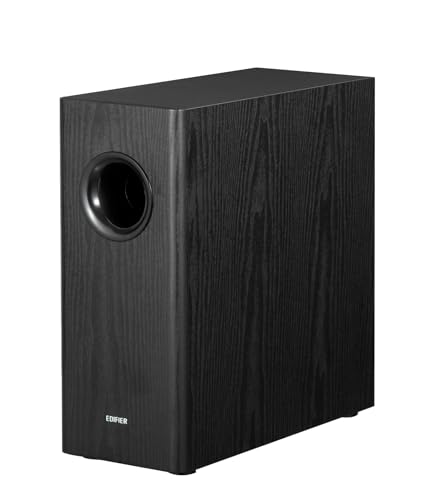
- 8-inch woofer with 35Hz deep bass
- Slim cabinet with 70W RMS Class-D power
- Adjustable low-pass filter and phase selector
Best For: Compact home audio setups needing controlled, deep bass
Flexible-Connection Pick
BESTISAN Down-Firing Powered Subwoofer

- 8-inch down-firing woofer
- RCA, LFE, AUX, and high-level inputs
- Coaxial cable included
Best For: Mixed systems needing versatile wired bass integration
Room-Filling Precision – SVS SB-1000 Pro
SVS SB-1000 Pro Subwoofer (Black Ash) | 12-in Driver, 325 Watt RMS, Sealed Cabinet
Check Price On AmazonThe SVS SB-1000 Pro is a strong choice among subwoofers for large rooms when you want controlled, room-filling bass from a relatively compact sealed cabinet. Its 12-inch driver, 325-watt RMS amplifier, DSP tuning, and app-based controls support both music and home theater use.
Best For: Buyers who want powerful, tunable bass in a compact sealed subwoofer.
Pros:
- 12-inch high-excursion driver delivers substantial output with controlled distortion.
- 325 watts RMS and more than 820 watts peak power provide strong dynamic headroom.
- App control and DSP offer convenient volume, preset, and in-room tuning adjustments.
- Rigidly braced sealed cabinet helps reduce unwanted resonance.
Cons:
- It is a wired, corded-electric subwoofer, so placement requires access to power and a suitable connection.
- Its premium control and DSP features may be more than needed for a basic system.
The SB-1000 Pro stands out for combining serious output with precise control and a cabinet compact enough for many rooms. It is particularly appealing when you want large-room capability without choosing a physically oversized enclosure.
Practical Theater Bass – Klipsch R-100SW
The Klipsch R-100SW is a straightforward option among subwoofers for large rooms, pairing a front-firing 10-inch woofer with a 300-watt peak all-digital amplifier. Its LFE and line-level RCA inputs make it compatible with many home theater receivers.
Best For: Home theater users seeking affordable, adjustable bass with conventional RCA connectivity.
Pros:
- 10-inch spun-copper IMG woofer provides dedicated low-frequency output.
- 300 watts peak power supports impactful movie and gaming sound.
- Volume, low-pass crossover, and phase controls help integrate it with a system.
- Auto power-on adds convenience for everyday use.
Cons:
- Its 10-inch driver and 150-watt continuous amplifier rating offer less headroom than larger, more powerful models.
- Connectivity is wired through RCA, with no wireless communication technology.
The R-100SW keeps setup simple while offering the controls most receiver-based systems need. It can be a sensible pick for listeners who prioritize movie and gaming impact without requiring app-based tuning.
Compact Everyday Upgrade – Yamaha NS-SW050
The Yamaha NS-SW050 is a compact, accessible choice among subwoofers for large rooms, with an 8-inch cone woofer and 100 watts of dynamic power. Its twisted flare port and Advanced YST II technology are designed to support clear, tight bass for home theater and music playback.
Best For: Smaller systems and buyers who want a compact powered subwoofer for general home entertainment.
Pros:
- Twisted flare port is designed to help produce clear, tight bass.
- Advanced YST II technology supports the 8-inch woofer’s performance.
- Compact 12-by-14-by-12-inch dimensions fit more easily into limited spaces.
- Works with a broad range of devices, including televisions, computers, projectors, and mobile devices.
Cons:
- The 8-inch driver and 100-watt power rating provide less output headroom than the larger models in this roundup.
- Its supplied specifications identify wired subwoofer connectivity rather than a wireless connection.
The NS-SW050 is better suited to modest listening areas or systems that need a compact bass extension than to demanding large-room playback. Its small footprint and simple design make it an easy everyday upgrade.
High-Impact 12-Inch Bass – Klipsch R-12SW
The Klipsch R-12SW is built for listeners who want assertive low-end performance from one of the larger subwoofers for large rooms. Its 12-inch copper-spun front-firing woofer and 400-watt dynamic amplifier are suited to both music and home theater.
Best For: Home theater and music systems that need powerful bass from a 12-inch floor-standing design.
Pros:
- 12-inch front-firing woofer provides substantial low-frequency presence.
- 400 watts of dynamic amplifier power supports high-impact listening.
- Low-pass crossover and phase control help with system integration.
- Line and LFE inputs support compatibility with many receivers.
Cons:
- The approximately 20-by-20-by-17.7-inch cabinet requires more floor space than compact alternatives.
- It uses wired connectivity and does not include wireless communication technology.
- The supplied dimensions and weight information may warrant careful placement planning.
The R-12SW is the output-focused choice in this group, pairing a 12-inch driver with the highest stated amplifier rating. Its larger enclosure makes it a better fit for listeners who have the space and want pronounced bass for films and music.
Premium Large-Room Power – REL HT/1510 Predator
For shoppers comparing subwoofers for large rooms, the REL HT/1510 Predator stands out with a front-firing 15-inch driver, a 1,000-watt Class D amplifier, and bass extension to 20Hz at -6dB. It is designed for premium home theaters and listening spaces up to 800 square feet.
Best For: Premium home theaters, audiophile stereo systems, and large listening spaces that need powerful, deep bass.
Pros:
- 15-inch driver delivers impactful bass with less strain than smaller subwoofers.
- 1,000-watt amplification supports strong output for movies and music.
- RCA and XLR connections provide flexible system integration.
- Can be used as a stereo pair for larger spaces or maximum impact.
Cons:
- Large and heavy at approximately 70 pounds.
- Premium design may be more subwoofer than smaller rooms require.
- Wireless connectivity is listed, but the supplied notes do not specify the protocol.
The HT/1510 Predator is the strongest match here for a spacious room where deep, chest-impacting bass is a priority. Its size, power, and premium positioning make it best suited to buyers building a high-performance system rather than seeking a compact upgrade.
High-Output Home Theater Value – Klipsch R-120SW
The Klipsch R-120SW is a practical option for buyers seeking subwoofers for large rooms without moving to a much larger 15-inch model. Its 12-inch high-excursion woofer, rear-firing port, and 400-watt maximum acoustic output are suited to home entertainment systems.
Best For: Home theater listeners who want strong, room-filling bass from a conventional 12-inch powered subwoofer.
Pros:
- 12-inch spun-copper woofer supports high-excursion bass.
- 400-watt maximum acoustic output and 116dB output rating provide substantial impact.
- Bass-reflex enclosure with a rear-firing port helps support low-frequency output.
- Includes a grille, power cord, and manual.
Cons:
- Frequency response is listed from 29Hz to 120Hz, so it does not reach as low as the REL model.
- Uses wired RCA connectivity rather than a broader range of connection options.
- Its 200-watt amplifier rating is lower than the listed 400-watt peak output.
The R-120SW offers a sensible middle ground: more driver and output than a compact subwoofer, while remaining smaller and lighter than the REL. It is a good fit when home theater impact matters but the room or budget does not call for an ultra-premium 15-inch design.
Compact Bass Upgrade – Polk Audio PSW10
The Polk Audio PSW10 is a compact powered subwoofer for shoppers who want an affordable bass upgrade, though it is positioned for small-to-mid-size rooms rather than very large spaces. Its 10-inch woofer, 100-watt maximum output, and flexible inputs make it easy to add to an existing home audio system.
Best For: Small-to-mid-size rooms, entry-level home theater systems, and listeners who want a compact, easy-to-integrate bass boost.
Pros:
- 10-inch Dynamic Balance woofer adds bass depth and punch.
- Built-in amplifier provides up to 100 watts of power.
- Continuously variable 80-160Hz crossover supports system matching.
- Includes speaker-level and line-level inputs, outputs, and a phase toggle.
Cons:
- Designed for small-to-mid-size rooms, so it is less suitable for truly large spaces.
- Maximum output is substantially lower than the Klipsch and REL models.
- Listed frequency response is 40-160Hz at -3dB, offering less deep-bass extension than the larger alternatives.
The PSW10 is best viewed as a straightforward system upgrade rather than a dedicated solution for a large room. Choose it when compact dimensions, flexible hookup options, and modest extra bass matter more than maximum volume or deep cinematic impact.
High-Output Pick – Rock Shaker 10-Inch Powered Subwoofer
For shoppers comparing subwoofers for large rooms, the Rockville Rock Shaker stands out with a 10-inch woofer, 300W RMS output, and 600W peak power. Its built-in Class-D amplifier and adjustable controls make it a practical choice for adding impactful bass to a home theater, music, or gaming setup.
Best For: Large-room home theater systems that need strong, adjustable bass output.
Pros:
- 10-inch woofer with 300W RMS and 600W peak output
- Built-in Class-D amplifier is matched to the woofer and enclosure
- Volume, crossover, and phase controls support system tuning
- RCA and high-level inputs and outputs provide flexible connectivity
Cons:
- Its floor-standing cabinet has a sizable 18.9-by-18.3-by-14.6-inch footprint
- Wired connectivity only; it has no wireless communication technology
- It is not water resistant
The Rock Shaker is the strongest output-oriented option in this group. Its larger driver and high power rating suit spacious rooms, while the MDF cabinet and adjustment controls help integrate it into a variety of wired systems.
Space-Saving Choice – Edifier T5s 8-Inch Powered Subwoofer
The Edifier T5s is a compact powered option for shoppers seeking subwoofers for large rooms without a bulky cabinet. Its 8-inch long-throw woofer reaches 35Hz, while the 70W RMS Class-D amplifier, low-pass filter, and phase selector help deliver controlled bass in home audio and theater setups.
Best For: Users who want deep bass and flexible placement in a slimmer enclosure.
Pros:
- 8-inch woofer reaches a stated 35Hz frequency response
- Low-pass filter adjusts from 30Hz to 160Hz, with 0°/180° phase selection
- Compact cabinet measures 15.71 inches deep by 6.69 inches wide
- Auto-standby activates after 15 minutes of inactivity
Cons:
- Its 70W RMS output is lower than the Rockville option
- RCA-based wired connections only; wireless sources are not supported
- Best suited to systems with a sub-out, RCA connection, or compatible line-in speakers
The T5s prioritizes a slim profile, low distortion, and easy integration over maximum output. It can work well when room-filling bass is desired but available floor space is limited, provided the rest of the system supports its wired connection requirements.
Flexible-Connection Pick – BESTISAN Down-Firing Powered Subwoofer
The BESTISAN SW65C is a compact powered subwoofer for buyers who need broad wired compatibility. Its down-firing 8-inch driver, RCA, LFE, AUX, and high-level connections make it adaptable for home theater, TV audio, speakers, soundbars, and other compatible line-level sources.
Best For: Mixed home audio systems that need multiple input options and easy bass enhancement.
Pros:
- Down-firing 8-inch woofer helps distribute bass across the floor
- Supports RCA, AUX, LFE, and high-level speaker connections
- Works with compatible TVs, receivers, speakers, soundbars, and source devices
- Coaxial cable is included for quick setup
Cons:
- 60W maximum output is modest compared with higher-powered alternatives
- Requires pairing with main speakers or a soundbar for full audio
- The manufacturer recommends line-level signals and cautions against direct pairing with high-power amplifiers
The SW65C is more about connection flexibility than maximum room-filling output. Its compact cabinet and down-firing design make it easy to add to an existing system, but buyers with very large spaces should keep its 60W power rating and pairing requirements in mind.
How We Picked the Best Subwoofers for Large Rooms
We focused on powered subwoofers with enough driver area, amplifier capacity, and low-frequency extension to contribute meaningfully in spacious rooms. The selection includes compact models for moderate spaces, larger ported designs for stronger output, and premium options intended for demanding home theater or music systems.
We also considered connection simplicity, cabinet design, published power ratings, brand reputation, and how easily each model can integrate with an AV receiver, stereo system, soundbar, or powered speakers. Real-world performance depends on room acoustics, placement, crossover settings, and calibration, so specifications should be treated as useful guideposts rather than guarantees.
Quick Comparison
| What to Prioritize | Best Fit | Why It Matters |
|---|---|---|
| Compact size and lower cost | 8- or 10-inch models | Suitable for smaller large-room layouts, apartments, or modest listening levels |
| Balanced output and versatility | 12-inch models | A strong middle ground for music, movies, and larger seating areas |
| Maximum impact | 15-inch premium model | Better suited to high-volume home theater and very open spaces |
| Simple installation | Powered subwoofer with line-level inputs | Reduces the need for a separate amplifier and simplifies system matching |
Key Buying Factors for Subwoofers for Large Rooms
Driver Size and Output
Larger drivers generally move more air, helping a subwoofer produce higher output with less strain. A 10-inch model can work in a moderately spacious room, while 12-inch and 15-inch designs are more appropriate when you want deeper, louder bass across a broad seating area.
Sealed Versus Ported Cabinets
Sealed subwoofers typically offer controlled, compact bass and can suit music-focused systems. Ported models often deliver greater output around their tuning frequency, making them attractive for action films and high-impact effects. Port noise, cabinet size, and placement requirements can vary.
Room Placement and Calibration
Placement has a major effect on perceived bass. Try the front wall first, then test corners and side-wall positions while listening for even response rather than maximum boom. An AV receiver’s room correction, a subwoofer level control, and an adjustable crossover can make a substantial difference.
System Compatibility
Check whether your receiver or speakers provide the required subwoofer or line-level connection. Confirm available controls for volume, phase, and crossover, and remember that a powerful subwoofer cannot compensate for a weak source connection or poorly balanced main speakers.
Who Should Buy Which Subwoofers for Large Rooms?
Choose an 8- or 10-inch model if you want an affordable upgrade, have limited floor space, or listen at moderate levels. A 12-inch subwoofer is the safer all-purpose choice for many living rooms, especially when movies and music share the system. Step up to a high-output 15-inch design if your room is genuinely large, seating is spread out, and you want forceful cinema-level impact.
For the most even bass in a very large or irregular room, consider using two matched subwoofers instead of one oversized unit. Whichever model you choose, allow room for experimentation: careful placement and calibration often matter as much as a difference in headline specifications.