Fosi Audio ZP3 review searches usually come from people who want more control over a home audio stack without moving into a full component rack.
This one is aimed at that exact buyer: someone building a flexible stereo or 2.1 setup and wanting balanced connectivity, switching convenience, and tone shaping in one box.
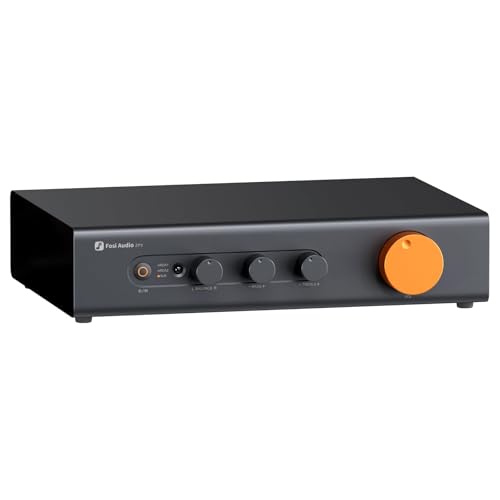
ZP3 Review Summary
The Fosi Audio ZP3 is a feature-dense preamp for practical home audio setups.
It makes the most sense for listeners who want to manage multiple sources, feed a subwoofer, and fine-tune tonal balance without adding unnecessary complexity.
What stands out is the combination of RCA1, RCA2, and XLR inputs, plus RCA, XLR, and sub-out outputs.
That gives the ZP3 a wider useful range than a bare-bones preamp, especially if you are building a 2-channel system today and may later shift toward a 2.1 layout.
The strongest fit is the buyer who values control and routing flexibility over minimalist design.
If you want a simple volume knob and nothing else, the ZP3 may be more than you need.
If you want a central hub with input switching, balanced signal options, HPF, tone controls, and memory behavior, it is clearly aimed in your direction.
Review Scorecard
| Category | Score | Why it earns that score |
|---|---|---|
| Connectivity flexibility | 9/10 | Three inputs and multiple output paths make it easy to integrate sources and speakers. |
| System versatility | 9/10 | Works naturally in both 2-channel stereo and 2.1 setups. |
| Tone control usefulness | 8/10 | Bass, treble, balance, and bypass options support real-world tuning. |
| Subwoofer integration | 8/10 | Dedicated sub-out and HPF settings are strong for bass management. |
| Ease of use | 8/10 | Remote control and input memory reduce daily friction. |
| Noise-conscious design | 8/10 | Balanced XLR support and premium listed parts suggest a serious signal path. |
This is a smart buy if you want one control center for several audio tasks.
It is less compelling if your setup is already final, simple, and fully satisfied by a basic passive controller.
Key Features and Specifications of ZP3
The ZP3 is built around a straightforward but capable control layout.
According to the product record, it supports RCA1, RCA2, and XLR inputs, with RCA, XLR, and sub-out outputs.
That matters because it is not just a preamp for one stereo chain; it can sit in the middle of a small home system and handle more than one source or destination.
The balanced design is another important point.
The listing highlights balanced XLR in/out, plus RCA/XLR signal conversion for compatibility.
For buyers with gear that already uses balanced connections, that can be a meaningful reason to choose this unit over simpler alternatives.
The unit also includes an HPF high-pass filter with three settings.
In practical terms, that means you can send only mids and highs to the main speakers while routing low frequencies to the subwoofer output.
For systems where bass clarity matters, that is more useful than a generic tone knob alone.
Other listed controls include bass and treble adjustment, a bypass function, and L/R balance knobs.
The volume memory feature is especially helpful when different inputs are used for different sources, because the unit remembers the level for each one.
The product record also notes premium parts such as ELNA capacitors, NJR NJU72315 volume IC, relays, and gold-plated RCA jacks.
Those details do not guarantee a sonic outcome on their own, but they do signal that the ZP3 is trying to position itself as a more serious component than a budget knob box.
Useful facts at a glance:
- Brand/model: Fosi Audio ZP3
- Inputs: RCA1, RCA2, XLR
- Outputs: RCA, XLR, Sub-Out
- Control features: remote input switching, volume adjustment, bass, treble, L/R balance
- Filter feature: three-level high-pass filter
- Memory behavior: remembers volume per input
- Design note: first-use volume should be turned down before playback
Pros and Cons of ZP3
Pros
- Flexible input and output options suit mixed-source systems.
- Balanced XLR support helps it fit higher-end or cleaner-routing setups.
- HPF and sub-out make it more useful for 2.1 integration than many basic preamps.
- Tone controls and balance adjustment give you real tuning range.
- Remote control and per-input volume memory improve convenience.
Cons
- The feature set may be unnecessary if you only need a simple stereo volume controller.
- More controls usually mean more setup decisions, which can slow down first-time use.
- The listing emphasizes system flexibility more than a minimalist hi-fi philosophy.
- Buyers who never use a subwoofer or balanced gear may not benefit from the added routing options.
The basic tradeoff is clear: more control, more complexity.
For the right system, that is a good trade.
For a stripped-down desktop or two-speaker rig, some of the ZP3’s strengths may go unused.
Who Should Buy ZP3?
The ZP3 is best for people assembling a small but serious home audio system.
If you have multiple sources, want to switch between them easily, and care about keeping the signal path organized, this preamp makes sense.
It is also a strong match for buyers who are planning or already running a 2.1 setup.
The sub-out and HPF features are the main reason to consider it over simpler preamps, because they make bass integration feel intentional rather than improvised.
This is a good fit if you want:
- A central controller for stereo and subwoofer routing
- Balanced XLR compatibility
- Tone shaping without buying a separate processor
- Remote input switching and volume control
- A compact device that still behaves like a real system hub
You should probably skip it if:
- You only need one source and one fixed output
- You do not use a subwoofer
- You prefer a fully passive, no-frills signal path
- You are trying to minimize knobs, menus, and setup choices
In short, the ZP3 suits the buyer who thinks in terms of system management rather than just speaker hookup.
ZP3 for Stereo and 2.1 Systems
Input Switching in Daily Use
The three-input layout is one of the most practical parts of the ZP3.
It lets you keep separate sources available without physically swapping cables, which is useful in living rooms, shared listening spaces, or mixed-media systems.
Subwoofer and High-Pass Filtering
The dedicated sub-out and three-level HPF matter because they let you treat bass management as a real setup decision.
Instead of simply adding a sub and hoping the rest blends well, you can filter the main output and make the system feel more coherent.
Tone Shaping and Balance Control
Bass, treble, and balance controls give the ZP3 enough adjustment range to correct for room issues or speaker pair mismatches.
The bypass option is useful if you want to compare a cleaner signal path against your tuned setting.
Volume Memory and Safety Notes
Per-input volume memory is a quiet but valuable convenience feature, especially when different sources have different output levels.
The first-use warning in the listing is also worth respecting: start low and raise volume carefully, since the unit may remember high levels if you are not cautious.
Alternatives to ZP3
If you want a simpler preamp with fewer routing features, look at the Fosi Audio Preamps.
That is the most natural place to start if you like the brand but do not need all of the ZP3’s flexibility.
If balanced connectivity is your priority, the Schiit preamp line is a credible alternative category to compare.
It is the sort of option buyers consider when they care more about signal-path philosophy and fewer extra controls.
If your system centers on subwoofer integration and home stereo control, the Nobsound preamp family is another Amazon-searchable comparison point.
It may appeal to buyers who want similar functionality in a different package.
If you want a more feature-rich home audio controller, the Douk Audio preamp range is worth a look.
It is a relevant alternative for shoppers comparing compact control hubs rather than bare volume devices.
Is ZP3 Worth It?
Yes, if you will use the features it offers.
The Fosi Audio ZP3 is worth considering for buyers who want a flexible preamp that can handle multiple inputs, balanced connections, bass routing, tone control, and convenient switching in one compact unit.
It is not the best choice for someone who only wants a minimal volume controller or a single-input signal path.
But for a compact stereo or 2.1 system where routing and adjustment matter, the ZP3 looks like a sensible, capable, and well-targeted buy.