Choosing the right stage instrument can make a live set feel effortless or frustrating. The best workstation keyboards for live performance combine reliable sound engines, fast hands-on control, and a layout that supports quick changes onstage.
In this roundup, we focused on models that balance playability, performance features, and real-world workflow so you can find the right fit for club gigs, worship, touring, and studio-to-stage use.
Best 10 Workstation Keyboards for Live Performance Picks for 2026
Expressive Controller Pick
Arturia KeyLab mk3 61-Key White

- 61 keys with aftertouch
- 12 pressure-sensitive pads
- Nine encoders plus pedal inputs
Best For: Players who want expressive stage control in a compact controller
Stage Keyboard Choice
Yamaha CK88 88-Key Stage Keyboard

- 88 keys with built-in speakers
- Two split points for layered performance
- Piano, organ, strings, brass, and synth sounds
Best For: Players needing a versatile 88-key stage keyboard for live gigs
Gig-Ready Synth Pick
Roland JUNO-D6 61-Note Synthesizer

- Over 3800 onboard sounds
- USB-C audio/MIDI interface
- Battery power support for portability
Best For: Performers who need a compact live keyboard with lots of sounds
Software Integration Pick

- 88 semi-weighted Fatar keys
- Polyphonic aftertouch standard
- High-res screen with NKS integration
Best For: Software-based performers who want an expressive 88-key controller
Stage-Ready Arranger Power
Yamaha PSRSX720 61-Key Arranger

- Accompaniment styles add backing-band support
- Assignable knobs, joystick, and chord looper boost live control
- SA voices add more realistic instrument detail
Best For: Solo performers and live players who want arranger support
Creative Control Hub
Arturia KeyLab Essential mk3 61-Key

- Pads, faders, and encoders support hands-on control
- Scale Mode, Chord Mode, and Arpeggiator aid performance
- Custom DAW integration fits software-based setups
Best For: Software players and producers needing a compact controller
Expressive Performance Workhorse
Yamaha MODX M7 76-Key Synthesizer

- Three engines cover analog, FM, and realistic sounds
- 8 faders and Super Knob support live expression
- Color touchscreen and 76 semi-weighted keys aid workflow
Best For: Gigging keyboardists wanting expressive synth control
AstroLab Live Synth Hub
Arturia AstroLab 61-Key Stage Keyboard

- 44 instruments and over 1800 presets
- DAW-free live performance focus
- 61-key stage keyboard with essential controls
Best For: players who want a wide sound palette and streamlined live use
Weighted Control Center
Arturia KeyLab 88 mk3 Weighted Controller

- 88 fully weighted hammer-action keys
- 12 pads, 9 encoders, and 9 faders
- USB-C controller with Ableton Live support
Best For: keyboardists who want weighted feel and deep hands-on control
Clip Launch Compact
Akai APC Key 25 MK2 Ableton Controller
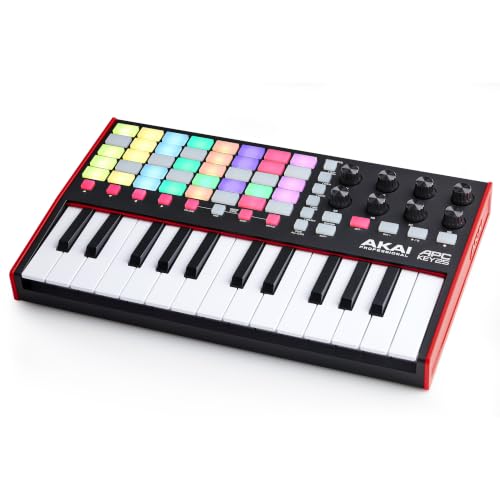
- 25 velocity-sensitive mini keys
- 40 RGB pads for clip launching
- 8 knobs with tight Ableton Live mapping
Best For: Ableton performers who want a compact clip-launching controller
Expressive Controller Pick – Arturia KeyLab mk3 61-Key White
If you’re comparing workstation keyboards for live performance, the Arturia KeyLab mk3 focuses on hands-on control and expressive playing. Its 61-key layout, aftertouch, pressure-sensitive pads, and assignable encoders make it a practical fit for players who want a responsive controller on stage.
Best For: Performers who want a compact 61-key controller with expressive controls and pedal inputs.
Pros:
- 61-key design with aftertouch for added expression
- 12 pressure-sensitive performance pads for live triggering
- Nine assignable encoders for flexible control
- Sustain and auxiliary pedal inputs for stage setup
Cons:
- Only the supplied notes are available here, so deeper sound engine details aren’t listed
- 61 keys may be limiting for players who prefer a full 88-key range
Overall, this is a straightforward live-performance controller built around tactile control rather than onboard sounds. It suits players who value a balanced, well-made board with performance-focused hardware.
Stage Keyboard Choice – Yamaha CK88 88-Key Stage Keyboard
For workstation keyboards for live performance, the Yamaha CK88 is built around a broad stage-ready sound set and practical split options. It offers two split points, built-in speakers, and a range of piano, organ, string, brass, and synth sounds that can be controlled in real time.
Best For: Keyboard players who want an 88-key stage instrument with built-in speakers and a versatile live sound palette.
Pros:
- 88 keys with an intermediate to professional skill profile
- Two split points for playing three sounds across the keyboard
- Built-in speakers plus battery or corded power options
- Wide sound set including piano, organ, strings, brass, and synths
Cons:
- At 28.9 pounds, it is not the lightest stage option
- Its focus is live keyboard sounds rather than deep workstation production features
The CK88 looks like a strong choice when you need a single board for gigging and fast sound changes. It leans into real-time performance flexibility and authentic stage voices rather than complexity.
Gig-Ready Synth Pick – Roland JUNO-D6 61-Note Synthesizer
Among workstation keyboards for live performance, the Roland JUNO-D6 stands out for its pro sounds and streamlined live workflow. It gives you 61 synth-action keys, instant access to essential band sounds, and a ZEN-Core engine with more than 3800 onboard sounds.
Best For: Live performers who want a compact, gig-ready keyboard with a large onboard sound library.
Pros:
- Over 3800 onboard sounds powered by the ZEN-Core engine
- Instant access to pianos, organs, synths, and other stage essentials
- USB-C audio/MIDI interface for mobile devices and computers
- Supports USB-C mobile battery power for portable use
Cons:
- 61 keys may be too compact for players who want a larger range
- Its included-components listing is limited to the synthesizer only
This is a practical pick if your priority is fast access to reliable live sounds and modern connectivity. It keeps the setup focused while still offering plenty of tonal range for stage use.
Software Integration Pick – NI Komplete Kontrol S88 MK3
If you’re shopping workstation keyboards for live performance and work heavily with software instruments, the Native Instruments S88 MK3 is built for deep integration. Its 88 semi-weighted keys, polyphonic aftertouch, and high-resolution screen support a focused control experience for compatible software.
Best For: Players who want an 88-key controller with strong software integration and expressive key response.
Pros:
- 88 semi-weighted keys set in a Fatar keybed
- Polyphonic aftertouch as standard
- High-resolution full-color screen for browsing and tweaking
- Direct integration with Kontakt and NKS-compatible software
Cons:
- Designed as a keyboard controller, so it depends on external software and devices
- Best results come from Native Instruments and other NKS-compatible tools
This model makes the most sense for players who want an expressive controller at the center of a software-based live rig. Its strengths are control, integration, and keybed quality rather than onboard standalone sounds.
Stage-Ready Arranger Power – Yamaha PSRSX720 61-Key Arranger
Yamaha 61-Key Arranger Keyboard, Multiple Styles and Voices, Assignable Live Control Knobs PSRSX720
Check Price On AmazonIf you want workstation keyboards for live performance that can carry an entire arrangement, the Yamaha PSRSX720 is built for that job. Its accompaniment styles act like a backing band while you stay in control of chords, and the assignable knobs, joystick, and chord looper make it easier to manage a performance without losing flow.
Best For: Solo performers and live keyboard players who want arranger-style support with hands-on real-time control.
Pros:
- Accompaniment styles create a pro-sounding backing band for live playing
- Assignable knobs and joystick offer flexible real-time sound control
- Chord Looper lets you loop progressions and focus on soloing or two-handed parts
- Super Articulation voices add realistic details like sax slides and guitar scratches
Cons:
- 61 keys may feel limiting for players who prefer a wider range
- Arranger-focused workflow is less suited to players who only need a simple controller
The PSRSX720 stands out when you need a keyboard that can fill out a live set with minimal extra gear. It combines performance features and expressive control in a way that supports both accompaniment-driven songs and more hands-on playing.
Creative Control Hub – Arturia KeyLab Essential mk3 61-Key
For workstation keyboards for live performance that also need to work as a flexible controller, the Arturia KeyLab Essential mk3 is a practical choice. It gives you velocity-sensitive keys, pads, faders, encoders, and DAW integration, so you can shape sounds, trigger parts, and move through software instruments quickly.
Best For: Players and producers who want a compact MIDI controller with software integration and performance-friendly controls.
Pros:
- Scale Mode, Chord Mode, and Arpeggiator support creative live and studio use
- 8 velocity- and pressure-sensitive pads plus 9 faders and 9 encoders add hands-on control
- Custom DAW scripts help it integrate more deeply with major music software
- Analog Lab V and included instruments expand the sound library right away
Cons:
- It is a MIDI controller, so it does not include built-in keyboard sounds
- 61 keys may not be enough for players wanting a larger performance range
This model makes sense if your live setup depends on software instruments and fast control rather than onboard arranger sounds. It is especially useful when you want one compact board to handle both composing and performance tasks.
Expressive Performance Workhorse – Yamaha MODX M7 76-Key Synthesizer
If your search for workstation keyboards for live performance is focused on expressive control and stage-ready sound, the Yamaha MODX M7 fits that brief well. Its three sound engines, 8 faders, Super Knob, color touchscreen, and improved semi-weighted action are designed to make sound shaping and playing feel fast and direct on stage or in the studio.
Best For: Gigging keyboardists and sound explorers who want a lightweight synth with deep performance control.
Pros:
- Three sound engines cover analog, FM, and realistic instrument tones
- 8 physical faders and Super Knob provide hands-on real-time expression
- Color touchscreen and dedicated knobs streamline navigation and editing
- 76 semi-weighted keys offer a more substantial feel for performance play
Cons:
- As a synthesizer, it is less focused on arranger-style backing features
- 76 keys add more size than a compact 61-key board
The MODX M7 is a strong fit when you want a performance instrument that responds quickly and gives you multiple sound engines to work with. It balances expressive control, portability, and workflow improvements in a way that suits serious live use.
AstroLab Live Synth Hub – Arturia AstroLab 61-Key Stage Keyboard
For workstation keyboards for live performance, the Arturia AstroLab is built for players who want a stage-ready instrument without relying on a laptop. Its 61-key format, advanced virtual synthesis, and ecosystem of sounds make it a strong pick when you need quick access to iconic synths, modern textures, and a setup that moves cleanly from studio to stage.
Best For: Players who want a DAW-free live keyboard with a wide sound palette and streamlined performance control.
Pros:
- Built-in virtual synthesis with 44 instruments and over 1800 presets.
- Designed to bridge studio production and live performance without extra complexity.
- 61-key layout keeps it practical for stage use while still giving playable range.
- Focuses on essential controls so you can spend more time playing and less time menu-diving.
Cons:
- 61 keys may feel limiting for players who want a larger performance range.
- Best suited to users who value its ecosystem and preset approach over a traditional workstation layout.
AstroLab is a compelling option if your priority is expressive live sound design in a performance-friendly format. It stands out most for musicians who want a modern, all-in-one stage keyboard that stays away from DAW dependence.
Weighted Control Center – Arturia KeyLab 88 mk3 Weighted Controller
Arturia KeyLab 88 mk3 88-key Weighted Hammer-action Keyboard Controller - Black
Check Price On AmazonIf you want workstation keyboards for live performance that also feel close to a piano, the Arturia KeyLab 88 mk3 is aimed squarely at that role. Its fully weighted 88-key Fatar TP/110 action, aftertouch, performance pads, encoders, faders, and USB-C connectivity make it a strong controller for players who need hands-on control on stage and in the studio.
Best For: Keyboardists who want an 88-key weighted controller with deep hands-on control for live sets and Ableton workflows.
Pros:
- 88 fully weighted hammer-action keys with velocity and aftertouch.
- Includes 12 pressure-sensitive performance pads plus 9 encoders and 9 faders.
- USB-C power and connection keep the setup modern and simple.
- Supported software includes Ableton Live for performance and production use.
Cons:
- At 43.4 pounds, it is far less portable than compact performance keyboards.
- As a controller, it depends on connected software or hardware for sound generation.
The KeyLab 88 mk3 makes sense if weighted feel matters as much as control depth. It is a solid pick for live players who want a serious 88-key controller that can anchor a performance rig.
Clip Launch Compact – Akai APC Key 25 MK2 Ableton Controller
For workstation keyboards for live performance in a compact format, the Akai Professional APC Key 25 MK2 is clearly geared toward Ableton users. It combines 25 velocity-sensitive mini keys with a bright 5×8 RGB pad matrix, making it useful when you want clip launching, quick navigation, and basic melodic playing in a small USB-powered controller.
Best For: Ableton Live performers and producers who want a compact, portable controller for clip launching and hands-on control.
Pros:
- Pre-mapped for 1:1 integration with Ableton Live 11.2.7 and later.
- 40 RGB pads provide clear visual feedback for launching clips and samples.
- 8 assignable knobs give direct control over volume, pan, sends, and automation.
- USB-powered and plug-and-play for simple stage or studio setup.
Cons:
- 25 mini keys are limited for players who need a larger key range.
- Designed around Ableton, so it is less universal than some general-purpose controllers.
The APC Key 25 MK2 is a focused live-performance controller rather than a full-size keyboard. It is best when portability, clip control, and tight Ableton integration matter more than a traditional keyboard feel.
How We Picked These Workstation Keyboards for Live Performance
We prioritized instruments and controllers that support fast navigation, dependable key action, expressive control, and practical stage features. For Workstation Keyboards for Live Performance, that means looking beyond sound count alone and weighing how easily you can move through patches, layers, splits, and performance changes in real time.
We also favored models with useful live tools such as pads, knobs, touchscreen control, aftertouch, weighted actions, onboard sounds, built-in speakers, or deep software integration, depending on the performer’s needs.
Quick Comparison
For simplicity, think of the lineup in three groups: full-featured stage instruments for all-in-one performance, controller-focused options for DAW or soft-synth users, and compact instruments for players who need portability above all else. Weighted 88-key models are best for pianists, 61-key synth-action boards suit fast lead and split work, and 25-key controllers work best as secondary or travel rigs.
Key Buying Factors for Workstation Keyboards for Live Performance
Key Action and Size
Your keybed should match your playing style. Weighted 88-key boards feel closest to an acoustic piano, while semi-weighted or synth-action keys are better for organ parts, synth leads, and quick program changes. If you travel often, consider whether 61 or 76 keys give you enough range without making transport difficult.
Sound Engine and Onboard Workflow
Live performers benefit from immediate access to sounds, layers, splits, and effects. An onboard sound engine can reduce reliance on a laptop, while controllers with excellent software integration can be ideal if your rig is already computer-based.
Hands-On Control
Pads, sliders, assignable knobs, aftertouch, touchscreens, and transport controls all help shorten the distance between idea and execution. The more quickly you can switch sounds or shape a part, the more confidently you can perform.
Stage Practicality
Check weight, power options, speaker availability, and connectivity before buying. Built-in speakers are useful for rehearsals and small setups, while MIDI and USB compatibility matter for modern hybrid rigs.
Who Should Buy Which Workstation Keyboards for Live Performance?
Pianists and players who need a realistic feel should lean toward 88-key weighted models. Synth players and gigging keyboardists who value speed and portability may prefer 61-key stage boards. If you want one board to cover arranger functions, backing styles, and live control, look at performance-oriented arranger models. If your setup centers on software instruments, a controller workstation may be the smarter choice. And if you need a compact secondary rig, a small pad-and-key controller can still be highly effective for triggering parts and controlling a live set.
Ultimately, the best choice depends on whether you want an all-in-one instrument or a performance controller that fits into a larger rig. Prioritize responsiveness, reliability, and the features you’ll actually use onstage.