If you need to feed several headphones from one source without losing clarity or volume, the right desktop headphone distribution amplifier makes a big difference. These units are built for musicians, engineers, podcasters, and content creators who want reliable monitoring with simple control.
Below, we’ve rounded up 10 options that balance output count, input flexibility, build quality, and value so you can choose the best fit for your setup.
Best 10 Desktop Headphone Distribution Amplifiers Picks for 2026
Rack-Ready 8-Channel Workhorse
Behringer HA8000 V2 8-Channel Headphone Amp

- 8 high-power channels
- Up to 16 headphone pairs
- Rack-mount 19" design
Best For: Budget-minded studios needing many headphone outs
Compact Project Studio Pick
ART HeadAMP4 4-Channel Stereo Headphone Amp

- 4 stereo output channels
- 1/8-inch and 1/4-inch I/O
- Stackable metal case
Best For: Small studios wanting a simple shared-monitoring amp
Balanced 4-Channel Monitor Hub
Samson QH4 4-Channel Headphone Amplifier

- 4 independent stereo channels
- Individual volume on each output
- Balanced inputs plus aux I/O
Best For: Four-person monitoring in compact studios or pods
High-Output Rack Monitor System
8-Channel Headphone Mixing Amp with LED Meters

- 8 channels and 16 headphone outs
- Mono/stereo routing options
- 6-segment LED metering
Best For: Pro studios and live monitoring rigs
Compact 4-Channel Desktop Splitter
Mackie HM-4 4-Channel Headphone Amp

- Drives four headphones from one source
- Independent volume per listener
- Compact metal design with plug-and-play setup
Best For: Small recording or rehearsal sessions that need simple shared monitoring
Flexible 4-Channel Studio Monitor Amp
Rockville RHPA4 4-Channel Headphone Amp

- Supports up to eight headphones
- Stereo/mono switching with per-channel volume
- USB-A powered metal housing
Best For: Portable or small studio monitoring with lots of headphone connection options
High-Capacity 10-Output Monitor Hub
Arklove HP10 10-Channel Headphone Amplifier
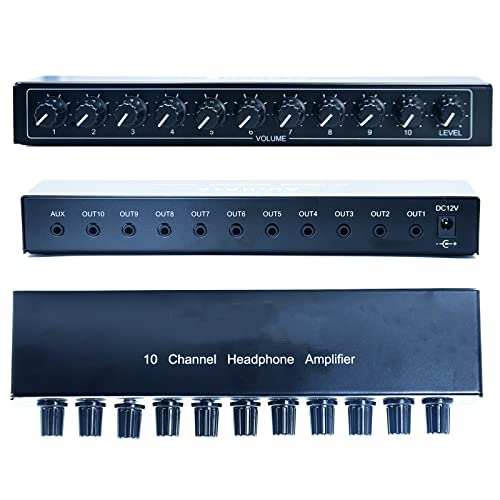
- Ten outputs with individual level control
- Compact metal design for studio and stage
- Includes 12V power adapter and power switch
Best For: Larger sessions that need many headphone outputs with independent control
4-Channel Studio Hub

- 8 outputs for multi-listener monitoring
- Independent volume on each channel
- Stereo/mono switching with flexible inputs
Best For: Small studios needing multiple headphone feeds
Portable 8-Out Splitter

- 8 outputs with per-channel volume control
- Works as a headphone amp or audio distributor
- Includes adapters for 3.5mm compatibility
Best For: Portable studio or stage monitoring with many listeners
Compact 4-Listener Monitor

- Powers four headphones at once
- Independent level controls for each output
- Compact design for studio or travel use
Best For: Small groups needing simple monitoring on a desk
Rack-Ready 8-Channel Workhorse – Behringer HA8000 V2 8-Channel Headphone Amp
If you need desktop headphone distribution amplifiers for a studio or rehearsal setup, the Behringer HA8000 V2 gives you a practical way to feed multiple listeners from one unit. Its 8 high-power channels, dual main inputs, and per-channel direct inputs make it flexible for monitoring different sources while keeping the system simple to operate.
Best For: Studios and live rooms that need an affordable rack-mounted headphone amp with lots of outputs.
Pros:
- 8 discrete amplifier channels with support for up to 16 pairs of headphones
- Each channel includes an 8-digit LED output meter and source selection switches
- Rear-panel direct inputs and extra phones outputs support separate mixes
- Rack-mountable 19″ design helps keep a studio setup organized
Cons:
- Requires rack space rather than a compact desktop footprint
- More features than a simple personal headphone amp if you only need one or two outputs
Overall, the HA8000 V2 is built for multi-user monitoring rather than casual listening. If you want a budget-conscious distribution amp with serious channel count and straightforward studio integration, it is a strong fit.
Compact Project Studio Pick – ART HeadAMP4 4-Channel Stereo Headphone Amp
For smaller setups, the ART HeadAMP4 is a straightforward choice among desktop headphone distribution amplifiers. It offers 4 stereo output channels, 1/8-inch and 1/4-inch inputs and outputs, and a metal stackable case that fits easily into a home or project studio workflow.
Best For: Home and project studios that want a compact, low-noise 4-output headphone amp.
Pros:
- 4-channel stereo design for shared monitoring
- 1/8-inch and 1/4-inch inputs and outputs add flexible connectivity
- Designed for lower noise, lower distortion, and more output
- Compact extruded metal case can be stacked with other gear
Cons:
- Only 4 output channels, so it is not ideal for larger sessions
- Less feature-rich than larger rack-style distribution amps
The HeadAMP4 keeps things simple and practical for small recording spaces. If you need a durable, space-saving amp for a few listeners, it covers the essentials without adding complexity.
Balanced 4-Channel Monitor Hub – Samson QH4 4-Channel Headphone Amplifier
The Samson QH4 is a practical option if you’re comparing desktop headphone distribution amplifiers for a compact monitoring setup. It provides four independent stereo headphone channels, individual volume control on each output, and both balanced 1/4″ inputs plus a stereo 1/8″ aux input and output for easy integration.
Best For: Pods, studios, and shared listening spaces that want four independent headphone mixes.
Pros:
- Four independent stereo headphone channels with individual level control
- Two balanced 1/4″ inputs support cleaner stereo routing
- Stereo 1/8″ aux input and output add convenient source flexibility
- Lightweight design suits portable or desktop monitoring use
Cons:
- Not designed for large groups beyond four channels
- More basic than 8-channel rack-mount distribution units
In practice, the QH4 is a good middle-ground solution for users who want individual control without moving up to a larger studio distribution amp. It is especially appealing when clean stereo monitoring and simple connectivity matter most.
High-Output Rack Monitor System – 8-Channel Headphone Mixing Amp with LED Meters
This 8-channel unit is built for users who want desktop headphone distribution amplifiers with serious routing flexibility and monitoring features. It supports mono and stereo modes, offers 16 headphone outputs across front and rear jacks, and adds 6-segment LED metering so you can keep an eye on levels during studio or live sessions.
Best For: Professional monitoring setups that need flexible routing, metering, and 16 headphone outs.
Pros:
- 8 high-power channels with support for up to 16 headphone outputs
- Mono/stereo switching and dedicated rear input jacks for flexible routing
- 6-segment LED meters on all 8 channels help track levels in real time
- Independent channel volume plus master input control simplify balancing
Cons:
- Rack-style 1U format is better for installed setups than casual desktop use
- Feature set may be more than needed for small personal listening setups
Overall, this model is aimed at demanding monitoring environments where routing options and output count matter. If you want a powerful distribution amp with real-time metering and per-channel control, it is well equipped for the job.
Compact 4-Channel Desktop Splitter – Mackie HM-4 4-Channel Headphone Amp
If you need desktop headphone distribution amplifiers for a small tracking room, rehearsal space, or podcast setup, the Mackie HM-4 keeps things simple. It takes a 1/4-inch or 1/8-inch source and gives four listeners their own output level, making it easy to share a mix without everyone fighting for the same volume knob.
Best For: Small sessions where each listener needs independent volume control from a compact, plug-and-play amp.
Pros:
- Drives four headphones from a single source
- Independent level control for each listener
- Compact metal build that can sit on a desk or mount nearby
- Plug-and-play operation with no power supply hassle
Cons:
- Limited to four outputs
- No advanced routing or stereo/mono switching mentioned
This is a straightforward choice if you value a tiny footprint and easy setup over extra features. The HM-4 focuses on the essentials: shared monitoring, separate volumes, and a durable chassis for everyday session use.
Flexible 4-Channel Studio Monitor Amp – Rockville RHPA4 4-Channel Headphone Amp
Among desktop headphone distribution amplifiers, the Rockville RHPA4 stands out for flexibility. Each of its four channels has both 1/4-inch and 3.5mm outputs, so it can support up to eight headphones while giving every user a dedicated volume knob for personal monitoring.
Best For: Studio, podcast, or portable recording setups that need multiple headphone connections and stereo/mono flexibility.
Pros:
- Supports up to eight headphones across four channels
- Each channel has its own volume control
- Stereo/mono switching for different monitoring needs
- USB-A powered for laptop or wall-adapter use
Cons:
- Requires 5V USB power rather than a traditional internal supply
- Metal box is compact, but not rack-specific
The RHPA4 is a practical pick when you want more connection options than a basic splitter can provide. Its mix of dual output types, per-channel control, and portable power makes it well suited to small studios and mobile rigs.
High-Capacity 10-Output Monitor Hub – Arklove HP10 10-Channel Headphone Amplifier
If your desktop headphone distribution amplifiers need to feed a larger group, the Arklove HP10 is built for bigger monitoring sessions. It offers 10 headphone outputs with dedicated level control, plus a power switch and a compact metal design that makes it easy to carry between studio and stage use.
Best For: Larger studio or stage sessions where multiple listeners need independent headphone volume control.
Pros:
- Up to 10 headphone outputs with independent volume control
- Compact, portable design for studio and stage applications
- Includes a 12V DC power adapter
- Supports both 3.5mm and 6.35mm headphones with an adapter
Cons:
- 3.5mm to 6.35mm adapter is needed for some headphones
- More outputs than many small desktop setups require
The HP10 makes sense when you need more than a basic 4-channel unit and want each listener to control their own level. Its simple, high-capacity layout is aimed at sessions where keeping everyone in the mix matters more than adding extra processing features.
4-Channel Studio Hub – 4 Channel Headphone Amplifier
If you need desktop headphone distribution amplifiers for a small studio, this 4-channel unit gives you eight headphone outputs and flexible input options in a compact metal case. It’s built for recording, mixing, podcasting, streaming, and everyday multi-listener setups, with independent level control for each listener and stereo/mono switching.
Best For: Studios and content setups that need up to eight headphone outputs with individual volume control.
Pros:
- 8 headphone outputs with 4 input channels for multi-listener monitoring
- Independent volume controls for each output
- 1/4″, 1/8″ TRS, and RCA input compatibility for flexible connections
- Stereo/mono switching adds useful routing flexibility
Cons:
- Best performance depends on using suitable RCA cables and avoiding interference-heavy power setups
- Compact size is practical, but not intended for large rack-style installations
This is a practical pick if you want a compact distribution amp with lots of outputs and simple control at each station. The metal housing and anti-slip feet also make it a sensible choice for mobile or shared workspaces.
Portable 8-Out Splitter – 8 Channel Headphone Amp
For buyers comparing desktop headphone distribution amplifiers, this 8-channel model stands out for its one-input, eight-output layout and independent volume controls on every channel. It’s aimed at studio and stage use, with mono/stereo switching, metal construction, and included 6.35mm-to-3.5mm adapters for broader plug compatibility.
Best For: Recording studios, stage setups, and portable rigs that need eight separate headphone feeds.
Pros:
- 8 stereo output channels with independent volume control
- Acts as both a headphone amp and an audio distributor
- Mono/stereo switch adds flexibility for different source types
- Includes 9 adapters for connecting 3.5mm gear
Cons:
- 1/8″ devices require a conversion plug
- Single-input design may be less suitable for more complex routing needs
This model makes sense when you want a straightforward distribution amp that can serve many listeners at once without taking up much space. The metal build and portable design make it a strong fit for mobile recording or shared workstations.
Compact 4-Listener Monitor – Pyle PHA40 4-Channel Amp
If you’re shopping for desktop headphone distribution amplifiers with a simple four-listener layout, the Pyle PHA40 keeps the setup small and easy to move. It powers up to four headphones at once, uses independent output level controls, and is designed for studio or on-stage monitoring from a 1/4″ TRS source input.
Best For: Small studios or live setups that need four headphone outputs in a compact box.
Pros:
- Powers up to four headphones simultaneously
- Independent volume control for each listener
- Compact footprint is easy to carry and place on a desk
- Built for monitoring with ultra-low-noise amplification
Cons:
- Only four outputs, so it’s not ideal for larger groups
- Plastic enclosure is less rugged than metal-bodied options
This is a no-frills monitoring solution for smaller teams that want dependable headphone splitting without extra complexity. Its compact size and dedicated controls make it easy to use in both studio and portable applications.
How We Picked These Desktop Headphone Distribution Amplifiers
We focused on practical features that matter in real-world monitoring setups: number of channels, output count, stereo and mono support, connector compatibility, power delivery, and physical design. We also looked for models that suit desks, racks, rehearsal rooms, and small studios without requiring complicated setup.
Quick Comparison
Some Desktop Headphone Distribution Amplifiers are designed for simple shared listening, while others offer more outputs and stronger amplification for larger groups. Compact 4-channel models are usually best for small teams or personal studios, while 8-channel and higher-output units make more sense when multiple performers need independent headphone feeds.
Key Buying Factors for Desktop Headphone Distribution Amplifiers
Channel Count and Output Needs
Match the amplifier to the number of listeners you typically support. If you only need a few seats, a 4-channel unit is often enough. For band rehearsals, classroom environments, or larger production spaces, higher-output Desktop Headphone Distribution Amplifiers are more practical.
Input and Output Compatibility
Check whether your gear uses ¼-inch, 3.5 mm, or TRS connections. Some amplifiers include adapters or multiple input options, which can save time and reduce cable clutter. If you switch between consumer and pro audio equipment, connector flexibility is especially important.
Stereo Vs. Mono Routing
Stereo support is ideal for music production, editing, and immersive playback. Mono modes can be useful for monitoring spoken voice, live sound checks, or situations where a single combined feed is easier to manage.
Power, Headroom, and Build Quality
A good headphone amplifier should deliver enough clean level without distortion, especially when several pairs are connected at once. Metal housings, sturdy knobs, and dependable power supplies are worth prioritizing for frequent use.
Who Should Buy Which Desktop Headphone Distribution Amplifiers?
If you run a small home studio or podcast desk, compact Desktop Headphone Distribution Amplifiers are usually the best value. Bands, live rooms, and classrooms should lean toward higher-channel models with stronger distribution capability. Buyers who need portability should focus on smaller units that are easy to move, while fixed installations may benefit from rack-friendly or heavier-duty designs. In short, choose the least complicated model that still gives every listener enough volume, the right connections, and the routing flexibility your workflow requires.