Choosing the right powered studio monitors can make a bigger difference than most upgrades in a home or project studio. The best pairs help you hear balance, EQ, and flaws more clearly, so mixes translate better everywhere.
Below, we’ve narrowed the field to 10 strong options for different rooms, budgets, and use cases, from compact desktop setups to larger near-field monitoring needs.
Best 10 Powered Studio Monitors Picks for 2026
Compact Desktop Pick
Yamaha HS4 Powered Studio Monitor Pair

- Pair of 4.5-inch monitors with 1-inch dome tweeters
- Room control and high trim for basic tuning
- XLR/TRS, RCA, and stereo mini inputs included
Best For: Small home studios and desk-based editing setups
Wide-Sweet-Spot Choice
JBL 305P MkII 5" Studio Reference Monitors

- Image Control Waveguide for precise imaging
- Dual 41W Class-D amps with 112W max output
- Boundary EQ and HF Trim for room tuning
Best For: Music production, podcasting, and wide-listening-area setups
Neutral Mixing Staple
Yamaha HS5 Powered Studio Monitor Pair

- 5-inch nearfield monitors designed for sonic purity
- Bi-amped 70W system with XLR/TRS inputs
- 54 Hz to 30 kHz response for broad monitoring
Best For: Critical listening in small studios and home production spaces
Room-Tuning Pick
PreSonus Eris E7 XT Active Studio Monitor

- 6.55-inch low-frequency driver for deeper lows
- 100° x 60° EBM waveguide with wide sweet spot
- Level, HPF, LF Trim, HF Trim, and Acoustic Space controls
Best For: Larger nearfield setups that need flexible room tuning
Compact Desk Monitor Pick
Mackie CR3.5 Studio Monitors (Pair)

- Pair of 3.5-inch powered monitors for desks and small studios
- Tone knob and location switch help fine-tune the sound
- Includes isolation pads and all required cables
Best For: Desktop creators and small-space setups
Flat-Response Entry Choice
Edifier MR4 Powered Studio Monitors
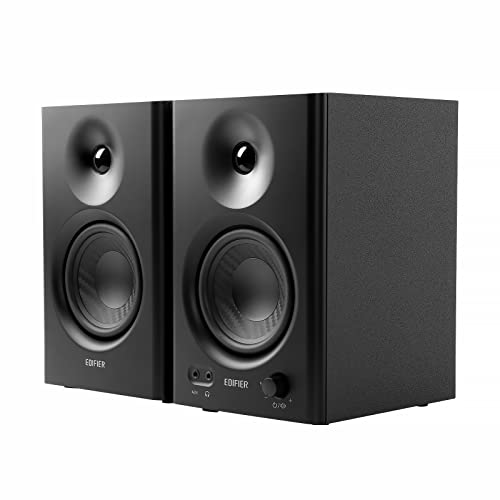
- Almost flat tuning aimed at accurate near-field listening
- TRS, RCA, AUX, and headphone output for flexible hookups
- High and low knobs plus dual listening modes
Best For: Artists and PC users wanting balanced desktop monitoring
Wireless Value Monitor Set
Ortizan C7 Powered Studio Monitors

- Bluetooth 5.3 plus USB, RCA, TRS, and AUX inputs
- 24-bit DAC and flat-response tuning for cleaner playback
- 3.5-inch woofer and silk dome tweeter suit compact spaces
Best For: Gamers and creators who want wired and wireless flexibility
Compact Near-Field Pick
KRK Classic 7 Powered Two-Way Professional Studio Monitor

- 73-watt self-powered design
- Front-firing port for flexible placement
- Low/high trim controls for room tuning
Best For: Home studios that need a 7-inch powered monitor with easy tuning
Desktop Stereo Pair
PreSonus Eris 3.5 Powered Studio Monitors, Pair

- Complete stereo pair for quick setup
- 50W built-in amp with clear output
- Front inputs and tuning controls add convenience
Best For: Desktop audio, gaming, and small near-field studio setups
Hi-Res Budget Monitor
Edifier MR3 Powered Studio Monitor, Hi-Res Active Bluetooth

- Hi-Res certified with flat response tuning
- TRS, RCA, AUX, and Bluetooth inputs
- App-based EQ plus monitor modes
Best For: Small studios and desks that need flexible connectivity and easy sound shaping
Compact Desktop Pick – Yamaha HS4 Powered Studio Monitor Pair
If you want powered studio monitors for a small desk or editing setup, the Yamaha HS4 pair keeps things simple and practical. The 4.5-inch woofer, 1-inch dome tweeter, and room control plus high trim give you useful tuning for music production or video work without a lot of fuss.
Best For: Home studios, DAW workstations, and creators who need a compact stereo monitor pair with flexible inputs.
Pros:
- Pair includes XLR/TRS, RCA, and stereo mini connectivity for easy hookup.
- Room control and high trim help adapt the sound to your space.
- Compact 4.5-inch design is suited to desk-based setups.
- Includes speaker cable, stereo mini to RCA cable, and anti-slip pads.
Cons:
- 26W output is modest compared with larger studio monitors.
- 4.5-inch woofer may be less ideal for deeper low-end needs.
- Designed more for nearfield use than larger rooms.
This is a straightforward option if you need accurate, desk-friendly powered studio monitors with multiple input choices and basic room tuning. It fits best in smaller production spaces where size and versatility matter more than raw volume.
Wide-Sweet-Spot Choice – JBL 305P MkII 5" Studio Reference Monitors
The JBL 305P MkII pair is built for buyers who want powered studio monitors with clear imaging and a room-friendly listening area. Its Image Control Waveguide, dual 41-watt Class-D amps, and Boundary EQ/HF Trim controls make it a strong fit for music production, podcasting, and mix checks.
Best For: Producers and creators who want a wide sweet spot, adjustable voicing, and a full-featured active monitor pair.
Pros:
- Patented Image Control Waveguide supports precise imaging and a wide sweet spot.
- Dual 41-watt Class-D amplifiers provide 112W maximum output.
- Boundary EQ and HF Trim help tailor the sound to the room.
- XLR/TRS inputs and a sturdy MDF enclosure add flexibility.
Cons:
- 5-inch woofer may not satisfy users wanting very deep bass.
- Bulkier than ultra-compact monitors for tight desks.
- AC-powered design requires a dedicated power outlet.
Overall, this is a versatile studio reference option with practical tuning features and a reliable stereo pair layout. It makes sense when accuracy, imaging, and setup flexibility are higher priorities than portability.
Neutral Mixing Staple – Yamaha HS5 Powered Studio Monitor Pair
The Yamaha HS5 pair is a classic choice if you want powered studio monitors that emphasize sonic purity over coloration. With a 5-inch woofer, 1-inch dome tweeter, and XLR/TRS inputs, these nearfield monitors are aimed squarely at music production and studio monitoring.
Best For: Engineers and producers who prefer a clean, straightforward monitor pair for critical listening.
Pros:
- Nearfield design focuses on studio monitoring and music production.
- 5-inch woofer and bi-amped 70W system support balanced output.
- 54 Hz to 30 kHz frequency response gives broad coverage.
- XLR and TRS inputs accept balanced or unbalanced signals.
Cons:
- 5-inch size may not deliver the deepest bass on its own.
- Best suited to close-up listening rather than larger spaces.
- Control set is simpler than some monitor models with more tuning options.
If you want a no-nonsense monitoring tool, this pair keeps the focus on accuracy and consistency. It is a strong fit for small studios where honest playback matters more than extra features.
Room-Tuning Pick – PreSonus Eris E7 XT Active Studio Monitor
PreSonus Eris E7 XT 2-Way Active Studio Monitor with EBM Waveguide (Pack of 1)
Check Price On AmazonThe PreSonus Eris E7 XT is a powered studio monitor built for buyers who want more space and more adjustment. Its 6.55-inch low-frequency transducer, 1.25-inch silk-dome tweeter, and 100° x 60° EBM waveguide are designed to deliver strong imaging with a wide sweet spot.
Best For: Creators who need a larger nearfield monitor with flexible acoustic controls and a wide listening area.
Pros:
- 6.55-inch woofer supports deeper low-end than smaller monitors.
- EBM waveguide provides a wide sweet spot and solid imaging.
- Level, HPF, LF Trim, HF Trim, and Acoustic Space controls allow tuning.
- Includes Studio One Prime and Studio Magic plug-in suite.
Cons:
- Single monitor listing means you need to confirm whether you want one or a pair.
- Larger cabinet may take more desk or stand space.
- More tuning options can take a little setup time.
For users who want a monitor that can be tailored to the room, the E7 XT offers useful flexibility and a larger driver size. It is especially appealing if you want one speaker to handle both detail and low-end presence in an indoor studio.
Compact Desk Monitor Pick – Mackie CR3.5 Studio Monitors (Pair)
If you want powered studio monitors for a desk, small studio, or multimedia setup, the Mackie CR3.5 keeps things simple and practical. It’s a compact 3.5-inch pair with a tone knob for quick voicing changes and a location switch to help correct bass when the speakers sit near a wall or out in the open.
Best For: Desktop creators, casual mixing, and small spaces where a compact powered monitor pair makes sense.
Pros:
- Sold as a pair and sized for desks and small studios
- Tone knob lets you adjust voicing without menu diving
- Location switch helps tailor bass placement near walls or in free space
- Includes isolation pads and all cables needed to get started
Cons:
- 3.5-inch woofers are best for compact setups rather than bigger rooms
- Limited to wired RCA and TRS connections
Overall, this is a straightforward powered monitor pair for users who want an easy desk-friendly setup with useful tuning controls. It’s a good fit when convenience, size, and a more honest listening reference matter more than deep low-end output.
Flat-Response Entry Choice – Edifier MR4 Powered Studio Monitors
The Edifier MR4 is a strong option if you want powered studio monitors tuned for a responsive, almost flat curve. With a 4-inch woofer, 1-inch silk dome tweeter, and MDF cabinet design, it aims for clear near-field monitoring while still being easy to live with for everyday computer audio.
Best For: Artists, music creators, and PC users who want a balanced near-field monitor with flexible inputs.
Pros:
- Professionally tuned for an almost flat response curve
- Offers TRS balanced, RCA, AUX, and front headphone output
- Dual mode design supports monitor listening or everyday music playback
- High and low frequency knobs make quick adjustments easy
Cons:
- Powered from a corded electric source, so it is not portable
- Front-panel controls may feel basic for users wanting deeper tuning tools
For a budget-friendly studio monitor style speaker, the MR4 focuses on clarity, flexibility, and practical controls. It fits well in compact production spaces where you want a neutral reference without giving up simple day-to-day usability.
Wireless Value Monitor Set – Ortizan C7 Powered Studio Monitors
The Ortizan C7 stands out if you want powered studio monitors with more connection options, including Bluetooth 5.3, USB with a built-in 24-bit DAC, RCA, TRS, and AUX. Its 3.5-inch carbon fiber woofer and 0.75-inch silk dome tweeter are tuned for a flat response, making it a practical pick for compact content creation and general listening.
Best For: Gamers, creators, and mixed-use setups that benefit from both wired and wireless input options.
Pros:
- Bluetooth 5.3 adds wireless playback convenience
- USB input with 24-bit DAC helps minimize signal loss
- Flat-response tuning is aimed at accurate monitoring
- Multiple inputs make it easy to connect phones, mixers, and other gear
Cons:
- 3.5-inch drivers are compact, so output is better suited to smaller spaces
- Wireless focus may matter less for users who only want a basic wired monitor pair
As a feature-rich powered monitor set, the C7 is built for flexibility first. It makes sense if you want accurate-ish studio-style sound plus the convenience of Bluetooth and digital USB connectivity in one compact package.
Compact Near-Field Pick – KRK Classic 7 Powered Two-Way Professional Studio Monitor
If you want powered studio monitors with a bigger 7-inch footprint, the KRK Classic 7 is built for straightforward studio use without needing a separate amp. Its bi-amped Class A/B design, front-firing port, and low/high frequency trim controls make it a practical fit for recording and mixing in rooms where placement and tuning matter.
Best For: Home studios and mixing setups that need a self-powered 7-inch monitor with room-tuning controls.
Pros:
- 73-watt self-powered design with amps matched to the drivers
- Front-firing port supports more flexible placement near walls
- Low- and high-frequency controls help tailor the response to your room
- Heavy-duty enclosure is built for studio use
Cons:
- Single monitor sold as one unit, not a stereo pair
- 7-inch size takes up more desk or stand space than compact models
Overall, the Classic 7 is a solid choice if you want a powered monitor with enough output and adjustment options for serious studio work. It leans more toward practical monitoring than desk-friendly minimalism.
Desktop Stereo Pair – PreSonus Eris 3.5 Powered Studio Monitors, Pair
The PreSonus Eris 3.5 is a compact set of powered studio monitors designed for desktop listening, gaming, and light production work. With 50 watts of built-in amplification, balanced TRS and RCA inputs, a front aux input, and front headphone jack, it’s built to be easy to connect and easy to live with on a desk.
Best For: Desktop setups, gaming rigs, and small studios that need an affordable powered stereo pair.
Pros:
- Sold as a complete stereo pair for immediate setup
- 50 watts of built-in amplification for clear, distortion-free sound
- High- and low-frequency tuning controls help match the room
- Multiple inputs plus a front headphone jack improve convenience
Cons:
- 3.5-inch drivers are better for near-field use than larger rooms
- Not as much low-end output as bigger studio monitors
For buyers who want powered studio monitors that fit easily on a desk, the Eris 3.5 offers a flexible, user-friendly feature set. It’s a strong match when connectivity and compact size matter as much as sound quality.
Hi-Res Budget Monitor – Edifier MR3 Powered Studio Monitor, Hi-Res Active Bluetooth
The Edifier MR3 is a feature-rich option in powered studio monitors, combining Hi-Res Audio certification with flexible wired and Bluetooth connectivity. Its 3.5-inch mid-low drivers, 1-inch tweeters, and Music, Monitor, and Custom modes make it useful for audio production, video editing, guitar practice, and everyday listening.
Best For: Small home studios and desktop users who want monitor-style sound with Bluetooth and app-based EQ control.
Pros:
- Hi-Res Audio certified with a flat response from 52Hz to 40kHz
- Balanced TRS, RCA, AUX, and Bluetooth support for flexible connections
- Music, Monitor, and Custom modes add versatility
- EDIFIER ConneX app allows detailed EQ adjustments
Cons:
- Single speaker listing may not suit buyers expecting a ready-made pair
- 3.5-inch drivers are best for near-field listening rather than larger rooms
The MR3 stands out if you want modern convenience alongside monitor-style accuracy. It’s especially appealing for mixed-use setups where production tools and casual listening both matter.
How We Picked the Best Powered Studio Monitors
We focused on models that make sense for real-world studio use: accurate frequency response, practical size options, strong build quality, and features that help with placement and room tuning. We also considered whether each set is better suited to beginners, content creators, beatmakers, or more demanding mixing work.
Quick Comparison
Smaller models are usually the best fit for tight desks, editing stations, and low-volume listening, while 5-inch and 7-inch speakers generally offer more low-end extension and a fuller monitoring picture. If you work in an untreated room, placement flexibility and rear-panel controls can matter as much as raw specs.
Key Buying Factors for Powered Studio Monitors
Driver Size and Room Size
Smaller drivers can be a smart choice for compact spaces, but they may not reveal as much low bass. Larger drivers can play fuller and louder, though they often need more distance and a better room setup to perform their best.
Accuracy Vs. Extra Features
For mixing, clarity and neutrality matter more than bass boost or flashy extras. Bluetooth, tone controls, and desktop-friendly design can be useful, but they should not outweigh sound quality if you plan to produce seriously.
Connectivity and Placement
Check for the inputs you need, such as balanced TRS or XLR, especially if you are connecting to an audio interface. Also look for front or rear controls, boundary EQ, and other tools that can help Powered Studio Monitors adapt to your space.
Power and Listening Distance
Near-field monitors are designed to be heard up close. Make sure the speaker size and amplifier power match how far you sit from them and how loudly you work.
Who Should Buy Which Powered Studio Monitors?
If you need the most compact setup, look at smaller desktop-friendly models. For a balanced all-around choice, 5-inch options are often the sweet spot for home studios. If you want more low-end detail for production or mixing in a larger room, consider 7-inch models. Creators who mainly need convenient everyday playback may appreciate Bluetooth-equipped picks, while serious mixing users should prioritize the most neutral, well-connected options in the lineup.