The best MIDI controllers for home studios make it easier to play instruments, trigger samples, automate software, and build polished tracks without relying on a mouse and keyboard.
These 10 options cover compact USB and Bluetooth keyboards, pad-focused beat makers, and larger controllers for piano-style performance. The right choice depends on your space, software, playing style, and need for portability.
Best 10 Midi Controllers for Home Studios Picks for 2026
Compact Beat-Making Pick

- 25 velocity-sensitive mini keys
- 8 MPC pads and 8 assignable knobs
- Includes production software and sounds
Best For: Beat makers and compact home studios
Wireless Pad-Production Pick

- 16 RGB velocity-sensitive pads
- Bluetooth, USB MIDI, and MIDI In/Out
- OLED display with assignable controls
Best For: Finger drummers and mobile producers
Next-Generation Keyboard Pick

- 25 velocity-sensitive mini keys
- Color screen and push-turn encoder
- Chord, scale, and advanced arpeggiator modes
Best For: Feature-focused portable producers
Full-Size Keybed Pick

- 49 full-size velocity-sensitive keys
- Pitch and modulation wheels
- Includes DAW and instrument software
Best For: Keyboard players and expressive songwriting
Best Wireless Keyboard
M-VAVE K5 25-Key MIDI Controller

- 25 velocity-sensitive keys plus eight RGB pads
- Bluetooth battery operation or USB connection
- Eight knobs and two touch strips for DAW control
Best For: Mobile songwriters and beat makers needing keys, pads, and wireless control
Best Pad Controller

- 16 velocity-sensitive MPC pads for beat production
- Three banks provide 48 assignable pad locations
- Includes MPC Beats and Ableton Live Lite
Best For: Producers focused on finger drumming, samples, and effects
Best Wireless DAW Mixer
Donner STARRYCTRL Wireless MIDI Controller
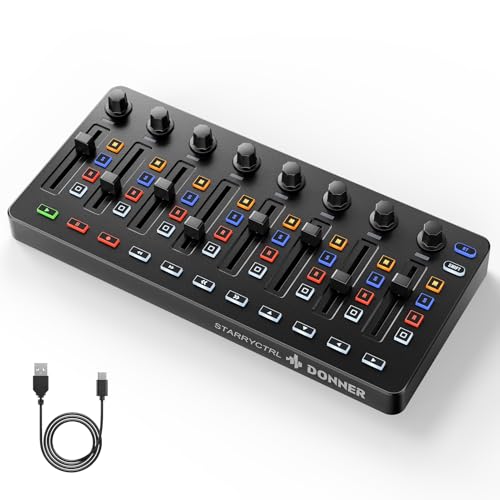
- Eight faders and eight knobs for volume and pan
- 43 assignable buttons with MCU support
- Rechargeable wireless design with anti-jump LED indicators
Best For: DAW mixing, live control, and cable-conscious home studios
Best All-Around Starter

- 25 velocity-sensitive mini keys with eight MPC pads
- Eight knobs, thumbstick, and built-in arpeggiator
- Includes MPC Beats, instruments, and sound content
Best For: Home-studio beginners and beat makers wanting keys and pads in one controller
Best Wireless Pad Option
Mini Wireless MIDI Pad Controller

- 16 RGB velocity pads with aftertouch
- Bluetooth and USB MIDI connectivity
- Up to 15 hours of battery-powered use
Best For: Mobile beat making, DJ performance, and sample triggering
Best Wireless Keyboard Value
DaierTek 25-Key MIDI Controller

- 25 keys, eight pads, eight encoders, and touch strips
- Bluetooth with a 2,000 mAh battery
- Smart chord, smart scale, and arpeggio functions
Best For: Portable producers wanting keyboard, pad, and wireless control
Compact Beat-Making Pick – Akai MPK Mini MK3
The Akai MPK Mini MK3 is a practical choice for anyone building a compact setup around midi controllers for home studios. Its 25 velocity-sensitive mini keys, MPC-style pads, assignable knobs, joystick, and built-in arpeggiator cover melody, drums, synth control, and basic plugin tweaking without taking up much desk space.
Best For: Beat makers, beginners, and home-studio producers who want an all-in-one portable keyboard controller.
Pros:
- Combines 25 velocity-sensitive keys with eight MPC-style pads and eight assignable knobs.
- Includes a four-way pitch/modulation joystick and adjustable arpeggiator.
- Comes with MPC Beats, virtual instruments, sound content, NKS support, and a Splice trial.
Cons:
- Mini keys may be less suitable for players who prefer full-size piano-style keys.
- USB connection is the listed connectivity option, with no standalone power supply included.
The MPK Mini MK3 offers broad control in a small footprint, making it especially useful when desk space and portability matter more than a full-length keyboard.
Wireless Pad-Production Pick – EMP16 MIDI Pad Controller
The EMP16 stands out among midi controllers for home studios when pad performance and flexible connections are priorities. It provides 16 RGB velocity-sensitive pads, four banks for up to 64 assignable pads, Bluetooth 5.0, USB MIDI, and standard MIDI input and output for connecting software or external gear.
Best For: Finger drummers, mobile producers, and performers who want wireless or battery-powered pad control.
Pros:
- Offers 16 RGB pads with velocity curves, aftertouch, Full/Half Level, and 16 Level functions.
- Bluetooth 5.0, USB MIDI, and standard MIDI In/Out support flexible studio and stage setups.
- Includes assignable faders, buttons, rotary knobs, OLED feedback, Note Repeat, and sequencing controls.
Cons:
- AA batteries are required for battery-powered operation and are not included.
- Its pad-focused layout does not provide piano keys for keyboard-style playing.
With wireless operation, onboard visual feedback, and extensive pad and control assignments, the EMP16 is a versatile option for rhythm-first workflows and portable production.
Next-Generation Keyboard Pick – Akai MPK Mini IV
The Akai MPK Mini IV is designed for producers who want modern workflow features in a compact controller for midi controllers for home studios. Its 25 velocity-sensitive mini keys, color screen, push-and-turn encoder, RGB MPC pads, USB-C connection, and chord, scale, and advanced arpeggiator modes support quick songwriting and hands-on DAW control.
Best For: Producers and content creators seeking a portable keyboard with current performance and navigation features.
Pros:
- Pairs 25 velocity-sensitive keys with pressure-sensitive RGB MPC pads.
- Color screen, encoder, assignable knobs, and mapped transport controls reduce computer-dependent navigation.
- Includes a large instrument collection, Ableton Live Lite 12, Melodics trial, Splice access, and NKS support.
Cons:
- Mini keys may not suit players seeking full-size keyboard spacing.
- The compact controller has one USB-C port listed for USB connectivity.
The MPK Mini IV is a strong fit for fast, feature-rich production in a small package, particularly if chord, scale, display, and DAW-navigation tools are important to your workflow.
Full-Size Keybed Pick – M-Audio Keystation 49 MK3
The M-Audio Keystation 49 MK3 is a straightforward option for midi controllers for home studios when a longer, more natural playing surface matters. It features 49 full-size velocity-sensitive keys, pitch and modulation wheels, a volume fader, transport controls, octave buttons, and a sustain-pedal input.
Best For: Keyboard players, songwriters, and producers who prefer full-size keys for expressive parts.
Pros:
- Provides 49 full-size velocity-sensitive keys for nuanced performances.
- Includes pitch and modulation wheels, volume control, transport buttons, and sustain-pedal input.
- Plug-and-play Mac and PC operation requires no driver or power supply, and bundled software supports production.
Cons:
- It is substantially wider than compact 25-key controllers.
- The keyboard-focused design does not include drum pads or onboard arpeggiator controls.
- iOS use requires an Apple to USB Camera Adapter, sold separately.
The Keystation 49 MK3 prioritizes playable key range and essential performance controls, making it a sensible centerpiece for piano-style parts in a home studio.
Best Wireless Keyboard – M-VAVE K5 25-Key MIDI Controller
For home studios that need both keys and hands-on controls, the M-VAVE K5 is a versatile choice among midi controllers for home studios. Its 25 velocity-sensitive keys, drum pads, knobs, touch strips, Bluetooth connectivity, and rechargeable battery support mobile or desktop music-making.
Best For: Songwriters, beat makers, and producers who want a compact wireless controller with keyboard and pad functionality.
Pros:
- Combines 25 velocity-sensitive keys, eight RGB pads, eight assignable knobs, and two touch strips.
- Bluetooth and USB connectivity, with a built-in battery rated for about 16 hours.
- Works with Windows, Mac, Android, and iOS, plus major DAWs and GarageBand for iOS.
- Includes smart chord and smart sound features for practice and performance.
Cons:
- Its 25-key layout is compact rather than suited to extended full-range playing.
- Wireless operation requires keeping the rechargeable battery charged.
The K5 is a strong all-in-one option when portability matters. Choose it over a pad-only controller if you want playable keys and flexible plugin control in the same compact unit.
Best Pad Controller – Akai Professional MPD218
The Akai Professional MPD218 focuses on expressive finger drumming and sample triggering, making it a straightforward pick among midi controllers for home studios. It provides 16 velocity-sensitive MPC pads, three pad banks, assignable knobs, and dedicated performance features in a USB-powered format.
Best For: Beat makers, producers, programmers, and DJs who prioritize pads over a piano-style keyboard.
Pros:
- Sixteen thick, velocity-sensitive MPC pads support drums, samples, and effects.
- Three pad banks expand the setup to 48 assignable pad locations.
- Eighteen assignable 360-degree potentiometers are available across three banks.
- Includes MPC Beats, Ableton Live Lite, and Drum Synth 500 software.
Cons:
- It does not provide piano-style keys for melodic keyboard playing.
- USB is the listed connectivity option; wireless operation is not specified.
- iOS use requires a Camera Connection Kit, sold separately.
The MPD218 is best when fast, tactile beat programming is the priority. Its banked pads and MPC-style controls offer substantial triggering flexibility without adding a keyboard section you may not need.
Best Wireless DAW Mixer – Donner STARRYCTRL Wireless MIDI Controller
The Donner STARRYCTRL is designed for hands-on mixing rather than traditional keyboard playing. For midi controllers for home studios, its wireless design, eight faders, eight knobs, transport-style buttons, and Mackie Control Universal support make it useful for managing DAW sessions with less cable clutter.
Best For: Home-studio producers, DJs, and live performers who want wireless volume, pan, transport, and customizable MIDI control.
Pros:
- Eight faders and eight knobs provide direct volume and pan control.
- Smart LED anti-jump indicators help show when physical fader positions do not match track values.
- Supports Mackie Control Universal with dedicated solo, mute, record, and select controls.
- Offers 43 assignable buttons and includes Cubase 15 LE and WaveLab.
Cons:
- It is a mixer-style controller without listed piano keys or drum pads.
- The rechargeable battery is rated at 780mAh, so wireless sessions require battery management.
- Its deeper customization may take time to configure for individual workflows.
STARRYCTRL is a practical fit for producers who mix more than they play. The faders, anti-jump feedback, MCU support, and wireless operation make it especially appealing for compact studios and live-control setups.
Best All-Around Starter – Akai MPK Mini MK3
For home producers who want one compact controller for keys, drums, and plugin control, the Akai Professional MPK Mini MK3 is a versatile choice among midi controllers for home studios. Its 25 velocity-sensitive mini keys, MPC-style pads, assignable knobs, and built-in arpeggiator cover a broad range of production tasks while keeping the setup portable.
Best For: Home-studio beginners, beat makers, and producers who want keyboard and pad control in one USB-powered unit.
Pros:
- Combines 25 velocity-sensitive keys, eight MPC-style pads, and eight assignable knobs.
- Includes a four-way thumbstick for pitch and modulation plus a built-in arpeggiator.
- Comes with MPC Beats, three virtual instruments, 2GB of sound content, and NKS support.
Cons:
- The mini keys may feel less spacious than full-size keys.
- USB connectivity requires a compatible computer or USB-MIDI setup.
The MPK Mini MK3 is the most complete traditional controller here for a compact home production desk, especially if you want to switch between melodic parts, drum programming, and software controls without adding multiple devices.
Best Wireless Pad Option – Mini Wireless MIDI Pad Controller
If portability and cable-free beat triggering matter most, this mini wireless pad controller is a practical option among midi controllers for home studios. It offers 16 RGB velocity-sensitive pads with aftertouch, Bluetooth and USB MIDI, and app-based customization for production, DJ performance, or mobile sessions.
Best For: Mobile producers, DJs, and beginners who primarily need expressive pad control rather than a keyboard.
Pros:
- Supports both Bluetooth MIDI and USB MIDI for studio, live, and mobile use.
- Sixteen RGB velocity-sensitive pads include aftertouch for expressive triggering.
- Rechargeable battery provides up to 15 hours of continuous use, with three pad banks expanding control to 48 pads.
Cons:
- It has pads but no piano-style keyboard for melodic note entry.
- Customization requires the PC software or mobile app.
This controller makes the most sense when your workflow centers on finger drumming, samples, loops, and live triggers. Its battery and wireless connectivity also make it easier to move between a home studio and mobile setup.
Best Wireless Keyboard Value – DaierTek 25-Key MIDI Controller
The DaierTek 25-key controller adds wireless flexibility to a compact keyboard-and-pad layout, making it a capable choice among midi controllers for home studios. Along with velocity-sensitive keys, it provides eight backlit pads, eight encoders, touch strips, and performance-oriented smart chord, smart scale, and arpeggio functions.
Best For: Producers who want a portable 25-key controller with Bluetooth, drum pads, and guided performance features.
Pros:
- Combines 25 velocity-sensitive keys, eight RGB pads with aftertouch, and eight assignable encoders.
- Built-in 2,000 mAh battery offers about 16 hours of operation and supports Bluetooth connection.
- Works with Windows, macOS, Android, and iOS, plus DAWs such as Ableton Live, FL Studio, Cubase, and GarageBand.
Cons:
- Bluetooth setup on Windows requires a MIDI driver.
- Android Bluetooth MIDI must be configured within a compatible music app.
- The controller produces no sound by itself and requires music software or a DAW.
The DaierTek is a strong fit for users who want more than basic keys in a portable format. Its wireless battery operation and broad device compatibility are useful, while the smart modes can help newer players get started quickly.
How We Picked the Best Midi Controllers for Home Studios
We focused on the features that matter most in a home-production setup: key or pad response, control layout, DAW compatibility, connectivity, portability, and overall workflow value. The selection includes compact 25-key controllers, 49-key models, pad controllers for beat making, and wireless options for flexible desktop or mobile use.
Because product specifications and included software can vary by seller or revision, check the current listing before buying. Confirm the operating-system requirements, connection type, power needs, and whether the controller supports the DAW you use.
Quick Comparison
| Controller type | Best for | What to prioritize |
|---|---|---|
| 25-key keyboard | Compact composing and portable production | Key feel, octave controls, knobs, and pads |
| 49-key keyboard | Piano-style playing and wider melodies | Available desk space, key response, and sustain support |
| Pad controller | Drums, samples, finger performance, and clip triggering | Velocity sensitivity, pad count, aftertouch, and layout |
| Wireless controller | Mobile setups and cable-free performance | Bluetooth reliability, battery life, latency, and USB fallback |
Key Buying Factors for Midi Controllers for Home Studios
Keyboard Size and Playing Feel
Choose 25 keys when desk space and portability matter most. A 49-key controller gives you more range and reduces octave-shifting during melodies or bass lines. If expressive piano performance is important, compare key size, velocity sensitivity, semi-weighted action, and available sustain-pedal input.
Pads, Knobs, and Workflow Controls
Backlit velocity-sensitive pads are useful for drums, samples, and launching clips. Knobs, encoders, faders, transport buttons, and assignable controls can speed up mixing and sound design, but only if your DAW maps them reliably. A simpler layout may be better than a crowded controller for beginners.
Connectivity and Compatibility
USB remains the most dependable connection for low-latency recording. Bluetooth can make a controller more convenient with phones, tablets, and uncluttered desktops, but wireless performance depends on the host device and environment. Look for USB-C or USB compatibility that matches your computer, plus clearly supported Windows, macOS, iOS, or Android devices.
Space, Power, and Software
Measure your available desk width before choosing a controller, especially if you use studio monitors, an audio interface, or a laptop stand. Also check whether the unit is bus-powered, needs batteries, or includes a power adapter. Bundled software can add value, but confirm that licenses and trial versions meet your needs.
Who Should Buy Which Midi Controllers for Home Studios?
- Choose a compact 25-key keyboard if you produce in a small room, travel, or mainly enter bass lines, chords, and melodies.
- Choose a 49-key controller if you play piano parts regularly and have enough desk or stand space for a wider instrument.
- Choose a pad controller if drums, sample triggering, finger drumming, or live clip launching are central to your workflow.
- Choose a wireless model if you value portability or mobile production, while keeping USB available for dependable studio sessions.
- Choose a feature-rich hybrid controller if you want keys, pads, knobs, and DAW control in one device and are willing to spend time mapping it.
For most home producers, the best starting point is a controller that fits the desk, connects easily to the main computer, and offers the controls you will use every session—not simply the largest feature list.