A good pop filter can make a desk recording sound cleaner by reducing harsh plosives from words with strong “p” and “b” sounds. The best choice depends on your microphone shape, mounting space, and whether you need a flexible arm, foam cover, or layered screen.
We compare 10 popular options for streaming, podcasting, voice-over work, calls, and home recording so you can choose effective protection without adding unnecessary bulk to your setup.
Best 10 Microphone Pop Filters for Desksetups Picks for 2026
Flexible Dual-Layer Shield
Universal Gooseneck Pop Filter

- Dual-layer screen helps reduce plosives
- 360-degree adjustable gooseneck
- Clamp fits various tubular mounts
Best For: Flexible desk recording setups and streaming stations
Foam Mic Covers

- Designed for AT2020-series microphones
- Includes two foam covers
- Helps protect against dust and moisture
Best For: Low-profile AT2020 desk and call setups
Adjustable Recording Shield

- Dual-layer screen helps disperse air blasts
- Steel gooseneck supports flexible positioning
- Clamp fits compatible booms and stands
Best For: Home studios and adjustable boom-arm setups
PodMic-Fitted Foam Shield
RØDE WS14 Pop Filter for PodMic

- Purpose-built for PodMic and PodMic USB
- Low-profile for discreet video presence
- Ribbed high-density foam retains shape
Best For: Camera-ready PodMic desk and streaming setups
Best Three-Layer Shield
PEMOTech Metal Mesh Pop Filter

- Three-layer design reduces plosives and breath noise
- Quick elastic-band and rubber-ring installation
- Fits compatible 45–61 mm microphones
Best For: Vocal recording and streaming with compatible microphones
Best Acoustic Coverage
Penypeal Microphone Isolation Ball

- Five-sided foam enclosure reduces reflections and noise
- Double-layered opening targets plosives
- Lightweight 120 g design mounts to varied stands
Best For: Desktop and portable recording setups
Best for Blue Yeti
YOUSHARES Six-Layer Pop Filter

- Purpose-built for Blue Yeti microphones
- Six-layer filter plus included foam windscreen
- 360-degree gooseneck and swivel clip adjust easily
Best For: Blue Yeti streaming, podcasting, and voice recording
Best All-Around Desk Mount
Aokeo P10 Three-Layer Pop Filter

- Three-layer screen targets plosives and airflow noise
- 360° gooseneck enables precise positioning
- Includes two screens and a one-year warranty
Best For: Flexible desk recording setups and streaming
Best Slip-On Fit
Aokeo B-7 Three-Layer Mic Windscreen
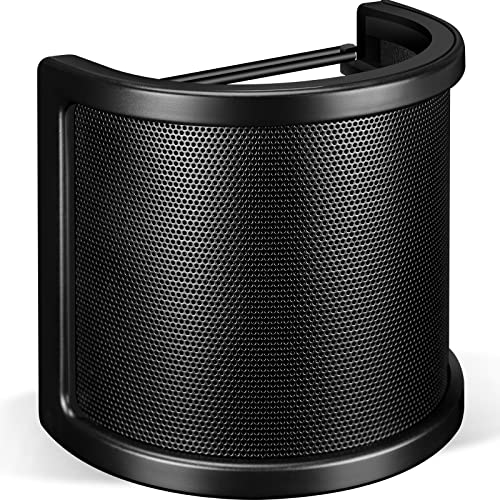
- Fits microphones from 45–63 mm in diameter
- Foam, metal mesh, and etamine layers reduce plosives
- Quick elastic-band and rubber-ring installation
Best For: Compatible vocal, streaming, and gaming microphones
Best for Blue Yeti Compatibility
Dual-Layer Gooseneck Pop Filter

- Listed as compatible with Blue Yeti microphones
- 360° gooseneck supports flexible positioning
- Adjustable clamp secures to a microphone stand
Best For: Blue Yeti users needing a clamp-mounted filter
Flexible Dual-Layer Shield – Universal Gooseneck Pop Filter
For microphone pop filters for desksetups, this universal dual-layer model offers broad mounting compatibility and flexible positioning. Its two-screen design helps diffuse bursts of air, while the adjustable clamp and gooseneck make it practical for singers, streamers, and voice recording.
Best For: Desk setups using tubular microphone stands or boom arms, especially when flexible placement matters.
Pros:
- Dual-layer screen helps contain plosives from sounds such as “B” and “P.”
- 360-degree gooseneck allows adjustment of angle and distance.
- Rotating clamp supports a variety of tubular mounts and includes a scratch-resistant gripper.
- Swivel mount simplifies installation, removal, and repositioning.
Cons:
- The clamp-and-gooseneck design takes more desk space than a fitted foam cover.
- At 6.4 ounces, it may need careful positioning on lighter stands.
This is a versatile choice when you want adjustable pop protection for a changing desk setup. Its universal clamp and dual-layer construction make it particularly useful for multi-purpose recording spaces.
Foam Mic Covers – AT2020 Two-Pack Windscreens
Audio-Technica AT2020 Pop Filter - 2 Windscreens for AT2020 & AT-2035 Microphones (Black)
Check Price On AmazonThese foam windscreens are a compact option for microphone pop filters for desksetups built around compatible Audio-Technica microphones. The two-pack slips over the microphone and is intended for AT2020, AT2020USB, and AT2020USB+ models while helping protect against dust and moisture.
Best For: AT2020-series users who prefer a simple, low-profile foam cover for vocals, calls, podcasts, or gaming.
Pros:
- Designed for Audio-Technica AT2020, AT2020USB, and AT2020USB+ microphones.
- Includes two foam windscreen covers.
- Durable, easy-clean quilted material helps protect the microphone from dust and moisture.
- Suitable for uses ranging from voiceovers and interviews to conference calls and online games.
Cons:
- Compatibility is more limited than universal clamp-on filters.
- It is a foam cover rather than an adjustable dual-screen shield.
- The microphone is not included.
If you already use a compatible AT2020-series microphone, this two-pack keeps the setup tidy and unobtrusive. It is best suited to buyers prioritizing a fitted foam solution over adjustable positioning.
Adjustable Recording Shield – NEEWER Dual-Layer Pop Filter
For microphone pop filters for desksetups, the NEEWER Professional Microphone Pop Filter Shield combines a dual-layer screen with a flexible steel gooseneck. Its clamp attaches to compatible microphone stands or boom mounts, making it useful when you need adjustable protection for vocals, streaming, or spoken recording.
Best For: Home studios and desk-mounted boom setups that need repositionable pop and plosive control.
Pros:
- Dual-layer construction disperses air pressure before it reaches the microphone.
- Adjustable gooseneck supports changes to angle and distance.
- Clamp is designed for a range of tubular booms and microphone stands.
- Swivel mount supports straightforward installation and location changes.
Cons:
- Its clamp-on format requires a suitable stand or boom mount.
- The listed 8.3-ounce weight may be more substantial than a foam cover.
- Microphone is not included.
This model is a practical middle ground for desk users who want traditional screen-style pop protection without committing to a fixed position. The adjustable gooseneck is useful for switching between speakers or recording distances.
PodMic-Fitted Foam Shield – RØDE WS14 Pop Filter for PodMic
The RØDE WS14 is a purpose-built choice among microphone pop filters for desksetups using a PodMic or PodMic USB. Its low-profile shape keeps the filter discreet on camera, while high-density foam and supporting ribs are designed to retain its form.
Best For: PodMic and PodMic USB users who want a neat, camera-friendly fitted foam filter.
Pros:
- Specifically designed for the PodMic and PodMic USB.
- Low-profile design maintains a discreet on-camera appearance.
- High-density foam construction includes supporting ribs for shape retention.
- Available in multiple colors, including black, white, blue, and red.
Cons:
- Compatibility is limited to the PodMic family.
- It does not provide the adjustable clamp and gooseneck of a stand-mounted filter.
Choose the WS14 when clean visual presentation and a fitted design matter more than universal mounting. It is a streamlined match for PodMic desk and camera setups.
Best Three-Layer Shield – PEMOTech Metal Mesh Pop Filter
For microphone pop filters for desksetups, the PEMOTech three-layer design is a practical choice when you want a compact cover for compatible microphones. Its foam, metal mesh, and etamine layers are designed to reduce plosives, breath sounds, wind interference, and recording crackles.
Best For: Vocal recording, streaming, YouTube videos, and speaking with compatible 45–61 mm microphones.
Pros:
- Three-layer construction targets plosives, breath sounds, and wind interference.
- Elastic bands and an inner rubber ring provide a quick, secure fit.
- Metal mesh helps keep saliva away from the microphone.
- Works with a broad range of listed microphone models and sizes.
Cons:
- Not compatible with Blue Yeti microphones.
- Fit is limited to microphones measuring 45–61 mm in diameter.
- The microphone is not included.
This is a straightforward desk-friendly option for users with a compatible microphone who want layered pop and moisture protection without a separate mounting arm.
Best Acoustic Coverage – Penypeal Microphone Isolation Ball
Among microphone pop filters for desksetups, the Penypeal isolation ball takes a more enclosed approach. Its five-sided foam design and double-layered opening are intended to reduce plosives, reflections, wind interference, and other unwanted sound during recording.
Best For: Desktop stands, small tripods, boom arms, floor stands, and recording setups using compatible 50–75 mm microphones.
Pros:
- Five-sided seal helps address noise from multiple directions.
- Double-layered opening filters divergent sound while recording.
- Includes a holder for different microphone sizes.
- Lightweight 120 g design is easy to mount and transport.
Cons:
- Compatible microphone diameter is limited to 50–75 mm.
- Its enclosed isolation-ball form may take up more space than a flat pop filter.
- The supplied details do not identify specific microphone models.
Choose this model when broader acoustic coverage matters more than a minimal footprint. Its lightweight mounting design suits flexible desktop and portable recording arrangements.
Best for Blue Yeti – YOUSHARES Six-Layer Pop Filter
For Blue Yeti owners comparing microphone pop filters for desksetups, the YOUSHARES model is purpose-built for that microphone. It combines a six-layer filter with a foam windscreen, adjustable gooseneck, and swivel clip to help manage plosives while keeping the filter positioned securely.
Best For: Blue Yeti streaming, podcasting, voice recording, and video recording.
Pros:
- Designed specifically for the Blue Yeti microphone.
- Six-layer construction includes metal mesh and high-density windproof sponge.
- 360-degree adjustable gooseneck supports flexible positioning.
- Includes both a pop filter and a foam windscreen.
Cons:
- Its compatibility is specialized rather than broadly universal.
- The filter and gooseneck may require more desk space than a simple cover.
- Designed around the Blue Yeti mounting arrangement.
This is the clearest fit for a Blue Yeti desk setup. The included windscreen adds versatility, while the adjustable gooseneck makes it easier to set the filter distance and angle.
Best All-Around Desk Mount – Aokeo P10 Three-Layer Pop Filter
For desk setups that need flexible positioning, this Aokeo P10 is a practical choice among microphone pop filters for desksetups. Its three-layer screen targets plosives, wind interference, hissing, and lisping, while the 360° gooseneck lets you fine-tune its placement.
Best For: Singers, streamers, actors, and home recording setups using a compatible microphone stand.
Pros:
- Three-layer construction helps control plosives and airflow noise.
- 360° rotating filter and steel gooseneck support precise positioning.
- Scratch-resistant clamp and swivel mount simplify installation and adjustment.
- Includes two screens and a one-year warranty.
Cons:
- Requires a compatible microphone stand or mounting point.
- Its metal construction weighs about 0.27 kg, which may be more than minimal desk filters.
The P10 stands out when adjustability matters. Its clamp-based design and three-layer screen make it a versatile desk recording accessory, especially for users who frequently change microphone position.
Best Slip-On Fit – Aokeo B-7 Three-Layer Mic Windscreen
The Aokeo B-7 uses a compact combination of foam, metal mesh, and etamine layers, making it a convenient option among microphone pop filters for desksetups. Its elastic bands and inner rubber ring are designed for quick installation on compatible microphones.
Best For: Vocal recording, streaming, gaming, and microphones measuring 45–63 mm in diameter.
Pros:
- Three-layer design helps reduce plosives, crackles, wind interference, and breath sounds.
- Elastic bands and an inner rubber ring provide a quick, secure fit.
- Metal mesh and plastic construction help keep saliva away from the microphone.
- Includes a two-year warranty with return or exchange support within 15 days.
Cons:
- Not compatible with the Blue Yeti according to the supplied specifications.
- Fit depends on the microphone diameter falling within the 45–63 mm range.
This is a good match for users who prefer a microphone-mounted filter rather than a separate clamp and gooseneck. Confirm your microphone’s dimensions before ordering, particularly if you use a Blue Yeti.
Best for Blue Yeti Compatibility – Dual-Layer Gooseneck Pop Filter
This dual-layer shield is a straightforward option for microphone pop filters for desksetups, with compatibility listed for Blue Yeti and other microphones. Its flexible 360° gooseneck and adjustable clamp help position the screen between the speaker and microphone.
Best For: Blue Yeti owners and desk recording users who want a clamp-mounted filter with flexible positioning.
Pros:
- Listed as compatible with Blue Yeti and other microphones.
- 360° flexible gooseneck supports convenient placement.
- Adjustable clamp is designed to secure to a microphone stand.
- Helps address hissing, lisping, plosives, and saliva accumulation.
Cons:
- Uses a dual-layer screen rather than the three-layer construction offered by some alternatives.
- Microphone is not included.
- Supplied notes do not specify a warranty or detailed clamp dimensions.
The main advantage here is its stated Blue Yeti compatibility combined with a flexible stand-mounted design. It is worth considering when you need adjustable positioning and a simple pop-shield setup.
How We Picked the Best Microphone Pop Filters for Desksetups
We focused on practical features that matter in everyday desktop recording: plosive reduction, microphone compatibility, mounting stability, adjustability, material quality, and ease of installation. The selection includes traditional dual-layer screens, three-layer designs, foam windscreens, microphone-specific covers, and enclosed acoustic-style filters.
Because microphones vary widely in size and housing design, compatibility is more important than appearance. A filter that works well with a Blue Yeti or PodMic may not suit a handheld microphone or a compact USB model.
Quick Comparison
| Filter type | Best suited to | Main advantage | Potential limitation |
|---|---|---|---|
| Dual-layer screen | Desk microphones and studio mics | Reliable plosive control with open airflow | Requires suitable stand or arm space |
| Three-layer shield | Streaming and voice recording | Extra filtering in a compact design | May slightly reduce high-frequency openness |
| Foam windscreen | USB and handheld microphones | Simple installation and low profile | Fit can be model-specific |
| Enclosed isolation filter | Recordings in untreated rooms | More surrounding acoustic absorption | Bulkier than standard pop filters |
Key Buying Factors for Microphone Pop Filters for Desk Setups
Compatibility and Clearance
Check the microphone dimensions, grille shape, and mounting method before buying. Desk microphones with built-in stands need a filter arm that can clamp or position independently, while some foam covers fit directly over the microphone head. Leave enough clearance to avoid touching the grille or blocking controls.
Filter Construction
Mesh screens generally provide a natural, open sound while stopping bursts of air. Layered metal, foam, and fabric designs add protection but can have a greater effect on treble if placed too close. Foam covers are convenient and discreet, though they are usually less adjustable.
Arm Stability and Positioning
A flexible gooseneck should hold its position without sagging. Look for a firm clamp, useful rotation, and enough reach to place the filter roughly 5–10 cm from the microphone. Correct distance is often as important as the filter material.
Cleaning and Durability
Choose a removable or washable cover when possible. Metal screens can usually be wiped clean, while foam collects dust and moisture over time and may need periodic replacement.
Who Should Buy Which Microphone Pop Filters for Desksetups?
- USB streamers: Choose an adjustable dual-layer or three-layer screen that clears the microphone’s controls and camera view.
- Blue Yeti owners: Look for a model specifically shaped for the Yeti or a universal shield with a stable independent arm.
- PodMic users: A microphone-specific RØDE-compatible filter offers a neat fit and straightforward installation.
- Handheld microphone users: Select a snug foam or layered windscreen designed for handheld mic dimensions.
- Home-recording users: Consider an enclosed acoustic filter if room reflections and nearby noise are bigger concerns than portability.
- Budget buyers: A basic dual-layer screen is usually the best starting point for reducing plosives without changing the rest of your setup.
For most desk setups, prioritize a secure fit and easy positioning over the highest layer count. A correctly placed, stable filter will generally improve speech clarity more than an oversized design that sits too far away or obstructs the microphone.