Choosing among hard drive duplicators for backups depends on more than drive capacity. The right model should match your drive type, preferred cloning method, transfer speed, and the number of copies you need to create.
This roundup covers standalone duplicators, offline cloning docks, and versatile USB-connected stations for SATA HDDs, SSDs, and select M.2 drives. Use the guide below to narrow the options by backup workflow and budget.
Best 10 Hard Drive Duplicators for Backups Picks for 2026
Best Value Dual-Bay Dock

- Supports 2.5-inch and 3.5-inch SATA drives
- Offline cloning without a computer
- USB 3.0 transfers up to 5Gbps
Best For: Simple home backups and drive access
Best for Image Libraries

- Creates and manages multiple disk images
- Four duplication modes, including sector-by-sector
- Standalone operation with LCD controls
Best For: IT imaging, deployment, and restore workflows
Best High-Capacity Dock

- Supports up to 44TB total capacity
- Offline cloning with a dedicated button
- USB 3.0 with UASP and TRIM support
Best For: Large-drive backups and computer-free cloning
Best for Fast Cloning
StarTech Dual-Bay SATA Duplicator
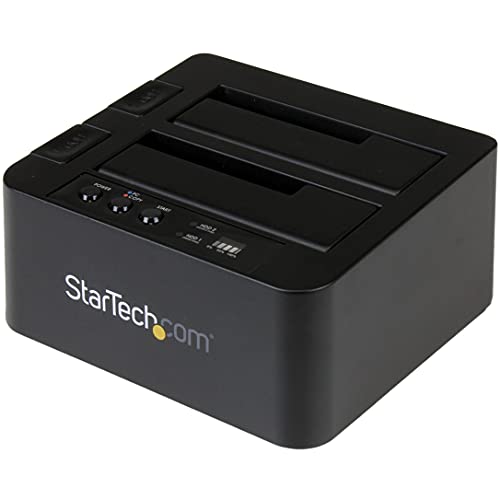
- Clones at up to 28GB per minute
- Supports SATA drives of any capacity
- USB 3.2 Gen 2 dock connectivity
Best For: Fast full-drive copies and professional workflows
Best Hybrid Dock
Rosewill Triple-Bay M.2 and SATA Cloner

- Offline cloning without a computer
- Supports M.2, 2.5-inch, and 3.5-inch drives
- USB 3.2 Gen 2x1 up to 10Gbps
Best For: Mixed-drive backup and cloning workflows
Best Standalone Duplicator

- No computer or software required
- Copies SATA drives at up to 90MB/s
- Includes DoD-compliant sanitization
Best For: Repeated SATA duplication and drive erasure
Best Dual-Bay Value

- Offline cloning with two drive bays
- Supports 2.5-inch and 3.5-inch SATA drives
- Up to 32TB per bay and 5Gbps USB 3.0
Best For: Home SATA backups and drive transfers
Best Type-C Value
Dual-Bay FIDECO Offline Clone Dock

- Offline cloning without a computer
- USB-C to USB-C and USB-C to USB-A cables included
- Supports 2.5- and 3.5-inch SATA HDDs and SSDs
Best For: Home and small-office SATA drive backups
Best Hub-Enabled Option

- Offline cloning with no computer required
- Up to 48TB total across two bays
- Three USB 3.0 Type-A hub ports
Best For: Workstations needing SATA backups and USB expansion
Best for IT Workflows
StarTech 4-Bay Duplicator and Eraser

- Standalone 1:3 cloning across four bays
- Quick and Secure Erase modes included
- USB and eSATA docking with IDE adapters
Best For: IT teams managing duplication and drive sanitization
Best Value Dual-Bay Dock – Sabrent USB 3.0 HDD Cloner
For straightforward hard drive duplicators for backups, the Sabrent EC-HD2B combines a two-drive SATA dock with offline cloning. It supports standard 2.5-inch and 3.5-inch SATA HDDs and SSDs, with plug-and-play USB 3.0 access and support for drives up to 10TB each.
Best For: Home users who want an uncomplicated dock for drive cloning, file access, and routine backups.
Pros:
- Supports both 2.5-inch and 3.5-inch SATA HDDs and SSDs.
- Offline cloning works without requiring a computer.
- USB 3.0 transfer speeds reach up to 5Gbps, with no drivers needed.
- Supports up to 20TB of combined storage capacity.
Cons:
- Offline cloning speed is listed at up to 60Mbps.
- Limited to two SATA drives at a time.
The Sabrent is a practical entry-level choice when you need both a drive reader and a simple offline duplicator. Its 2-year extended warranty requires product registration.
Best for Image Libraries – StarTech 1:1 SATA Duplicator
Among hard drive duplicators for backups, the StarTech SATDUP11IMG stands out for its built-in disk image library. This standalone unit can create, store, and restore multiple drive images without a computer, making it suited to repeatable system backup and deployment workflows.
Best For: IT professionals, system integrators, and administrators managing recurring PC or server images.
Pros:
- Stores multiple disk images on a single library drive.
- Offers four duplication modes, including sector-by-sector copying.
- Supports 2.5-inch and 3.5-inch SATA HDDs and SSDs of any capacity.
- LCD controls and LED indicators help manage drive and image operations.
Cons:
- Adapters for eSATA, mSATA, IDE, and M.2 SATA are sold separately.
- Its professional image-management features may be more than casual users need.
With a stated copy speed of up to 6GB per minute and a steel enclosure, this StarTech model is designed around controlled, repeatable backup and restore tasks rather than occasional consumer cloning.
Best High-Capacity Dock – ORICO Dual-Bay HDD Cloner
The ORICO DD28U3-C is a useful option for hard drive duplicators for backups when high-capacity media support matters. Its dual-bay design accepts 2.5-inch and 3.5-inch SATA drives, supports up to 44TB total, and provides offline cloning with a dedicated button.
Best For: Users backing up large SATA drives or moving data between drives without connecting to a computer.
Pros:
- Supports up to 44TB using two drives of up to 22TB each.
- Works with SATA I, II, and III HDDs and SSDs in 2.5-inch or 3.5-inch sizes.
- Offline cloning starts by holding the clone button for about three seconds.
- USB 3.0, UASP, and TRIM support enable up to 5Gbps transfers.
Cons:
- The target disk must be larger than the source disk for offline cloning.
- The dock does not power on without a hard drive inserted.
- It includes a 1-year warranty.
Its independent 36W power supply, automatic sleep mode, dust-resistant cover plate, and tool-free loading make the ORICO a flexible high-capacity dock for backups and everyday drive transfers.
Best for Fast Cloning – StarTech Dual-Bay SATA Duplicator
For users prioritizing speed, the StarTech SDOCK2U313R is one of the more capable hard drive duplicators for backups. It performs standalone sector-by-sector cloning at up to 28GB per minute, supports 2.5-inch and 3.5-inch SATA drives, and can also function as a USB drive dock.
Best For: IT technicians and advanced users who need fast, repeatable full-drive copies.
Pros:
- Copies entire drives, including empty sectors, at up to 28GB per minute.
- Works with SATA HDDs and SSDs of any capacity and is 4Kn compatible.
- Supports standalone cloning without a computer.
- USB 3.2 Gen 2 connectivity reaches up to 10Gbps when used as a dock.
Cons:
- Cloning requires a target disk equal to or larger than the source.
- Sector-by-sector copying may take longer than file-level backup when drives contain substantial empty space.
- An IDE adapter is sold separately.
With TRIM support, tool-free top loading, eject buttons, and multi-function status LEDs, this StarTech dock offers a strong combination of fast duplication and convenient drive access.
Best Hybrid Dock – Rosewill Triple-Bay M.2 and SATA Cloner
For shoppers comparing hard drive duplicators for backups, the Rosewill RS-N2S-CL stands out for its broad drive support and offline cloning. It handles M.2 NVMe and SATA SSDs plus 2.5-inch and 3.5-inch HDDs, while also working as a USB docking station.
Best For: Users who need one compact tool for cloning and accessing several types of drives.
Pros:
- Performs offline HDD and SSD cloning without a host computer.
- Supports up to three devices, including M.2, 2.5-inch, and 3.5-inch drives.
- Offers USB 3.2 Gen 2×1 transfer speeds up to 10Gbps.
- Tool-free drive installation and a compact, portable design simplify use.
Cons:
- The enclosure is plastic rather than metal.
- Its feature-rich design may be more than needed for simple SATA-only cloning.
The Rosewill is a flexible choice when backup workflows involve different drive formats. Its triple-bay layout and 10Gbps interface add convenience, though users seeking only basic SATA duplication may prefer a simpler unit.
Best Standalone Duplicator – Systor 1:1 HDD/SSD Duplicator
The Systor SYS101HS-DP is a dedicated option for hard drive duplicators for backups when computer-free operation matters. It copies SATA HDDs and SSDs at up to 90MB per second and also includes drive-erasing functions for reuse or sanitization.
Best For: Businesses and technicians performing repeated SATA drive duplication or erasure.
Pros:
- Operates as a complete standalone unit without a computer or software.
- Accepts both 2.5-inch and 3.5-inch SATA drives without an adapter.
- Can copy data only or duplicate an entire hard drive.
- Supports DoD 5220.22-M-compliant drive sanitization.
Cons:
- Its listed compatibility is centered on SATA drives.
- The maximum transfer rate is 90MB per second, below newer 10Gbps docking interfaces.
With hot-swappable operation, consistent stated copy speed, and sanitization support, the Systor is built for practical, repeatable drive work. It is especially appealing for users who value a focused duplicator over a general-purpose computer dock.
Best Dual-Bay Value – UGREEN CM198 SATA Drive Dock
The UGREEN CM198 is a straightforward pick among hard drive duplicators for backups, pairing dual-bay SATA access with offline cloning. It supports simultaneous 2.5-inch and 3.5-inch drives, provides up to 5Gbps USB 3.0 transfers, and supports capacities up to 32TB per bay.
Best For: Home users who want an affordable dual-drive dock for SATA cloning and file transfers.
Pros:
- Clones drives offline without connecting to a computer.
- Supports two 2.5-inch or 3.5-inch SATA drives at once.
- Offers up to 5Gbps USB 3.0 transfer speeds and broad SATA compatibility.
- Includes cooling features, a dust cover, anti-slip pads, and a USB-C cable.
Cons:
- It is limited to two drive bays.
- Its 5Gbps interface is slower than USB 3.2 Gen 2 options.
- Offline cloning requires the destination drive to have capacity at least as large as the source.
The UGREEN offers a useful balance of capacity, convenience, and simple offline cloning for SATA-based backups. It is less suited to M.2 drives or users who need the fastest available transfer interface.
Best Type-C Value – Dual-Bay FIDECO Offline Clone Dock
For straightforward hard drive duplicators for backups, the FIDECO dock combines two SATA bays with USB-C connectivity and offline cloning. It supports 2.5- and 3.5-inch SATA HDDs and SSDs, making it a practical option for home users who want to copy one drive to another without a computer.
Best For: Home and small-office backups using compatible SATA drives.
Pros:
- Offline cloning works without a computer.
- Includes both USB-C to USB-C and USB-C to USB-A cables.
- Supports Windows, macOS, and Linux with plug-and-play operation.
- USB 3.2 Gen 1 with UASP supports transfer rates up to 5Gbps.
Cons:
- Only supports 2.5- and 3.5-inch SATA drives.
- The target drive must be equal to or larger than the source drive for cloning.
The FIDECO is a compact, versatile choice when you need occasional drive access and uncomplicated offline duplication. Its dual cables add flexibility, though users with IDE, NVMe, or other drive formats will need a different solution.
Best Hub-Enabled Option – MAIWO Dual-Bay Drive Cloner
The MAIWO is one of the more flexible hard drive duplicators for backups because it combines dual-bay SATA cloning with three USB 3.0 hub ports. It supports 2.5- and 3.5-inch SATA HDDs and SSDs, with up to 24TB per bay according to the supplied specifications.
Best For: Users who want offline drive cloning plus extra USB connectivity at a workstation.
Pros:
- Copies a source drive to a target drive without a computer or drivers.
- Supports up to 24TB per port and 48TB total capacity.
- Three USB 3.0 Type-A hub ports expand connectivity.
- LED indicators show 25%, 50%, 75%, and 100% clone progress.
Cons:
- Limited to 2.5- and 3.5-inch SATA HDDs and SSDs.
- Uses USB 3.0 rather than a newer USB-C host connection.
Choose the MAIWO when a basic duplicator is not enough and you also need convenient USB-A expansion. Its independent 12V 3A power supply and progress indicators make it well suited to repeat backup tasks, while its drive-format support remains limited to SATA devices.
Best for IT Workflows – StarTech 4-Bay Duplicator and Eraser
For professional hard drive duplicators for backups, the StarTech.com SATDOCK4U3RE adds four bays, standalone 1:3 cloning, and drive-erasing functions. It supports 2.5- and 3.5-inch SATA drives, while included adapters also accommodate compatible 2.5- and 3.5-inch IDE drives.
Best For: IT professionals handling repeated drive duplication, sanitization, recovery, and data-transfer tasks.
Pros:
- Can clone one source drive to up to three target drives independently.
- Supports quick erase and Secure Erase aligned with NIST SP 800-88 Rev. 1 Purge.
- Works as a USB or eSATA docking station for drive access.
- LCD menu, drive doors, eject buttons, and multi-function LEDs support hands-on workflows.
Cons:
- Its broader professional feature set may be more than casual users need.
- Standalone cloning requires target disks equal to or larger than the source.
- Listed interfaces are USB-A and eSATA rather than USB-C.
The StarTech model is the strongest fit when backup operations overlap with deployment or secure drive disposal. Its four-bay, 1:3 design is more capable than a typical dual-bay dock, and the included IDE adapters broaden compatibility, but the unit is best suited to structured IT work rather than occasional home cloning.
How We Picked These Hard Drive Duplicators for Backups
We focused on the features that matter during repeat backup and drive migration tasks: offline cloning, source-to-target compatibility, supported drive sizes, rated transfer speed, erasing functions, connection standards, and bay count. We also considered whether each device is best suited to occasional home backups, IT maintenance, or higher-volume duplication.
Standalone models can clone drives without a computer, while USB docking stations often provide more flexibility for reading, restoring, and managing disks through a host computer. Because advertised speeds vary with drive performance and data conditions, treat them as maximum ratings rather than guaranteed real-world results.
Quick Comparison
| Best For | Look For | Typical Advantage |
|---|---|---|
| Occasional home backups | Dual-bay offline cloning | Simple drive-to-drive copying |
| Mixed SATA drive libraries | 2.5- and 3.5-inch support | Broad compatibility |
| M.2 and SATA SSD users | NVMe/SATA support | Greater format flexibility |
| IT technicians | Standalone duplicator with LCD or image tools | Repeatable, computer-free workflows |
| Batch duplication | Four-bay or multi-target design | Several copies per cycle |
Key Buying Factors
Drive Format and Capacity
Confirm whether the dock supports SATA I, II, and III drives and whether it accepts both 2.5-inch and 3.5-inch disks. If you use M.2 storage, check the exact interface: NVMe and SATA M.2 drives are not interchangeable. Capacity limits also matter, especially with newer high-capacity disks.
Offline Cloning and Drive Handling
Offline cloning is useful when you want a direct source-to-target copy without installing software. Make sure the destination drive is equal to or larger than the source, and remember that cloning can erase existing data on the target. A protected or clearly labeled source bay reduces mistakes.
Speed, Connectivity, and Erasing
Higher rated speeds can shorten large transfers, but the actual result depends on both drives, the interface, and the data pattern. USB 3.x is helpful for computer-connected use. If you regularly retire or repurpose disks, choose a model with a verified erase function rather than assuming cloning hardware provides secure data removal.
Bay Count and Workflow
A dual-bay dock is usually sufficient for one-to-one backups. Multi-bay duplicators make more sense for technicians or organizations creating several identical drives. Consider physical clearance, power requirements, cooling, and whether the unit supports simultaneous targets.
Who Should Buy Which Hard Drive Duplicators for Backups?
Home users making occasional local backups should prioritize a simple dual-bay SATA dock with offline cloning and clear status indicators. Users with both 2.5-inch and 3.5-inch drives should choose a universal SATA design with broad capacity support. If your storage collection includes M.2 NVMe drives, select a model specifically rated for NVMe rather than relying on a SATA-only dock.
IT professionals and repair shops benefit from dedicated standalone duplicators with LCD controls, image-management features, erasing tools, or multiple target bays. For frequent batch work, a four-bay model can save substantial time, provided the added cost and workspace are justified.
Before buying, verify the exact drive interface, target capacity, cloning direction, and included cables. Always maintain at least one additional backup: a duplicator copies data efficiently, but it does not replace an offline, off-site, or cloud backup strategy.