Photographers need more than simple external storage: a reliable duplicator can create a second copy of valuable image files without tying up a computer. The right dock can also make it easier to migrate drives, recover archives, or work with both 2.5-inch and 3.5-inch disks.
We selected 10 hard drive duplicators for photo storage across several use cases, including offline cloning, computer-connected transfers, multi-bay expansion, and SSD compatibility. The guide below explains what separates a convenient backup tool from an unnecessarily complicated one.
Best 10 Hard Drive Duplicators for Photo Storage Picks for 2026
Most Versatile Pick
ICY BOX Triple-Bay NVMe/SATA Cloner

- One-touch offline cloning
- Supports M.2 NVMe and SATA drives
- Three bays with USB 3.2 Gen 2
Best For: Mixed NVMe and SATA photo-storage workflows
Best SATA Speed Focus
StarTech Dual-Bay SATA Duplicator
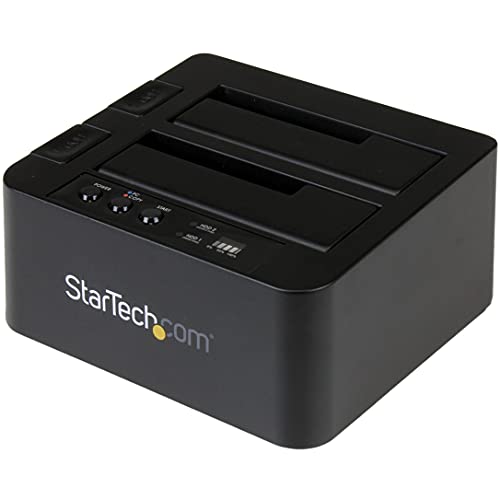
- Up to 28 GB/minute cloning
- Standalone sector-by-sector copying
- Supports 2.5/3.5-inch SATA drives
Best For: Conventional SATA photo archives and drive upgrades
Best for Large Archives

- Up to five SATA drives
- Stated 100TB total capacity
- Offline duplication for four copies
Best For: Large photo archives and multi-drive backup workflows
Best for Sanitization

- Standalone SATA duplication
- Supports data-only or full-drive copies
- DoD 5220.22-M erasure support
Best For: Small-scale photo backup and drive sanitization
Best Overall
SABRENT Dual-Bay HDD Docking Station

- Supports 2.5-inch and 3.5-inch SATA drives
- Offline cloning with no computer required
- USB 3.0 speeds up to 5Gbps
Best For: Home photographers needing a versatile two-drive dock
Best for Batch Duplication
EZ DUPE USB Cyclone 1-to-15 Duplicator

- Copies up to 15 USB devices at once
- Standalone operation needs no computer
- Offers multiple copy and erase modes
Best For: Studios and businesses duplicating many USB drives
Best High-Capacity Dock
ORICO Dual-Bay Hard Drive Cloner

- Supports up to 44TB across two drives
- Offline cloning with a dedicated button
- USB 3.0, UASP, and tool-free swapping
Best For: Large SATA-based photo archives and drive migrations
Balanced Offline Cloning

- Offline cloning without a computer
- Holds two SATA drives up to 20TB each
- USB 3.0 with UASP support
Best For: Straightforward photo-drive backups and transfers
High-Capacity Cooling

- Supports up to 32TB per bay
- Offline cloning without a computer
- Cooling, dust cover, and anti-slip pads
Best For: Large photo libraries needing a stable desktop dock
Hub-Enabled Backup

- Offline cloning with progress indicators
- Supports up to 24TB per bay
- Adds three USB 3.0 hub ports
Best For: Photo backups that also need convenient USB expansion
Most Versatile Pick – ICY BOX Triple-Bay NVMe/SATA Cloner
For shoppers comparing hard drive duplicators for photo storage, the ICY BOX stands out for supporting both M.2 NVMe and 2.5/3.5-inch SATA drives. Its three-bay, tool-free design makes it practical for moving or accessing drives across mixed storage setups.
Best For: Photographers and power users managing NVMe and SATA drives in the same workflow.
Pros:
- One-touch offline cloning without a computer or software installation.
- Supports NVMe-to-NVMe, SATA-to-NVMe, and other listed drive combinations.
- Three independent bays allow multiple drives to be connected at once.
- USB 3.2 Gen 2 provides transfer rates up to 10 Gbps and includes USB-C/USB-A connectivity.
Cons:
- Its plastic enclosure may feel less substantial than an aluminum dock.
- NVMe support may be unnecessary if your photo archive uses SATA drives exclusively.
The ICY BOX is the most flexible choice here for mixed-drive photo workflows. It combines offline cloning with broad compatibility, though users seeking only simple SATA duplication may prefer a more focused dock.
Best SATA Speed Focus – StarTech Dual-Bay SATA Duplicator
The StarTech dual-bay dock is a straightforward option among hard drive duplicators for photo storage when your archive uses 2.5- or 3.5-inch SATA HDDs and SSDs. It performs standalone sector-by-sector copies and can also connect drives to a computer over USB.
Best For: Photographers who need reliable SATA cloning and occasional drive access without installing software.
Pros:
- Standalone cloning works without a computer and supports drives of any capacity.
- Copies entire drives sector by sector at speeds up to 28 GB per minute.
- Supports 2.5/3.5-inch SATA HDDs and SSDs, including 4Kn and TRIM.
- Tool-less top-loading design includes drive doors, eject buttons, and status LEDs.
Cons:
- Limited to two SATA drives at a time.
- The target drive must be equal to or larger than the source drive.
- NVMe drives are not supported.
With its focused SATA compatibility and published 28 GB/minute duplication rate, this StarTech model suits conventional photo-storage setups. Its two-bay layout is less flexible than larger docks, but the design is purpose-built and easy to operate.
Best for Large Archives – ORICO Five-Bay SATA Dock
For large photo and video libraries, the ORICO five-bay dock offers substantial expansion and offline duplication. It accepts up to five 2.5- or 3.5-inch SATA drives, with a stated maximum of 20TB per drive, making it a strong capacity-oriented option among hard drive duplicators for photo storage.
Best For: Professional photographers who need multiple SATA drives and high total storage capacity.
Pros:
- Five-bay design supports up to five SATA drives and a stated 100TB total capacity.
- One-button offline duplication can create four copies without a computer.
- Aluminum construction and vertical layout support heat dissipation.
- Includes USB-C and USB-A connectivity and supports Windows and macOS systems.
Cons:
- USB 3.2 Gen 1 is slower than the 10 Gbps interface on some competing docks.
- Cloning overwrites the target disk, so backups are needed before duplication.
- Its five-bay footprint may be more than needed for a small photo library.
The ORICO is the capacity specialist in this group. Its five bays and four-copy offline duplication are useful for managing large archives, while the slower Gen 1 interface makes it less appealing for users prioritizing maximum USB transfer performance.
Best for Sanitization – Systor 1:1 HDD/SSD Duplicator
The Systor 1:1 is a compact, standalone option for users who need basic drive copying plus erasure features. For hard drive duplicators for photo storage, it fits workflows involving 2.5- and 3.5-inch SATA HDDs or SSDs and supports copying data-only or an entire drive.
Best For: Small businesses and photographers who need straightforward SATA duplication with data sanitization.
Pros:
- Operates without a computer or software.
- Accepts both 2.5- and 3.5-inch drives without an adapter.
- Copies at speeds up to 90 MB per second, even when multiple drives are loaded.
- Supports data-only or whole-drive copying and DoD 5220.22-M-compliant erasure.
Cons:
- Its listed 5.4 GB/minute speed is much lower than faster modern docks.
- It does not offer NVMe compatibility.
- The product is a 1:1 duplicator, so it is less suited to making several simultaneous copies.
The Systor is best viewed as a practical copying and sanitization tool rather than a high-capacity archival dock. Its adapter-free SATA support and erasure function make it useful for controlled, small-scale photo-storage maintenance.
Best Overall – SABRENT Dual-Bay HDD Docking Station
For photographers looking for hard drive duplicators for photo storage, the SABRENT EC-HD2B offers a straightforward dual-bay setup for 2.5-inch and 3.5-inch SATA hard drives or SSDs. It supports drives up to 10TB, connects over USB 3.0, and can clone drives offline without a computer.
Best For: Home photographers who need a simple dock for drive access, backups, and occasional offline cloning.
Pros:
- Supports both 2.5-inch and 3.5-inch SATA HDDs and SSDs.
- Offline cloning requires no drivers or computer connection.
- USB 3.0 transfer speeds reach up to 5Gbps.
- Supports drives up to 10TB.
Cons:
- Offline cloning is listed at up to 60Mbps, slower than the USB 3.0 interface’s maximum transfer rate.
- Designed for two drives, so it is not intended for larger batch duplication jobs.
The SABRENT is a practical all-purpose choice when you want one device for reading, transferring, and duplicating photo-storage drives. Its plug-and-play design keeps setup simple, while the two-bay layout makes direct drive-to-drive cloning convenient.
Best for Batch Duplication – EZ DUPE USB Cyclone 1-to-15 Duplicator
The EZ DUPE USB Cyclone is a specialized option among hard drive duplicators for photo storage, with support for up to 15 USB devices at once. It works as a standalone duplicator, supports drives above 2TB, and provides several copy and erase modes for larger-scale workflows.
Best For: Studios, businesses, or photographers who regularly duplicate multiple USB hard drives or flash drives without using a computer.
Pros:
- Duplicates up to 15 USB devices simultaneously.
- Standalone operation requires no computer or software.
- Supports full, partitioned, percentage, and essential-file copy modes.
- Includes four erase modes, including DoD 3-pass and DoD 7-pass options.
Cons:
- Its listed speed is up to 45MBps, below the 5Gbps interface maximum of some USB 3.0 docks.
- At 7 pounds, it is less convenient for portable use.
- Designed for USB-connected media rather than direct SATA drive bays.
The USB Cyclone is overbuilt for occasional home backups but compelling for repeat duplication jobs. Independent bandwidth design and slow-drive alerts are useful when multiple USB media devices are being copied together.
Best High-Capacity Dock – ORICO Dual-Bay Hard Drive Cloner
The ORICO dual-bay dock is a strong fit for photographers comparing hard drive duplicators for photo storage because it supports up to 44TB across two drives. Its offline clone button, USB 3.0 connectivity, and compatibility with 2.5-inch and 3.5-inch SATA media make it useful for expanding or migrating photo libraries.
Best For: Photographers managing large SATA-based photo archives who want high-capacity drive support and computer-free cloning.
Pros:
- Supports up to 44TB total capacity using two drives up to 22TB each.
- Works with 2.5-inch and 3.5-inch SATA I/II/III HDDs and SSDs.
- Offline cloning starts with a dedicated button and does not require a computer.
- USB 3.0 with UASP and tool-free drive swapping supports convenient file transfers.
Cons:
- The target disk must be larger than the source disk for offline cloning.
- The dock will not power on without a hard drive inserted.
- It supports two bays rather than high-volume multi-drive duplication.
ORICO is the most capacity-focused choice in this group. It combines a compact two-bay design with a 36W power supply, automatic sleep behavior, and broad device and operating-system compatibility, making it well suited to large photo-storage maintenance.
Balanced Offline Cloning – WAVLINK Dual-Bay Dock
For photographers looking for hard drive duplicators for photo storage, the WAVLINK Dual Bay Docking Station offers a straightforward way to access two SATA drives and clone one drive to another without a computer. Its fixed bezels, UASP support, and compatibility with drives up to 20TB per bay make it a practical backup tool.
Best For: Photographers who want simple, computer-free drive cloning and dual-drive file transfers.
Pros:
- Supports 2.5-inch and 3.5-inch SATA HDDs and SSDs.
- Offline cloning starts with a dedicated button and requires no computer.
- Supports up to two 20TB drives and includes USB-C adapter connectivity.
- UASP support can improve transfer performance over conventional USB 3.0.
Cons:
- The target drive must have capacity equal to or greater than the source drive for cloning.
- It is designed for SATA drives rather than other drive interfaces.
The WAVLINK is a well-rounded option when you need both routine drive access and occasional offline duplication. Its dual-bay design is especially useful for maintaining a second copy of a photo archive.
High-Capacity Cooling – UGREEN Dual-Bay Dock
The UGREEN Dual-Bay Hard Drive Docking Station is a strong candidate among hard drive duplicators for photo storage when capacity and drive protection matter. It supports two SATA drives at the same time, offers computer-free cloning, and adds cooling, a dust cover, and anti-slip pads for a more secure desktop setup.
Best For: Photographers managing large SATA-based photo libraries and wanting extra protection around an always-available dock.
Pros:
- Supports two 2.5-inch or 3.5-inch SATA drives up to 32TB each.
- Offline cloning works without connecting the dock to a computer.
- 360-degree cooling, a dust cover, and anti-slip pads support safer everyday use.
- Includes a 1-meter USB-B to USB-C cable for flexible connections.
Cons:
- USB 3.0 transfer speeds are listed at up to 5Gbps.
- Cloning requires the target drive to be at least as large as the source drive.
- Compatibility is centered on SATA hard drives and SSDs.
With its unusually high stated capacity and cooling-focused design, the UGREEN dock suits photographers building large, expandable archives. It is a sensible choice if physical drive access and desktop stability are priorities.
Hub-Enabled Backup – MAIWO SATA Drive Cloner
The MAIWO Hard Drive Docking Station Cloner combines offline SATA duplication with three USB 3.0 hub ports. For photographers comparing hard drive duplicators for photo storage, it provides a convenient way to clone a source drive, connect flash storage, and organize transfers from one powered desktop station.
Best For: Photographers who want drive cloning plus extra USB ports for flash drives and connected accessories.
Pros:
- Supports 2.5-inch and 3.5-inch SATA HDDs and SSDs, with up to 24TB per bay.
- Offline cloning requires no computer or drivers.
- LED indicators show clone progress at 25%, 50%, 75%, and 100%.
- Three USB 3.0 Type-A hub ports add convenient peripheral and flash-drive access.
Cons:
- The listed USB transfer bandwidth is up to 5Gbps.
- Cloning requires a target drive with capacity equal to or greater than the source.
- The hub’s phone-charging feature is limited to one port supporting 2.4A charging.
The MAIWO stands out for users who want more than a basic duplicator. Its progress lights and integrated USB hub make recurring photo backups and related file handling easier from a single powered unit.
How We Picked the Best Hard Drive Duplicators for Photo Storage
We focused on features that matter to photographers and image-heavy workflows: support for common SATA HDDs and SSDs, compatibility with both 2.5-inch and 3.5-inch drives, cloning without a computer, usable transfer speeds, capacity limits, and connection options. We also included different formats, from straightforward dual-bay docks to multi-drive stations and dedicated duplicators.
Because product specifications and real-world speeds can vary by drive, cable, file size, and host computer, advertised throughput should be treated as a ceiling rather than a guarantee. A duplicator is most useful when its workflow matches how you actually back up and organize photos.
Quick Comparison
- Best for mixed media: Choose a dock supporting both SATA hard drives and SATA SSDs.
- Best for occasional cloning: A dual-bay offline dock is usually the simplest option.
- Best for several working drives: Consider a five-bay station or a model with additional USB ports.
- Best for repeated professional duplication: A dedicated duplicator with standalone controls and verified erase functions may be preferable.
- Best for legacy and current setups: Look for USB 3.0 or USB-C connectivity, plus support for SATA I, II, and III where specified.
Key Buying Factors for Hard Drive Duplicators for Photo Storage
Drive Compatibility and Capacity
Confirm that the dock accepts your drive sizes and interfaces. Most models here target SATA drives, while the ICY BOX option also supports M.2 NVMe media. Check the maximum supported capacity before buying, especially if your photo archive uses large 3.5-inch disks or several drives.
Offline Cloning Versus Computer Transfers
Offline cloning copies one drive directly to another using buttons or a switch, which is convenient for creating a full duplicate. A computer-connected dock is better for selective file management, folder organization, Lightroom catalog work, and incremental backups. Some products support both modes.
Speed, Power, and Cooling
USB 3.0 and USB-C can reduce transfer times, but the drive itself may be the limiting factor. Mechanical hard drives generally run slower than SSDs. For long photo transfers, prioritize a stable power adapter, secure drive slots, and ventilation over headline speed alone.
Safety and Verification
Cloning and erasing are destructive operations. Look for clear source-to-target controls, status indicators, and a workflow that makes accidental selection less likely. Keep at least one additional backup before erasing any original drive.
Who Should Buy Which Hard Drive Duplicators for Photo Storage?
Choose a compact dual-bay dock such as the Sabrent, Orico, WAVLINK, UGREEN, or MAIWO when you want affordable access to two SATA drives and occasional offline cloning. The StarTech model is a strong fit for users who value a clearly specified, faster duplicator workflow. Choose the Systor when standalone duplication and erasing are central tasks.
For photographers managing multiple working disks, the ORICO five-bay station provides more room and connectivity. The EZ DUPE is better suited to repeated, higher-volume duplication tasks. If your archive includes both M.2 NVMe and standard SATA media, the ICY BOX model offers the broadest format flexibility. Whichever option you choose, maintain a separate backup stored away from your primary photo workspace.