Hard drive duplicators make it easier to clone, replace, sanitize, or manage drives without building a full desktop system. The best choice depends on your drive formats, required copy speed, number of bays, and whether you need standalone operation.
We compare 10 options ranging from simple dual-bay SATA docks to multi-drive duplicators with M.2 support, standalone controls, and secure erasing features.
Best 10 Hard Drive Duplicators Picks for 2026
Best Plug-and-Play Pick
SABRENT Dual-Bay HDD/SSD Cloner

- Supports 2.5-inch and 3.5-inch SATA drives
- Offline cloning requires no computer
- USB 3.0 supports up to 5Gbps
Best For: Simple home backups and occasional drive cloning
Best for IT Workflows
StarTech 1:1 SATA Duplicator and Eraser

- Three duplication modes for flexible copying
- Four erase modes, including three-pass overwrite
- Copy & Compare verifies completed clones
Best For: IT deployments, recovery, and drive sanitization
Best Multi-Drive Dock
SABRENT 4-Bay USB 3.0 Clone Station

- Accommodates up to four SATA drives
- Trayless, tool-free drive insertion
- Offline cloning works without a computer
Best For: Managing multiple drives from one desktop dock
Best High-Speed Cloner
StarTech Dual-Bay SATA Duplicator Dock
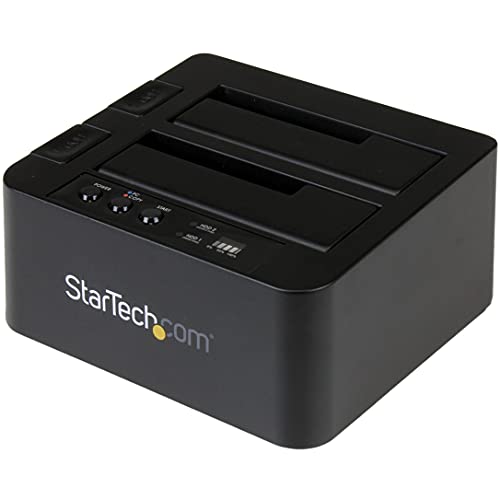
- Standalone cloning reaches up to 28GB per minute
- Supports SATA drives of any capacity
- Adds USB 3.2 Gen 2 drive-dock functionality
Best For: Fast cloning and professional SATA drive access
Portable Recovery Pick
Vinpower HDDMINI 1-to-2 Duplicator

- Standalone SATA cloning without a PC
- Read-error skip for drives with bad sectors
- Supports 3TB+ drives and DoD-style erasing
Best For: Portable SATA duplication and data recovery
Most Versatile Interface Support
StarTech Dual-Bay M.2/SATA Duplicator

- Supports NVMe, M.2 SATA, and 2.5/3.5-inch SATA
- Configurable duplication and HPA settings
- Five erase modes with on-screen controls
Best For: Professional mixed-drive cloning and sanitization
Simple SATA Workhorse

- Standalone 1:1 SATA cloning and erasing
- Fits 2.5-inch and 3.5-inch drives without adapters
- Supports data-only or whole-drive copying
Best For: Straightforward home and business SATA duplication
Best Value Hub

- Offline cloning without a computer
- Supports 2.5- and 3.5-inch SATA drives
- Includes three USB 3.0 hub ports
Best For: Home users and small offices needing cloning plus USB connectivity
Best Heavy-Duty Pick
StarTech.com 4-Bay Duplicator and Eraser

- Clones one drive to three targets
- Supports SATA and IDE drives with adapters
- Includes secure erase and NIST purge support
Best For: IT professionals managing duplication and drive sanitation
Best Dual-Bay Professional Pick
StarTech.com Standalone SATA Cloner

- Standalone sector-by-sector cloning
- Supports SATA I, II, III, and 4Kn drives
- Functions as a USB or eSATA drive dock
Best For: Technicians needing compact professional SATA cloning
Best Plug-and-Play Pick – SABRENT Dual-Bay HDD/SSD Cloner
For shoppers comparing hard drive duplicators, the SABRENT EC-HD2B is a straightforward dual-bay option for copying or accessing standard 2.5-inch and 3.5-inch SATA drives. It works without drivers, supports drives up to 10TB, and can clone offline without a computer.
Best For: Home users and technicians who want a simple SATA HDD/SSD dock with offline cloning.
Pros:
- Supports both 2.5-inch and 3.5-inch SATA HDDs and SSDs.
- Offline cloning works without additional software or a computer.
- USB 3.0 connectivity supports transfer speeds up to 5Gbps.
Cons:
- Offline cloning is listed at up to 60Mbps, slower than its USB transfer rating.
- Limited to two installed drives at a time.
The EC-HD2B is a practical choice when ease of use matters most. Its dual-bay design and plug-and-play setup make it useful for routine drive access, backups, and occasional cloning.
Best for IT Workflows – StarTech 1:1 SATA Duplicator and Eraser
The StarTech SATDUP11 is one of the more feature-focused hard drive duplicators in this lineup. It combines standalone SATA drive copying with multiple erase modes, making it suitable for deployments, recovery work, and drive sanitization without relying on an operating system.
Best For: IT professionals who need duplication, verification, and drive-erasing functions in one standalone unit.
Pros:
- Offers sector-by-sector, system-and-file, and all-partitions copy modes.
- Includes quick, secure, single-overwrite, and three-pass erase modes.
- Copy & Compare helps verify the cloned drive after duplication.
- Supports 2.5-inch and 3.5-inch SATA HDDs and SSDs of any capacity.
Cons:
- Optional adapters are required for eSATA, mSATA, IDE, and M.2 SATA drives.
- Its professional feature set may be more than casual users need.
With its LCD menu, standalone operation, and sanitation features, the SATDUP11 is better suited to repeatable technical workflows than basic home cloning. The two-year warranty and lifetime multilingual technical assistance add useful support for professional environments.
Best Multi-Drive Dock – SABRENT 4-Bay USB 3.0 Clone Station
The SABRENT DS-U3B4 expands the usual hard drive duplicator format with four SATA bays. It lets you manage up to four 2.5-inch or 3.5-inch drives from one trayless dock, while its offline clone function supports direct drive-to-drive copying without a computer.
Best For: Users who regularly access, compare, back up, or organize multiple SATA drives.
Pros:
- Holds up to four 2.5-inch or 3.5-inch SATA HDDs and SSDs.
- Trayless design allows direct drive insertion without tools.
- Offline cloning includes LED indicators for progress.
- USB 3.0 connection supports transfers up to 5Gbps and works with USB 2.0 systems.
Cons:
- It is larger and less minimal than a two-bay dock.
- The one-year limited warranty is shorter than some competing options listed here.
The DS-U3B4 makes the most sense for multi-drive management rather than occasional one-off cloning. Its four-bay layout and external power adapter provide a convenient central station for SATA drives, backups, and file transfers.
Best High-Speed Cloner – StarTech Dual-Bay SATA Duplicator Dock
The StarTech SDOCK2U313R is a dual-bay hard drive duplicator designed for standalone sector-by-sector cloning. It supports 2.5-inch and 3.5-inch SATA drives of any capacity, includes 4Kn compatibility and TRIM support, and can also connect to a computer as a USB-to-SATA dock.
Best For: Users who want fast standalone cloning plus flexible drive access through USB 3.2 Gen 2.
Pros:
- Copies complete drives sector by sector at speeds up to 28GB per minute.
- Works with 2.5-inch and 3.5-inch SATA HDDs and SSDs of any capacity.
- Supports 4Kn, TRIM, SATA III, and USB 3.2 Gen 2 connectivity.
- Tool-less top-loading bays include drive doors and eject buttons.
Cons:
- The target drive must be equal to or larger than the source drive.
- An IDE adapter is sold separately for IDE drives.
The SDOCK2U313R is a strong fit when cloning speed and interface flexibility are priorities. Its standalone operation keeps cloning independent of a computer, while the docking function adds everyday value for accessing SATA drives.
Portable Recovery Pick – Vinpower HDDMINI 1-to-2 Duplicator
For buyers comparing hard drive duplicators, the Vinpower HDDMINI is a compact standalone option for copying SATA 2.5-inch and 3.5-inch HDDs or SSDs without a computer. It supports both accessible-data copying and bit-for-bit duplication, with a read-error-skip mode for drives containing bad sectors.
Best For: Field work, drive recovery, and users who need portable SATA duplication with secure erasing.
Pros:
- Standalone operation requires no PC or software.
- Supports Smart Copy and bit-by-bit Raw Mode.
- Read-error skipping can preserve recoverable data from failing drives.
- Supports drives of 3TB and larger and includes DoD-style secure erasing.
Cons:
- Limited to SATA-based drives and a 1-to-2 duplication setup.
- Its listed speed is lower than the StarTech model’s advertised maximum.
The HDDMINI is a practical choice when portability and recovery-oriented features matter more than broad interface support. Its compact design and error-skipping mode make it especially useful outside a traditional workstation.
Most Versatile Interface Support – StarTech Dual-Bay M.2/SATA Duplicator
Among hard drive duplicators, the StarTech SM2DUPE11 stands out for supporting M.2 NVMe, M.2 SATA, and 2.5-inch or 3.5-inch SATA drives. Its standalone design offers configurable duplication, on-screen controls, and multiple erase modes for mixed-drive workflows.
Best For: IT departments and technicians handling both M.2 and traditional SATA drives.
Pros:
- Works with M.2 NVMe, M.2 SATA, and 2.5/3.5-inch SATA drives.
- Duplicates at speeds up to 7.5GB per minute according to the supplied specifications.
- Offers system/file, partition, whole-drive, and percentage duplication modes.
- Includes five erase modes, HPA controls, OSD, and error reporting.
Cons:
- Its broader compatibility and controls may be more than basic SATA-only users need.
- Adapters are required for IDE or mSATA drives.
This is the strongest all-around option for mixed storage environments. The dual-bay design, configurable copy modes, and NIST SP 800-88-related erase support give it useful flexibility for professional deployment and sanitization.
Simple SATA Workhorse – Systor 1:1 HDD/SSD Duplicator
The Systor SYS101HS-DP is a straightforward standalone choice among hard drive duplicators. It handles 2.5-inch and 3.5-inch SATA HDDs and SSDs, copies either selected systems and files or entire drives, and provides DoD 5220.22-M-style erasing without requiring a computer.
Best For: Home users and businesses that need uncomplicated 1:1 SATA cloning and erasing.
Pros:
- Operates independently of a computer or software.
- Accepts both 2.5-inch and 3.5-inch SATA drives without an adapter.
- Supports data-only or whole-drive duplication.
- Provides hot-swappable drive bays and DoD-style sanitization.
Cons:
- Supports SATA drives rather than M.2 NVMe media.
- Its 1:1 design is less suited to workflows requiring multiple target drives.
The Systor keeps the process focused on essential SATA cloning and erasing tasks. It is a sensible pick for users who value a simple interface, consistent listed transfer speed, and included long-term technical support over advanced cross-interface features.
Best Value Hub – MAIWO 2-Bay SATA Cloner
For shoppers comparing hard drive duplicators, the MAIWO 2-bay dock combines offline SATA cloning with everyday drive access and extra USB ports. It supports 2.5- and 3.5-inch SATA HDDs and SSDs, with up to 24TB per bay and a 48TB total capacity.
Best For: Home users, technicians, and small offices that want offline cloning plus a USB hub.
Pros:
- Clones drives offline without a computer or drivers.
- Supports both 2.5- and 3.5-inch SATA HDDs and SSDs.
- Offers three USB 3.0 ports, including one with 2.4A phone charging.
- Provides LED indicators for 25%, 50%, 75%, and 100% cloning progress.
Cons:
- Limited to SATA drives rather than IDE models.
- Its listed 5Gbps USB 3.0 bandwidth is below the faster standalone cloning rate claimed by some specialized docks.
The MAIWO is a practical multipurpose option when you need a straightforward offline duplicator and a USB-connected drive reader. Its tool-free dual-bay design and high stated capacity make it particularly flexible for routine backup and data-transfer tasks.
Best Heavy-Duty Pick – StarTech.com 4-Bay Duplicator and Eraser
Among hard drive duplicators, this StarTech.com model is built for higher-volume IT work. Its four bays support standalone 1:3 cloning, drive erasing, and docking, while included adapters extend compatibility to both SATA and IDE HDDs and SSDs.
Best For: IT professionals handling multiple drives, secure erasure, and repeat cloning jobs.
Pros:
- Copies one source drive to up to three targets without a computer.
- Supports 2.5- and 3.5-inch SATA drives of any capacity and includes IDE adapters.
- Offers Quick Erase and Secure Erase with NIST SP 800-88 Rev. 1 Purge support.
- Provides USB 3.2 Gen 1 and eSATA host connections plus an LCD menu.
Cons:
- The target disk must be equal to or larger than the source disk.
- Its four-bay design may be more equipment than occasional users need.
This is the most workflow-oriented choice in the group, especially for technicians who need both duplication and drive sanitation. The LCD controls, drive doors, status LEDs, and two-year warranty reinforce its professional focus.
Best Dual-Bay Professional Pick – StarTech.com Standalone SATA Cloner
This StarTech.com dock is a focused option for shoppers seeking hard drive duplicators with a smaller footprint. It performs standalone, sector-by-sector cloning of 2.5- and 3.5-inch SATA drives without a PC, and it also works as a USB or eSATA drive dock.
Best For: Technicians and advanced users who need a compact dual-bay SATA cloning and recovery dock.
Pros:
- Clones SATA drives independently of a computer and supports any file format.
- Compatible with SATA I, II, and III drives, including 4Kn models.
- Works with both 2.5- and 3.5-inch SATA HDDs and SSDs.
- Offers USB 3.2 Gen 1 or eSATA host connectivity and toolless loading.
Cons:
- The target disk must be equal to or larger than the source.
- IDE support requires a separately sold adapter.
With its dual-bay layout, sector-by-sector operation, and stated throughput of up to 22GB/min, this model balances professional features with a less bulky setup than a four-bay unit. It is a strong fit when SATA cloning is the priority and IDE support is not essential.
How We Picked These Hard Drive Duplicators
We selected models that cover the main use cases for home users, IT technicians, repair shops, and data-recovery workflows. Our comparison considers drive compatibility, standalone cloning, duplication speed, erasing functions, bay count, connectivity, capacity support, and ease of use.
A good duplicator should clearly distinguish source and target drives, provide reliable status feedback, and support the drive types you actually use. We also included both compact docking stations and dedicated standalone copiers so buyers can choose between convenience and higher-volume work.
Quick Comparison
| Best For | What to Look For |
|---|---|
| Basic home cloning | Dual-bay SATA support, simple controls, and USB 3.0 connectivity |
| Frequent technician work | Standalone 1:1 or 1:3 copying, fast sustained transfer rates, and status displays |
| Multiple source or target drives | Four-bay designs and independent drive access |
| M.2 upgrades | Support for both M.2 SATA and NVMe drives, with the correct key and interface compatibility |
| Data sanitization | Dedicated erasing modes and documented overwrite standards |
Key Buying Factors for Hard Drive Duplicators
Drive Format and Interface
Confirm whether you need 2.5-inch SATA, 3.5-inch SATA, M.2 SATA, NVMe, or a combination. A SATA-only dock cannot clone an NVMe drive without an appropriate adapter, and M.2 drives are not universally interchangeable.
Standalone Cloning Versus Computer-Assisted Copying
Standalone models copy directly from one inserted drive to another, which is useful for repeatable jobs and avoids relying on cloning software. USB docking stations are often more flexible for browsing drives, but some require a host computer and software to perform the clone.
Speed and Capacity
Advertised transfer rates are maximum figures and may vary with the source drive, target drive, data type, and interface. SSDs generally deliver faster results than hard disks. Check the supported capacity before buying, especially when upgrading to large modern drives.
Erasing and Security Features
If you retire or resell drives, choose a model with a documented erase process. Check which erase modes are included and whether they meet your organization’s policy. Cloning and erasing are separate functions, so do not assume every duplicator offers both.
Bay Count and Physical Design
Dual-bay models suit occasional upgrades and backups. Four-bay or 1:3 duplicators are better for production work, but they occupy more space and can cost more. Look for stable drive supports, clear labels, cooling, and accessible controls.
Who Should Buy Which Hard Drive Duplicators?
Choose a straightforward dual-bay SATA dock if you mainly clone or access 2.5-inch and 3.5-inch drives at home. Technicians handling repeated migrations should favor a standalone duplicator with clear controls, fast transfer performance, and an integrated eraser. Buyers managing several drives at once should consider a four-bay unit or a 1:3 duplicator.
For mixed storage environments, select a model that explicitly supports both SATA and NVMe M.2 drives. If your priority is secure retirement rather than cloning, prioritize documented erase modes over extra USB ports or docking convenience. Finally, verify the source and target drive capacities: the destination normally must be at least as large as the used data or the full source layout, depending on the duplicator’s cloning method.