A well-chosen patch bay can make a recording setup faster to reconfigure, easier to troubleshoot, and far less cluttered. The right model depends on your connectors, channel count, signal type, and preferred normaling options.
We compare 10 patch bays suited to home studios, project rooms, live rigs, and professional installations, including balanced TRS and XLR designs.
Best 10 Patch Bays Picks for 2026
Flexible Studio Routing

- 48 fully balanced 1/4-inch connections
- Normal, half-normal, and thru modes
- 1U rack-mountable metal construction
Best For: Studios needing flexible balanced signal routing
Wireless-Ready Connectivity

- 46-point TRS patchbay
- Bluetooth connectivity for portable devices
- 94 gold-plated TRS connectors
Best For: Studios integrating smartphones, tablets, or laptops
Three-Mode Signal Routing
Behringer ULTRAPATCH PRO PX3000

- 48-point balanced TRS patchbay
- Parallel, half-normalled, normalled, and open functions
- Rugged construction with high-quality jack connectors
Best For: Studios needing flexible, high-capacity signal routing
Dedicated XLR Patching

- 16-point XLR patchbay
- 32 gold-plated XLR connectors
- Aluminum enclosure for studio routing
Best For: Recording and live sound setups using XLR connections
Rack-Ready Organization

- 19-inch rack-mountable design
- Fully shielded steel construction
- Organizes XLR cables and reduces connector wear
Best For: XLR-based studio, PA, AV, and live-sound systems
High-Density XLR Routing

- 16 channels in a 1U rack format
- 32 total XLR connectors
- Fully shielded steel enclosure with reversible rack ears
Best For: Rack systems needing dense 16-channel XLR access
Flexible TRS Patching
- Eight balanced patch points
- Switchable normal, half-normal, and through modes
- Rugged extruded aluminum case
Best For: Balanced 1/4-inch TRS routing setups
Rack-Ready XLR Access
Hosa PDR-369 12-Point XLR Patchbay

- 12 XLR patch points
- One-unit steel rack chassis
- XLR3F-to-XLR3M balanced connections
Best For: Front-panel access to rack-mounted XLR inputs
Modular Routing Flexibility

- Four replaceable 4-channel blocks
- Supports 4 to 16 channel configurations
- Reversible rack ears and steel chassis
Best For: Flexible professional XLR routing and maintenance
Compact TRS Expansion

- Eight 1/4-inch TRS points
- Designed for mixers and outboard gear
- Steel enclosure with limited lifetime warranty
Best For: Smaller 1/4-inch TRS-based studio setups
Flexible Studio Routing – Samson S-Patch Plus
Samson S-Patch Plus Balanced 48-Point 1/4" Patch Bay | 1/4 Inch Phone Connections
Check Price On AmazonFor studios that need versatile patch bays, the Samson S-Patch Plus provides 48 balanced 1/4-inch connection points in a rack-mountable 1U design. Its front-panel switches make it easy to change routing modes without reaching behind your equipment.
Best For: Home and professional studios needing flexible, balanced signal routing.
Pros:
- Offers 48 fully balanced 1/4-inch TRS connections.
- Supports normal, half-normal, and thru operation.
- Front-panel switches simplify configuration changes.
- Solid metal construction and a 1U rack-mountable format suit equipment racks.
Cons:
- Uses 1/4-inch connections rather than XLR.
- The large number of connections may be more than a small setup requires.
The S-Patch Plus is a practical choice when you want centralized access to many balanced connections and the ability to change routing modes quickly.
Wireless-Ready Connectivity – Black Lion Audio PBR TRS-BT
The Black Lion Audio PBR TRS-BT combines a 46-point patchbay with Bluetooth connectivity, making it an unusual option among patch bays. Its gold-plated TRS connectors are suited to studio workflows that also incorporate smartphones, tablets, or laptops.
Best For: Audio producers integrating portable Bluetooth devices into a studio setup.
Pros:
- Provides 46 patchbay points for audio routing.
- Includes Bluetooth connectivity for compatible portable devices.
- Uses 94 gold-plated TRS connectors.
- Aluminum construction offers a durable enclosure.
Cons:
- Bluetooth compatibility may not suit every studio workflow.
- Its supplied information does not specify normalled or thru routing modes.
This PBR TRS-BT stands out for producers who want conventional TRS patching alongside a convenient way to bring Bluetooth-enabled devices into their audio production system.
Three-Mode Signal Routing – Behringer ULTRAPATCH PRO PX3000
Behringer ULTRAPATCH PRO PX3000 Multi-Functional 48-Point 3-Mode Balanced Patchbay
Check Price On AmazonThe Behringer ULTRAPATCH PRO PX3000 is a 48-point balanced patchbay designed to reduce cable clutter and organize studio connections. Its selectable routing functions give each channel flexibility for different equipment and signal-flow requirements.
Best For: Studios that need a high-capacity patchbay with multiple routing configurations.
Pros:
- Provides 48 balanced TRS patch points.
- Supports parallel, half-normalled, normalled, and open functions.
- Uses high-quality jack connectors and rugged construction.
- Helps bring order and clarity to studio cabling.
Cons:
- Its 48-point capacity may be excessive for compact setups.
- The supplied information does not specify a rack size or included patch cables.
The PX3000 is a strong fit when routing flexibility matters as much as connection count, particularly in a studio with several pieces of interconnected gear.
Dedicated XLR Patching – Black Lion Audio PBR XLR
The Black Lion Audio PBR XLR is a focused choice for setups that rely on XLR connections rather than 1/4-inch patch bays. It offers 16 patch points and 32 gold-plated XLR connectors for routing audio signals in recording or live sound environments.
Best For: Recording and live sound studios that need straightforward XLR signal routing.
Pros:
- Provides 16 XLR patch points.
- Includes 32 gold-plated XLR connectors.
- Designed for audio signal routing in recording and live sound studios.
- Compact aluminum enclosure weighs 16 ounces.
Cons:
- Offers fewer patch points than many 48-point 1/4-inch patch bays.
- Uses XLR connections, limiting compatibility with TRS-only cabling.
- The supplied information does not list selectable routing modes.
Choose the PBR XLR when your system is built around XLR connections and you prefer a dedicated, uncomplicated way to access and organize those signal paths.
Rack-Ready Organization – Art P48 Balanced Patch Bay
The Art Pro Audio P48 is a practical choice for organizing XLR connections in a studio, PA, AV, home-theater, or live-sound setup. Its 19-inch rack-mount format and fully shielded steel construction help keep patch bays tidy while reducing wear on equipment connectors.
Best For: Professional and home recording studios, installed audio, PA, AV, home theater, and live sound systems using XLR connections.
Pros:
- 19-inch rack-installable design
- Fully shielded steel enclosure
- Helps organize cables and protect equipment connectors from wear
- Backed by a 2-year warranty
Cons:
- Uses XLR connectors rather than 1/4-inch TRS connections
- Indoor usage is specified
The P48 is a straightforward rack-based solution when your system depends on XLR cabling. Choose it for durable, organized connectivity rather than for a compact desktop patching setup.
High-Density XLR Routing – ART P16 XLR Patchbay
The ART P16 is a high-density XLR option for patch bays that need 16 channels in a standard rack space. It places 16 female XLR connectors on the front and 16 male XLR connectors on the rear, with PCB wiring inside a rugged, fully shielded steel enclosure.
Best For: Rack-mounted systems requiring 16-channel XLR input and output access.
Pros:
- 16 channels with 32 total XLR connectors
- 19-inch, 1U rack-mountable enclosure
- Rugged, fully shielded black steel construction
- Reversible rack ears and a 3-year warranty
Cons:
- Limited to XLR connectivity
- At 1.4 kg, it is less lightweight than compact patching options
For installations centered on XLR equipment, the P16 offers an orderly 1U solution with generous connector density. Its front-female and rear-male layout is especially useful when consistent rack access matters.
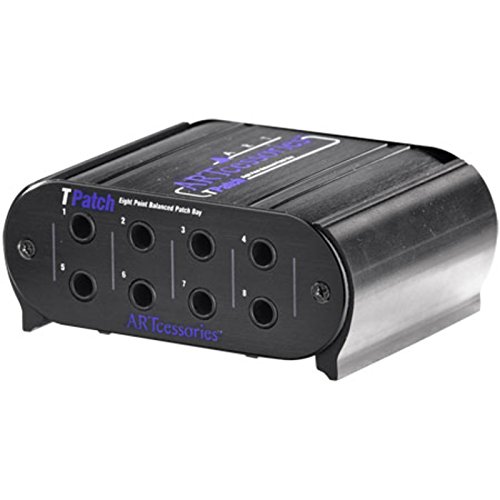
Flexible TRS Patching – Art Pro Audio TPatch
The Art Pro Audio TPatch is a compact choice for balanced 1/4-inch TRS patch bays. It provides eight balanced direct-signal points, four linked input/output pairs, and switchable half-normal, normal, and through-type operating modes for flexible signal routing.
Best For: Audio setups using balanced 1/4-inch TRS connections and needing selectable normalled routing.
Pros:
- Eight points for balanced direct signals
- Four linked input/output pairs
- Switchable half-normal, normal, and through modes
- Rugged extruded aluminum case
Cons:
- Provides fewer points than 16- or 48-point patch bays
- Uses 1/4-inch TRS connections rather than XLR
The TPatch stands out when routing flexibility is more important than maximum channel count. Its selectable operating modes make it a useful fit for balanced line-level workflows built around TRS connections.
Rack-Ready XLR Access – Hosa PDR-369 12-Point XLR Patchbay
The Hosa PDR-369 is a straightforward choice for bringing hard-to-reach XLR mixer inputs to the front of a rack. This 12-point patch bay uses XLR3F-to-XLR3M connections and a steel, one-unit rack chassis for balanced audio routing.
Best For: Studios and live setups that need convenient front-panel access to multiple XLR connections.
Pros:
- Provides 12 XLR patch points in a single rack unit.
- Uses XLR3F-to-XLR3M connections for balanced audio equipment.
- Steel chassis and limited lifetime warranty support long-term use.
Cons:
- Offers XLR connectivity only, so it is not suited to 1/4-inch TRS-based systems.
- Does not provide the modular configuration features found on some newer patch bays.
If your main goal is making rear or difficult-to-reach XLR inputs accessible from the front of a rack, the PDR-369 keeps the installation simple and focused.
Modular Routing Flexibility – AP16 16-Channel XLR Patchbay
The AP16 is a flexible option for patch bays in studios or live racks, combining 16 XLR channels with four independently managed modular blocks. Its reversible rack ears, steel chassis, and serviceable design are useful when routing needs may change over time.
Best For: Professional audio systems that need configurable channel groups, organized cabling, and flexible rack mounting.
Pros:
- Four modular 4-channel blocks can be configured for 4, 8, 12, or 16 channels without cutting.
- Individual modules can be removed or replaced without reworking the entire PCB.
- 24K gold-plated XLR pins, a full-steel chassis, and a dual-layer PCB are designed for reliable signal routing.
- Reversible rack ears support front- or rear-mounting in standard 19-inch racks.
Cons:
- Its 3.08-pound construction and modular features may be more than needed for a simple patching setup.
- It is designed around XLR connections rather than mixed connector formats.
The AP16 stands out when maintenance access and system-zone organization matter as much as channel count. Its modular construction offers more installation flexibility than a fixed-layout patchbay.
Compact TRS Expansion – Hosa MHB-350 8-Point Patchbay
The Hosa MHB-350 is a compact modular option for patch bays using 1/4-inch TRS connections. With eight points and a steel enclosure, it suits mixers, recorders, and outboard gear that use compatible balanced connectors.
Best For: Smaller studio racks that need 1/4-inch TRS patching between compatible audio equipment.
Pros:
- Provides eight points for 1/4-inch TRS patching.
- Works with compatible mixers, recorders, and outboard gear.
- Steel enclosure and limited lifetime warranty add practical durability.
Cons:
- Eight points provide less capacity than 12- or 16-channel XLR alternatives.
- It is not suitable for equipment that requires XLR patching without additional adapters or cabling.
Choose the MHB-350 when your setup is centered on 1/4-inch TRS equipment and you want a smaller patching solution. Its focused format avoids paying for XLR capacity you may not use.
How We Picked These Patch Bays
We focused on practical routing needs rather than specifications alone. The selection includes 1/4-inch TRS and XLR Patch Bays, compact modules, and larger rack-style units. We considered channel count, balanced signal support, connector accessibility, construction, normaling flexibility, and how easily each design fits common studio workflows.
Because Patch Bays can be wired in different ways, we also looked for products that suit a range of setups, from small desktop systems to racks containing preamps, compressors, interfaces, and outboard effects.
Quick Comparison
| Best For | Recommended Type | What to Prioritize |
|---|---|---|
| General studio routing | 48-point TRS patch bay | Balanced connections and adjustable normaling |
| XLR microphones and hardware | XLR patch panel | Connector quality, channel layout, and rack compatibility |
| Small setups | 8- or 12-point model | Compact size and straightforward wiring |
| Flexible signal management | Multi-mode patch bay | Normal, half-normal, and thru operation |
Key Buying Factors for Patch Bays
Connector Type
Match the patch bay to the cables and equipment you already use. TRS models are common for balanced line-level studio connections, while XLR panels are more convenient for microphones, preamps, and other gear with XLR sockets. Adapters can work, but they add clutter and potential failure points.
Point Count and Rack Space
Count the inputs and outputs you expect to connect, then leave room for expansion. A 48-point unit provides considerable flexibility, but a smaller 8- or 12-point model may be easier to install in a compact rack or desktop system.
Normaling Options
Normalled connections automatically route an output to its corresponding input until a plug is inserted. Half-normalled designs can feed another destination while preserving the original signal, and thru settings keep every connection independent. Select a model that supports the routing style you use most.
Balanced Operation and Build Quality
Balanced Patch Bays help reduce noise over suitable cables and equipment. Look for clearly labeled panels, secure jacks, dependable internal wiring, and a chassis that can withstand regular repatching. Confirm that the unit is intended for line-level signals if you plan to use it with studio hardware.
Who Should Buy Which Patch Bays?
Home and project studios: Choose a compact TRS or XLR model if you have a limited number of devices and want simpler cable management.
Growing recording racks: A 48-point balanced patch bay is the most flexible choice when you regularly connect interfaces, preamps, compressors, and effects.
Microphone-focused setups: XLR patch panels are convenient when your workflow centers on microphones, external preamps, and hardware with XLR connections.
Users who change routing often: Prioritize adjustable normaling and clearly labeled, front-accessible connections. These features reduce the need to reach behind the rack and make complex signal paths easier to manage.