A small gap around a studio door can undermine otherwise careful acoustic treatment. The right seal helps limit sound leakage while also blocking drafts, dust, and unwanted light.
This roundup compares 10 studio door seals, including adhesive foam, silicone, rubber, kerf-style frame seals, and door-bottom sweeps for different gap sizes and installation needs.
Best 10 Studio Door Seals Picks for 2026
Best Multi-Door Kit

- Treats up to four standard-size doors
- Includes seals and a door sweep
- Designed for studios and apartments
Best For: Multi-door sound-sealing projects
Best Push-In Option

- Fits 0.35- to 0.59-inch slots
- Requires no adhesive
- Provides 26 feet of foam strip
Best For: Doors with compatible recessed grooves
Best Single-Door Kit

- Designed for one standard door
- Includes a 25-foot seal
- Adds a 4-foot door sweep
Best For: Single-door studio sealing
Best Self-Adhesive Seal

- Seals 5/16- to 15/32-inch gaps
- Installs without tools
- Designed to reduce sound and drafts
Best For: Quick sealing of larger door gaps
Best Large-Gap Pick
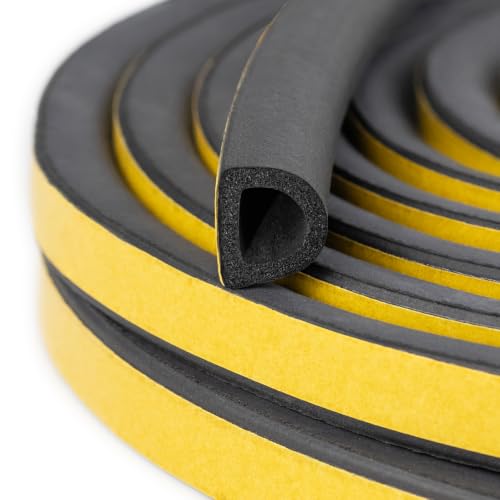
- Fits 5/16–15/32-inch gaps
- Flexible, compressible EPDM rubber
- 20 feet with mesh-reinforced adhesive
Best For: Large or uneven gaps around doors and windows
Best Foam Tape Value

- 33 feet across two rolls
- 1/2-inch wide by 1/4-inch thick
- Supports insulation and sound absorption
Best For: Narrow door and window sealing applications
Best Kerf-Mount Option

- 40-foot kerf weather strip
- Fits 1/8-inch grooves with a 5/32-inch ridge
- Covers stated gaps up to 7/8 inch
Best For: Grooved door frames with large gaps
Flexible Silicone Seal
Self-Adhesive D-Shaped Door Seal

- 20-foot cut-to-fit silicone roll
- Designed for 1/8- to 1/4-inch gaps
- Helps reduce drafts, dust, moisture, and noise
Best For: Small door and window gaps
Large-Gap Kerf Seal
Extra-Wide Exterior Door Weatherstrip

- 26-foot kerf weatherstripping roll
- Fits approximately 3/8- to 5/8-inch gaps
- Helps block wind, water, dust, light, and noise
Best For: Grooved frames with larger door gaps
Best Multi-Door Kit – Large Acoustic Seal Kit
Audimute Soundproofing Acoustic Door Seal Kit - Door Sweep and Seal - (Large Size)
Check Price On AmazonFor shoppers comparing studio door seals across several entrances, this large acoustic kit provides enough material to treat up to four standard-size doors. It combines polyurethane door seals with a door sweep to address gaps around the frame and underneath the door.
Best For: Apartments, studios, or projects involving multiple standard-size doors.
Pros:
- Designed to treat up to four standard-size doors.
- Includes two 50-foot door seals and one 25-foot door sweep.
- Easy to install and intended to help block sound through door gaps.
Cons:
- The large kit may provide more material than needed for a single door.
- Supplied notes do not specify an adhesive or mounting hardware.
Choose this option when coverage is the priority. Its larger material quantities make it a practical fit for multi-door sound-sealing work rather than a small one-door repair.
Best Push-In Option – Ravinte Q-Shaped Door Seal
The Ravinte Q-shaped strip is a push-in choice for studio door seals when the door frame has a compatible groove or recess. Its high-density foam core is designed to block light, drafts, dust, water, and some noise without adhesive.
Best For: Doors with slots measuring approximately 0.35 to 0.59 inches that need a no-adhesive installation.
Pros:
- Fits grooves or slots from 0.35 to 0.59 inches.
- Installs by inserting the strip, with no adhesive or residue.
- Offers 26 feet of material and helps block light, drafts, and noise.
Cons:
- Requires a compatible door groove or recess.
- The slot dimensions should be checked before ordering.
This is a strong fit for a clean, reversible installation. Measure the existing slot first, since compatibility depends on the frame’s groove size rather than simply the door’s overall dimensions.
Best Single-Door Kit – Standard Acoustic Seal Kit
Audimute Soundproofing Acoustic Door Seal Kit - Door Sweep and Seal - (Standard Size)
Check Price On AmazonFor one-door studio projects, this standard acoustic kit pairs a polyurethane door seal with a door sweep. It is designed to help block sound traveling through gaps around one standard-size door while keeping the installation straightforward.
Best For: A single standard-size apartment, studio, or interior door.
Pros:
- Designed to treat one standard-size door.
- Includes a 25-foot door seal and a 4-foot door sweep.
- Combines perimeter sealing with a bottom-door sweep.
Cons:
- Limited to one-door coverage.
- Supplied notes do not specify included adhesive or mounting hardware.
This compact kit makes sense when you want a coordinated seal and sweep for one door. It avoids buying the larger multi-door quantity while still addressing both frame and bottom gaps.
Best Self-Adhesive Seal – VITAM AMO EPDM Strip
For studio door seals that need a quick, tool-free application, this self-adhesive EPDM strip is designed for larger gaps from 5/16 to 15/32 inch. Its flexible, multi-hole design is intended to reduce air, light, water, and sound transfer around doors and windows.
Best For: Inside or outside door applications with a 5/16- to 15/32-inch gap.
Pros:
- Self-adhesive backing requires no tools or experience.
- Designed for larger gaps from 5/16 to 15/32 inch.
- EPDM material is described as flexible, durable, and suitable for interior or exterior use.
- Multi-hole design helps reduce sound propagation and closing pressure.
Cons:
- The 18-foot roll may require additional rolls for longer runs.
- Adhesive installation is less convenient to reposition than a push-in seal.
This strip is a practical choice when fast installation matters and the gap falls within its stated range. Confirm the measurement and prepare the surface carefully before applying the adhesive backing.
Best Large-Gap Pick – D-Shaped EPDM Door Seal
For studio door seals covering uneven or sizable gaps, this 20-foot D-shaped EPDM strip is designed for openings from 5/16 to 15/32 inch. Its hollow profile compresses during use, while the self-adhesive, mesh-reinforced backing supports a straightforward installation.
Best For: Exterior doors, RV entry doors, sliding glass door frames, and window frames with measured large gaps.
Pros:
- Fits 5/16–15/32-inch gaps.
- Flexible EPDM rubber remains usable in hot and cold weather.
- Helps reduce drafts, dust, light leaks, energy loss, and some outside noise.
- Can be cut to length and installed by cleaning, peeling, and pressing.
Cons:
- Requires careful gap measurement before purchase.
- The adhesive needs 24 hours to bond fully, and cold-weather installation may require warming.
This is a practical studio door seals option when a door has an uneven, larger gap and you want a compressible rubber profile rather than a thin foam tape.
Best Foam Tape Value – High-Density Door Seal Strip
This 33-foot foam strip offers a flexible approach to studio door seals where a narrow, adhesive-backed profile is appropriate. Made from CR foam and neoprene, it measures 1/2 inch wide by 1/4 inch thick and comes as two rolls for flexible cutting and placement.
Best For: Door and window edges needing a slim seal for insulation, sound absorption, impact protection, or weather protection.
Pros:
- Includes 33 feet across two rolls.
- High-density CR foam and neoprene provide sealing and warp resistance.
- Grid-backed adhesive is designed for secure application with less concern about residue.
- Can be cut to the needed length.
Cons:
- At 1/4 inch thick, it may not suit substantially larger gaps.
- Careful surface preparation is important for the adhesive to hold properly.
Choose this option when you need a long roll of relatively narrow foam tape for general sealing tasks and want material that can also help with sound absorption and insulation.
Best Kerf-Mount Option – Large-Gap Door Frame Seal
For studio door seals that need a frame-mounted solution, this 40-foot kerf weather strip is made for doors with compatible grooves. Its V-shaped design has an extended water-drop-shaped sealing area and is intended to cover gaps from 3/10 to 7/8 inch when the frame has a 1/8-inch groove.
Best For: Doors with existing kerf grooves and larger gaps requiring all-around wind, dust, water, light, and noise protection.
Pros:
- Provides 40 feet of sealing material for doors of various sizes.
- Designed for 1/8-inch grooves with a 5/32-inch ridge.
- Seals stated gaps from 3/10 to 7/8 inch.
- Includes four matching foam gaskets for cushioning or helping a door close properly.
Cons:
- Requires a compatible groove in the door frame.
- Groove and gap dimensions should be measured before ordering.
This is the most specialized choice in the group: it can handle a broad stated gap range, but only if your studio door frame has the required kerf channel and dimensions.
Flexible Silicone Seal – Self-Adhesive D-Shaped Door Seal
For studio door seals and general gap control, this 20-foot silicone strip is a practical choice for small gaps around door frames, windows, cabinets, and similar surfaces. Its flexible D-shaped profile is designed for gaps from 1/8 to 1/4 inch and can be cut to fit.
Best For: Small door and window gaps where an adhesive silicone seal is easy to install.
Pros:
- Flexible silicone helps block drafts, dust, moisture, light, and everyday noise.
- 20-foot roll can be trimmed for different projects.
- Peel-and-stick installation includes an adhesive promoter for smooth surfaces.
- Suitable for year-round use with good rebound and daily wear resistance.
Cons:
- Recommended only for relatively small gaps between 1/8 and 1/4 inch.
- Adhesive performance depends on a clean, dry surface and proper application.
This is a versatile studio door seal for light insulation and noise reduction projects, especially when you want a simple cut-to-fit installation. Measure the gap first to ensure the D-shaped strip can compress properly.
Large-Gap Kerf Seal – Extra-Wide Exterior Door Weatherstrip
When studio door seals need to handle a larger opening, this 26-foot kerf weatherstrip is built for door-frame grooves and gaps of approximately 3/8 to 5/8 inch. Its extra-wide, thick design suits exterior and entry doors as well as several other door and window applications.
Best For: Door frames with a compatible kerf groove and larger gaps requiring a replacement weatherstrip.
Pros:
- Covers larger gaps of approximately 3/8 to 5/8 inch.
- 26-foot length supports multiple door-frame projects.
- Foam construction with a covering and rigid PVC extended flanges.
- Helps block dust, water, noise, light, and wind.
Cons:
- Designed for installation in a door-frame groove, so it is not a general peel-and-stick strip.
- Measure the gap and confirm kerf compatibility before purchasing.
This option is more specialized than adhesive studio door seals, but it is a strong fit for larger door gaps when the frame has the required groove. Its extra-wide profile is particularly useful for exterior, entry, patio, and security doors.
High-Quantity Rubber Seal – 50-Foot D-Shape Weatherstrip with Scissors
This 50-foot D-shaped rubber strip is a useful studio door seal when you need extra material for multiple frames or repeated installations. It has a self-adhesive backing, includes tailor scissors, and is intended for gaps from 2.5 to 5.5 mm.
Best For: Multiple small-gap door or window projects where a long roll and included cutting tool are useful.
Pros:
- 50-foot length provides ample material for several applications.
- Includes tailor scissors for cutting the strip to size.
- Flexible rubber is designed to resist freezing or cracking in extreme temperatures.
- Self-adhesive backing is intended to become firm after 24 hours.
Cons:
- Suitable for gaps from 2.5 to 5.5 mm, so it may not fit larger openings.
- Requires a clean installation and a 24-hour setting period for the adhesive.
Choose this seal when coverage and convenience matter more than a short roll. The included scissors and long length make it practical for studios with several doors, windows, cabinets, or other compatible small-gap applications.
How We Picked These Studio Door Seals
We focused on door seals that address the most common weak points in a recording or practice room: the perimeter of the door and the gap beneath it. The selection includes several profile types, widths, thicknesses, lengths, and installation methods so you can match the product to your door rather than relying on a one-size-fits-all solution.
Priority went to products designed for larger gaps, acoustic isolation, weather sealing, or repeated use. We also considered practical details such as adhesive backing, kerf installation, flexible materials, coverage length, and whether a seal is better suited to a door bottom, frame, or both.
Quick Comparison
- Best for complete coverage: Acoustic door seal kits combine perimeter sealing with a door sweep.
- Best for easy installation: Self-adhesive foam, rubber, or silicone strips require minimal tools.
- Best for larger frame gaps: Q-shaped, D-shaped, extra-wide, and large-gap profiles can fill more space than thin foam tape.
- Best for clean replacement work: Kerf seals fit into a prepared channel and avoid exposed adhesive.
- Best for the threshold: A dedicated door-bottom seal helps close the gap where frame weatherstripping cannot.
Key Buying Factors for Studio Door Seals
Measure the Gap First
Close the door and measure the largest visible gap around the frame and underneath it. Check multiple points because older doors may be uneven. Choose a seal that compresses against the door without preventing the latch from engaging.
Choose the Right Profile
Foam tape is inexpensive and simple, while silicone and rubber generally offer better flexibility and durability. D-shaped and Q-shaped profiles are useful for larger perimeter gaps. Kerf weatherstripping is a better choice when the frame has a compatible slot or when you want a more integrated finish.
Do Not Overlook the Bottom Gap
Perimeter seals cannot close the space beneath the door. Use a door sweep or bottom seal if light, air, or sound is passing under the slab. Make sure the sweep contacts the floor or threshold lightly rather than dragging heavily.
Consider Installation and Maintenance
Clean and dry adhesive surfaces before installation, and cut strips carefully at corners. Adhesive-backed products are convenient but may need replacement after repeated use or exposure to temperature changes. Kerf seals take more preparation but are typically easier to replace cleanly.
Who Should Buy Which Studio Door Seals?
Recording studios and vocal booths: Choose a complete acoustic kit when you need to address both the door frame and bottom gap. For maximum results, pair sealing with proper door mass and acoustic construction.
Home musicians and podcasters: A self-adhesive silicone, rubber, or foam seal is a practical first step for reducing air paths around a standard interior door.
Rooms with oversized gaps: Select a large-gap or extra-wide profile, but verify its dimensions before ordering. A seal that is too thick can keep the door from closing properly.
Renters and quick fixes: Adhesive strips install with minimal tools and can be trimmed to length. Test the door operation before sealing every side.
Permanent renovations: Kerf-style weatherstripping offers a neater, more integrated result when the door frame supports it. Whichever style you choose, accurate measurement and a continuous seal are more important than simply adding more material.