If you want a beginner digital piano that feels closer to an acoustic instrument, the STRICH SDP-300S Digital Piano review starts with a strong case.
It combines weighted keys, teaching-friendly connectivity, and a home-friendly cabinet look in one package.
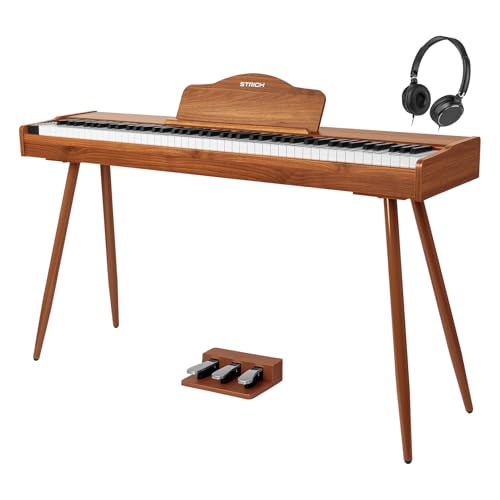
STRICH SDP-300S Review Summary
The STRICH SDP-300S Digital Piano is built for new players who want proper 88-key technique without jumping straight to an acoustic piano.
If you are shopping for a home practice instrument that looks more like furniture than a plastic keyboard, this model is worth a close look.
It is especially appealing for families, students, and self-learners who want hammer-action weighted keys, simple sound options, and app-based learning support.
The overall approach is practical rather than flashy: realistic touch, enough voices to keep practice interesting, and built-in speakers that make everyday playing easy.
Scorecard
| Category | Score | Why It Matters |
|---|---|---|
| Key Feel | 8.0/10 | 88 fully weighted, hammer-action keys with simulated ivory texture create a more acoustic-like response. |
| Sound Variety | 8.0/10 | 128 timbres, 200 drum rhythms, and voice functions add practice variety. |
| Speaker Performance | 7.0/10 | Dual 25W speakers are solid for home use, but not built for big-room projection. |
| Learning Features | 8.0/10 | Wireless MIDI, USB-MIDI, demos, dual-keyboard mode, and smart chord support help beginners. |
| Controls and Effects | 7.0/10 | Chorus, layer/split, octave shift, and transpose are useful, though not advanced-stage tools. |
| Design and Aesthetics | 8.0/10 | The mahogany wood-grain finish gives it a more polished, home-friendly look. |
| Beginner Suitability | 9.0/10 | Everything about the instrument is aimed at early learners and home practice. |
Bottom line: the STRICH SDP-300S Digital Piano is a smart buy for beginners who want a realistic playing feel, a full-size keyboard, and a visually attractive home setup.
It is not the best choice for advanced pianists, but it is a strong value-oriented learning instrument.
Key Features and Specifications of STRICH SDP-300S
Before judging whether the STRICH SDP-300S Digital Piano is worth it, it helps to look at the actual hardware and learning features.
This model aims squarely at home practice, and the spec sheet reflects that focus.
| Specification | Details |
|---|---|
| Brand / Model | STRICH SDP-300S |
| Type | Digital piano |
| Keys | 88 full-size keys |
| Action | Hammer-action, fully weighted |
| Key Texture | Simulated ivory texture |
| Color / Finish | Mahogany wood-grain |
| Speaker Power | Dual 25W speakers |
| Polyphony | 128 max |
| Preset Timbres | 128 |
| Drum Rhythms | 200 |
| Connectivity | Wireless MIDI, USB-MIDI, audio-in |
| Learning Support | Built-in demos, dual-keyboard mode, smart chord function, app compatibility |
| Effects / Functions | Chorus, layer, split, octave shift, transpose |
| Power | AC 100V-240V input, DC 12V 3A output, 5.5mm x 2.2mm connector |
| Skill Level | Beginner |
- 88-key layout supports proper hand positioning and early classical technique.
- Weighted hammer action gives beginners a more realistic practice experience.
- 128 timbres and 200 rhythms make lessons and casual playing more engaging.
- Wireless MIDI and USB-MIDI are particularly useful for lesson apps and home learning.
- Dual 25W speakers are convenient for everyday play without needing external amplification.
The feature mix is well chosen for a home player.
It focuses on things beginners actually use: a convincing key bed, easy sound switching, and simple connectivity for tablets or phones.
Pros and Cons of STRICH SDP-300S
Any honest STRICH SDP-300S Digital Piano pros and cons breakdown should acknowledge that this is a beginner-first product.
It does a lot right for the target audience, but it also has clear limits.
| Pros | Cons |
|---|---|
| Realistic weighted hammer-action keys | Not intended for advanced pianists |
| Full-size 88-key layout | Built-in speakers are good for practice, not stage-level output |
| Large selection of sounds and rhythms | Learning-focused interface may feel basic to experienced players |
| Wireless and USB-MIDI support | Furniture-style finish is decorative, not acoustic-grade cabinetry |
| Attractive mahogany wood-grain design | Advanced performance controls are limited |
| Beginner-friendly practice functions | Check stand and accessory inclusion carefully before buying |
What stands out most is that the SDP-300S does not try to be everything at once.
It stays focused on beginner usability, which is often the smarter design choice in this category.
How the Weighted Keys Feel for Beginners
If you are comparing entry-level digital pianos, key action should be near the top of your checklist.
The STRICH SDP-300S Digital Piano uses 88 fully weighted, hammer-action keys with a simulated ivory texture, and that combination matters more than casual buyers often realize.
For new players, weighted action helps build finger strength, control, and correct touch.
It also makes transitions easier if you later move to an acoustic piano or a more premium digital model.
The simulated ivory texture is a nice touch because it adds a bit of grip, especially during longer sessions when sweaty hands can become an issue.
From a buyer’s perspective, this is one of the instrument’s biggest strengths.
Some beginner keyboards feel too light and toy-like, which can hold back technique.
The SDP-300S avoids that problem and feels much more like a real piano than a typical portable keyboard.
However, advanced players may still notice the difference between this and higher-end graded hammer actions from Yamaha, Roland, or Casio.
That is normal at this level.
The real question is whether the action is good enough for learning, and in that regard, it is.
Sound Modes, Voices, and Rhythm Options
Sound variety is another reason the STRICH SDP-300S Digital Piano feels like a practical teaching tool rather than a bare-bones practice board.
With 128 preset timbres and 200 drum rhythms, it gives beginners room to experiment without overwhelming them.
The core piano tone is the most important sound here, and buyers should judge this instrument primarily on how well it supports daily practice.
Still, the extra voices are useful when a student wants to explore strings, organs, electric piano sounds, or accompaniment-style practice sessions.
That variety can help keep motivation high in the early months of learning.
The 128 polyphony max is also relevant.
In simple terms, it helps the instrument handle multiple notes and layered sounds more cleanly than very basic keyboards.
For beginner and early intermediate use, that is usually sufficient.
Effects such as chorus, layer, split, octave shift, and transpose add flexibility for lessons and casual practice.
They are not designed to replace a performance workstation, but they do give enough control for everyday home use.
If you want a keyboard that encourages exploration without becoming complicated, this is a sensible design choice.
Home Setup and Furniture-Style Design
One of the reasons people look at the STRICH SDP-300S Digital Piano instead of a simple portable keyboard is the appearance.
The mahogany wood-grain finish gives it a more furniture-like profile, which matters if the piano will live in a living room, bedroom, or dedicated study space.
This is a thoughtful choice by STRICH.
Many beginners end up placing a keyboard on a folding stand that looks temporary and gets in the way of regular use.
A more polished home setup can make it easier to stick with practice because the instrument feels like part of the room rather than a gadget you have to assemble every time.
The built-in speakers also support that all-in-one approach.
With dual 25W speakers, the piano is ready to play right away for solo practice, family use, or lessons at home.
It is not a concert amplifier, but it is strong enough for casual playing in a typical room.
Important drawback: the decorative wood-grain finish should not be mistaken for a full acoustic cabinet.
It looks attractive, but it is still a digital piano designed for practical home use.
Connectivity for Lessons and Practice Apps
For today’s beginner, connectivity can matter just as much as sound quality.
The STRICH SDP-300S Digital Piano includes wireless MIDI, USB-MIDI, and audio-in, which makes it flexible for a range of learning setups.
This is where the instrument becomes especially appealing to self-directed players.
App compatibility with iPad or phone-based teaching tools means a student can connect to guided lessons, rhythm training, or interactive feedback systems.
That kind of support often makes the difference between a keyboard that gets used and one that sits idle.
Wireless MIDI is a useful modern feature because it reduces cable clutter and makes it easier to pair with learning software.
USB-MIDI remains the dependable option for direct connections, so buyers get both convenience and reliability.
The built-in demos and dual-keyboard mode also fit the educational focus.
Beginners can use them for guided practice, teacher demonstration, or side-by-side learning with a parent or instructor.
If your buying decision depends on app integration, this model is meaningfully better equipped than many ultra-basic digital pianos.
How It Compares with Yamaha, Casio, Roland, and Alesis Alternatives
When evaluating the STRICH SDP-300S Digital Piano review, it helps to compare it with familiar names in the category.
This is not because STRICH must outperform every rival, but because buyers often cross-shop against brands they already know.
Yamaha P-45 is a common benchmark for a simple, respected beginner digital piano.
It is often favored for a straightforward playing experience and brand trust.
If you want a more established market option and do not need as many playful learning extras, Yamaha is a logical alternative.
Roland FP-10 is another strong comparison, especially for buyers who care about key feel and a compact profile.
Roland is usually attractive to players who want a more refined practice instrument and may later expand into serious study.
Casio Privia PX-S1100 appeals to shoppers looking for a sleeker portable digital piano with a more modern design.
It is a good alternative if space and portability matter more than furniture-style styling.
Alesis Recital Pro is also worth considering for buyers who want an accessible 88-key option with practice-friendly features.
It sits in a similar beginner-friendly decision space.
Compared with those alternatives, the STRICH SDP-300S stands out most for its home aesthetic and learning-friendly bundle of features. It is less about brand prestige and more about delivering a full-featured starter piano that feels ready for daily use.
Who Should Buy STRICH SDP-300S?
The STRICH SDP-300S Digital Piano makes the most sense for buyers who want a proper first piano without spending on a more advanced instrument than they need.
- Beginners learning at home who need weighted keys and full-size 88-key range.
- Students using apps or MIDI tools for guided lessons and practice support.
- Families who want a piano that looks attractive in the home and encourages regular practice.
- Adult learners returning to piano and wanting a realistic practice platform.
- Anyone upgrading from an unweighted keyboard and looking for better technique development.
Who should skip it?
If you are an advanced pianist, a gigging performer, or someone who wants more nuanced sound shaping and stage-ready projection, this is probably not your best fit.
In that case, a more established portable digital piano from Yamaha, Roland, or Casio may be the better long-term investment.
Best buyer fit: the SDP-300S is ideal for home practice, early skill development, and app-supported learning.
Buying Considerations Before You Choose
Before purchasing the STRICH SDP-300S Digital Piano, think about where and how it will be used.
This model is clearly optimized for indoor practice, so your buying decision should focus on comfort, room placement, and learning goals.
If you want a keyboard for travel, rehearsals, or frequent movement, a portable slab-style digital piano may be more convenient.
If you want a stable, attractive instrument that stays in one place and invites daily practice, the SDP-300S makes more sense.
Also consider whether you need external accessories.
The product title suggests a stand is included, but buyers should still verify what is in the box, especially if they want a bench, sustain pedal, headphones, or a more advanced stand arrangement.
Those details matter more than many shoppers realize.
Key decision factors:
- Do you want weighted keys or just a lightweight keyboard?
- Will the piano be used mostly for home practice?
- Do you plan to use lesson apps and MIDI connectivity?
- Do you care about a furniture-style design over portability?
- Will built-in speakers be enough for your space?
Is STRICH SDP-300S Worth It?
So, is STRICH SDP-300S Digital Piano worth it?
For the right buyer, yes.
It delivers the three things beginners need most: a realistic weighted keybed, a full 88-key layout, and enough learning features to support regular practice.
The value proposition is strongest if you want a home piano that looks good in the room and supports app-based learning from day one.
The dual 25W speakers, 128 timbres, 200 rhythms, and MIDI connectivity make it feel more complete than a stripped-down beginner keyboard.
That makes it a well-rounded choice for self-study and first-time piano learners.
It is not the best choice for advanced players, and it should not be mistaken for a premium performance instrument.
But if your goal is to start on the right footing, practice consistently, and enjoy a more polished home setup, the STRICH SDP-300S Digital Piano is a strong contender.
Final verdict: buy it if you are a beginner or returning player who values realistic key action, useful teaching features, and a home-friendly design.
Skip it if you need a higher-end stage piano or more sophisticated sound control.